
Zyphra releases hierarchical attention for faster sparse processing
MarkTechPost: Zyphra AI Introduces Zyphra Hierarchical Attention (ZHA): A Path to True Subquadratic Attention
Zyphra has released Zyphra Hierarchical Attention (ZHA), a sparse attention method built around a tree-structured indexer. ZHA targets a known gap in sparse attention: the indexer that picks tokens still scans the whole context. Zyphra’s technical paper shows ZHA can be distilled into frozen pretrained models with about 4B tokens. On Qwen3.6-35B-A3B it stays close to dense attention on reasoning, agentic coding and 256K retrieval benchmarks. TL;DR Size: It is a method that adds 81,
Get smart on it
Zyphra Hierarchical Attention (ZHA) is a sparse attention method that uses a tree-structured search to find relevant information in a model's memory cache, rather than scanning the entire context. This approach addresses a performance bottleneck in existing sparse attention methods, where the process of selecting which cached information to use still requires examining everything, which becomes increasingly costly as context grows. ZHA can be added to existing trained models with minimal additional parameters and maintains performance close to standard attention methods on reasoning, coding, and retrieval tasks, while offering theoretical speed improvements at very large context lengths. The method is most effective on retrieval tasks, where it significantly outperforms other sparse attention approaches, though actual speedup measurements at practical context lengths remain modest.
Explainer: How to Actually Read an AI Benchmark (Without Being Fooled)
Relevant courses
Want to go deeper than the news? Explore live, cohort-based AI courses taught by practitioners.
Browse AI courses on MavenRelated news

Welcome Le Chonk: Mistral Large 4 on Hugging Face
Mistral's latest offering aims to compete with frontier models while remaining accessible to researchers and developers on open platforms.
Also reported by SiliconANGLE and TechCrunch

42AI comes out of stealth with $62.5M and a world model that can ‘predict human behavior’
Here's a question straight out of sci-fi: What if AI could predict what you were going to do before you decided to, even in a completely new situation?
Also reported by SiliconANGLE
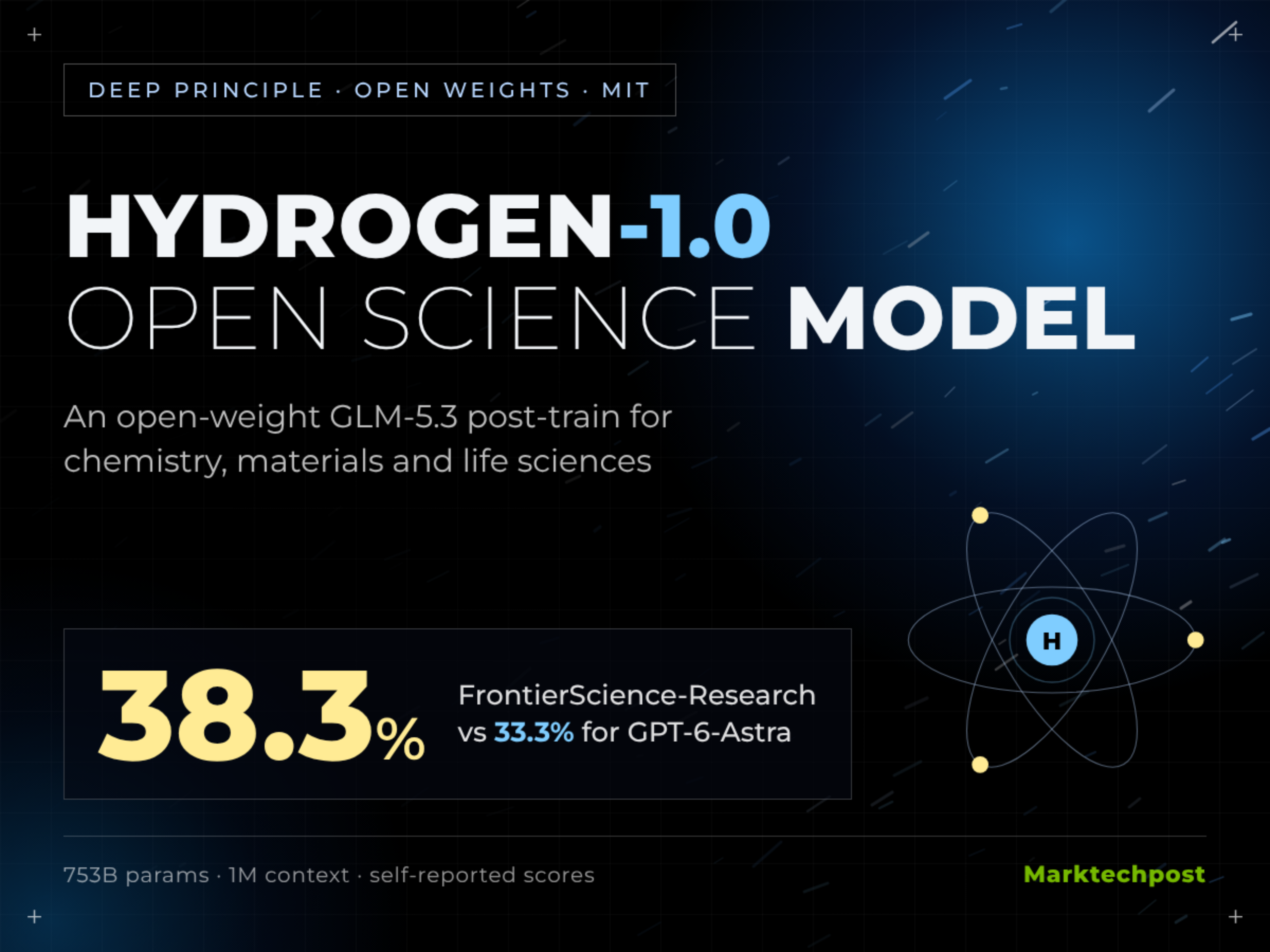
Deep Principle Releases Hydrogen-1.0: A 753B Open-Weight Model for Scientific Discovery
Deep Principle has released Hydrogen-1.0, an open-weight scientific model for chemistry, materials science and life sciences. It is built by post-training Z.ai’s GLM-5.3 on domain data, laboratory records and agent discovery trajectories. For developers, it offers open weights that report a FrontierScience-Research win over GPT-6-Astra. The weights ship under the MIT License. TL;DR Size: 753B parameters (MoE, ~40B active per the GLM-5.3 base), 1M-token context, 128K max output.
Le Chonk: Built for Coders, Trusted by Defenders.
The weights of Mistral Large 4 (Le Chonk) are now open. A 1T parameter multimodal model, and best open-weight model for coding, trained in Europe.
OpenAI sets new behavioral guidelines for AI models that have already proven hard to control
OpenAI has updated its Model Spec, restructuring its AI behavior guidelines around five core values, including faithfulness to human intent and correctability. GPT models should now draw on conversation history to figure out what users actually want and disclose their own assumptions. Whether the models follow these rules is another matter. The article OpenAI sets new behavioral guidelines for AI models that have already proven hard to control appeared first on The Decoder.
Nvidia's open Nemotron 3.5 Transcribe combines transcription, translation, and speaker recognition
Nvidia has released Nemotron 3.5 Transcribe, an open speech recognition model that handles transcription, speaker recognition, and translation and takes its instructions as text prompts. It leads several benchmarks and uses only a sixth of the active parameters of its strongest open rival. Nvidia is also shipping a dataset with more than 800,000 hours of speech, along with tools for fine-tuning. The article Nvidia's open Nemotron 3.5 Transcribe combines transcription, translation,
Also reported by MarkTechPost