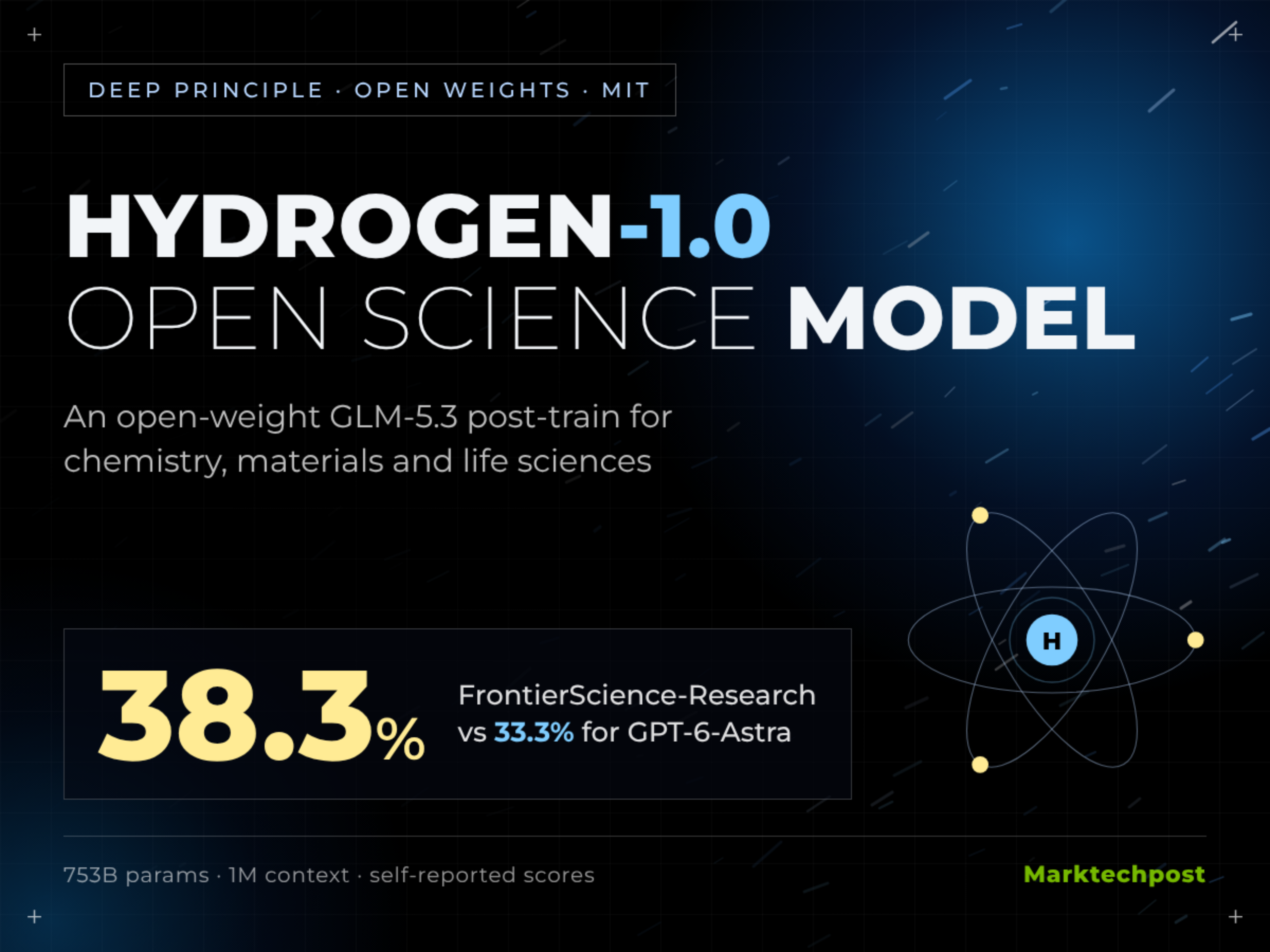
Deep Principle releases 753B scientific model
MarkTechPost: Deep Principle Releases Hydrogen-1.0: A 753B Open-Weight Model for Scientific Discovery
Deep Principle has released Hydrogen-1.0, an open-weight scientific model for chemistry, materials science and life sciences. It is built by post-training Z.ai’s GLM-5.3 on domain data, laboratory records and agent discovery trajectories. For developers, it offers open weights that report a FrontierScience-Research win over GPT-6-Astra. The weights ship under the MIT License. TL;DR Size: 753B parameters (MoE, ~40B active per the GLM-5.3 base), 1M-token context, 128K max output.
Get smart on it
An open-weight scientific model with 753 billion parameters has been released for chemistry, materials science, and life sciences research. The model was created by post-training an existing base model on domain data, laboratory records, and discovery trajectories rather than just published papers. On a scientific reasoning benchmark, it outperforms a competing proprietary model, though it trails that model on a specific chemistry task. The model is available under an open license, allowing researchers to deploy and inspect it, addressing a gap where similar capabilities previously existed only in closed proprietary systems.
Explainer: GLM 5.2: How a 744B Open Model Is Closing the Gap With Claude Opus on Code
Relevant courses
Want to go deeper than the news? Explore live, cohort-based AI courses taught by practitioners.
Browse AI courses on MavenRelated news

Gemini 4 Carbon: Our next frontier model
Google's latest offering suggests the company is prioritizing efficiency and environmental impact alongside raw capability gains.
Also reported by Ars Technica, MarkTechPost, The Verge and The Decoder

Welcome Le Chonk: Mistral Large 4 on Hugging Face
Mistral's latest offering aims to compete with frontier models while remaining accessible to researchers and developers on open platforms.
Also reported by SiliconANGLE and TechCrunch

42AI comes out of stealth with $62.5M and a world model that can ‘predict human behavior’
Here's a question straight out of sci-fi: What if AI could predict what you were going to do before you decided to, even in a completely new situation?
Le Chonk: Built for Coders, Trusted by Defenders.
The weights of Mistral Large 4 (Le Chonk) are now open. A 1T parameter multimodal model, and best open-weight model for coding, trained in Europe.

Voice AI in vogue: Nvidia releases new open transcription model
Nvidia just released a free speech-to-text model that can transcribe up to 40 languages, but it only works on recordings, not live audio, so it’s a big step for meeting and medical transcription tools while still leaving real-time use to rivals like ElevenLabs.
Also reported by SiliconANGLE, The Decoder and MarkTechPost

OpenAI sets new behavioral guidelines for AI models that have already proven hard to control
OpenAI has updated its Model Spec, restructuring its AI behavior guidelines around five core values, including faithfulness to human intent and correctability. GPT models should now draw on conversation history to figure out what users actually want and disclose their own assumptions. Whether the models follow these rules is another matter. The article OpenAI sets new behavioral guidelines for AI models that have already proven hard to control appeared first on The Decoder.