Nokia Open-Sources AnyJev: A Training-Free Layer That Turns Any Open LLM Into a Calibrated Decision Model
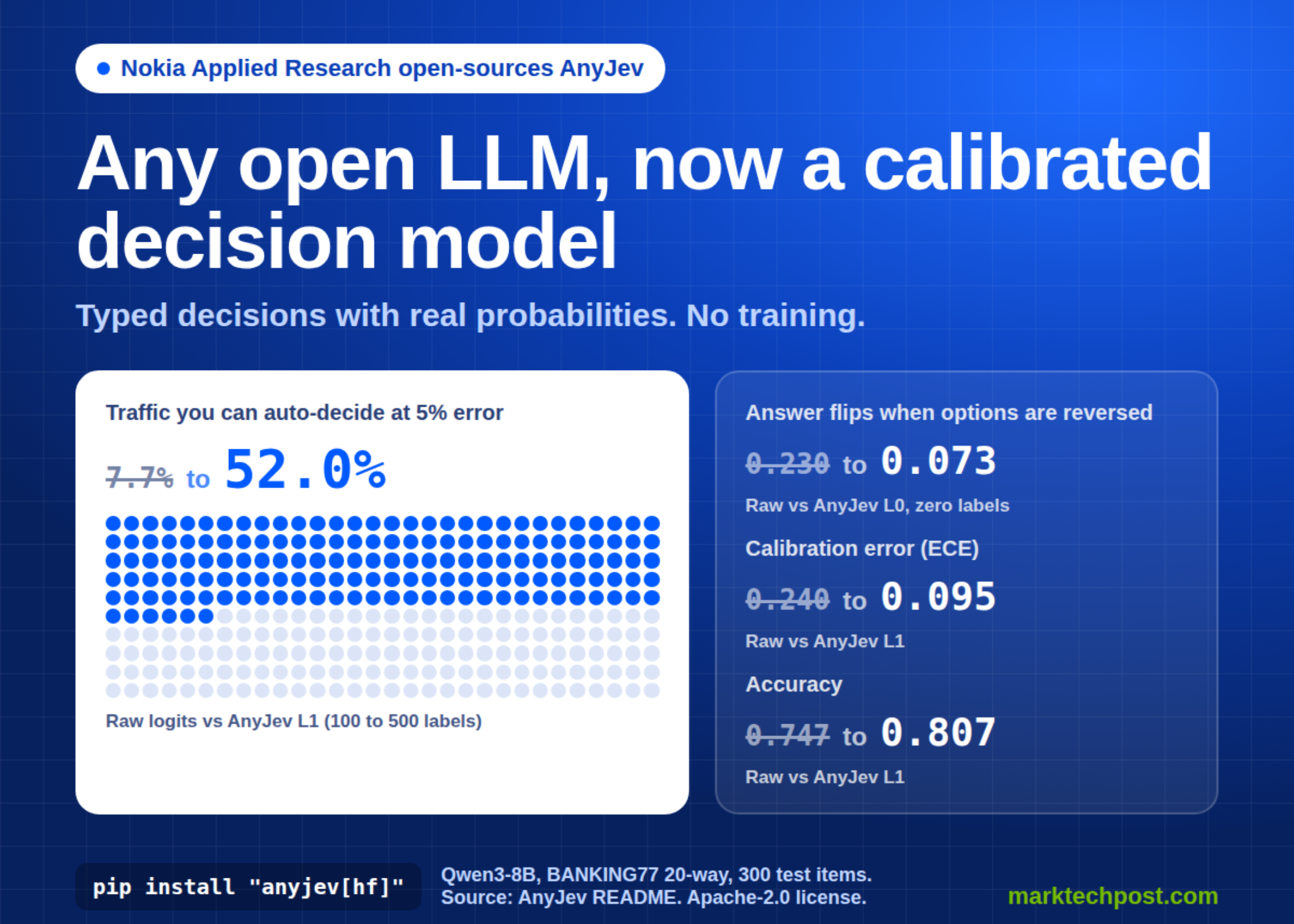
Nokia’s applied research team has open-sourced AnyJev, a Python library that turns an open LLM into a decision model. It needs no training. It targets a common production job: picking one answer from a fixed set instead of writing a sentence. Is it deployable? Yes, it installs from PyPI, ships under Apache-2.0, and has transformers and vLLM backends with shared-prefix scoring. What is AnyJev? AnyJev borrows its interface from Jev. Jev is the System One decision model that TypeS
Get smart on it
AnyJev is an open-source Python library that converts open language models into decision models without requiring training. Instead of generating text, it picks one answer from a fixed set of options and provides a probability score based on the model's token distribution. The library addresses two key problems with directly reading model scores: answers can change when options are reordered, and probabilities are often poorly calibrated. AnyJev solves these issues through two levels of correction: L0 uses cyclic shifts of option order and batch prior correction to remove position and label bias, while L1 adds temperature scaling for better calibration.
Related news
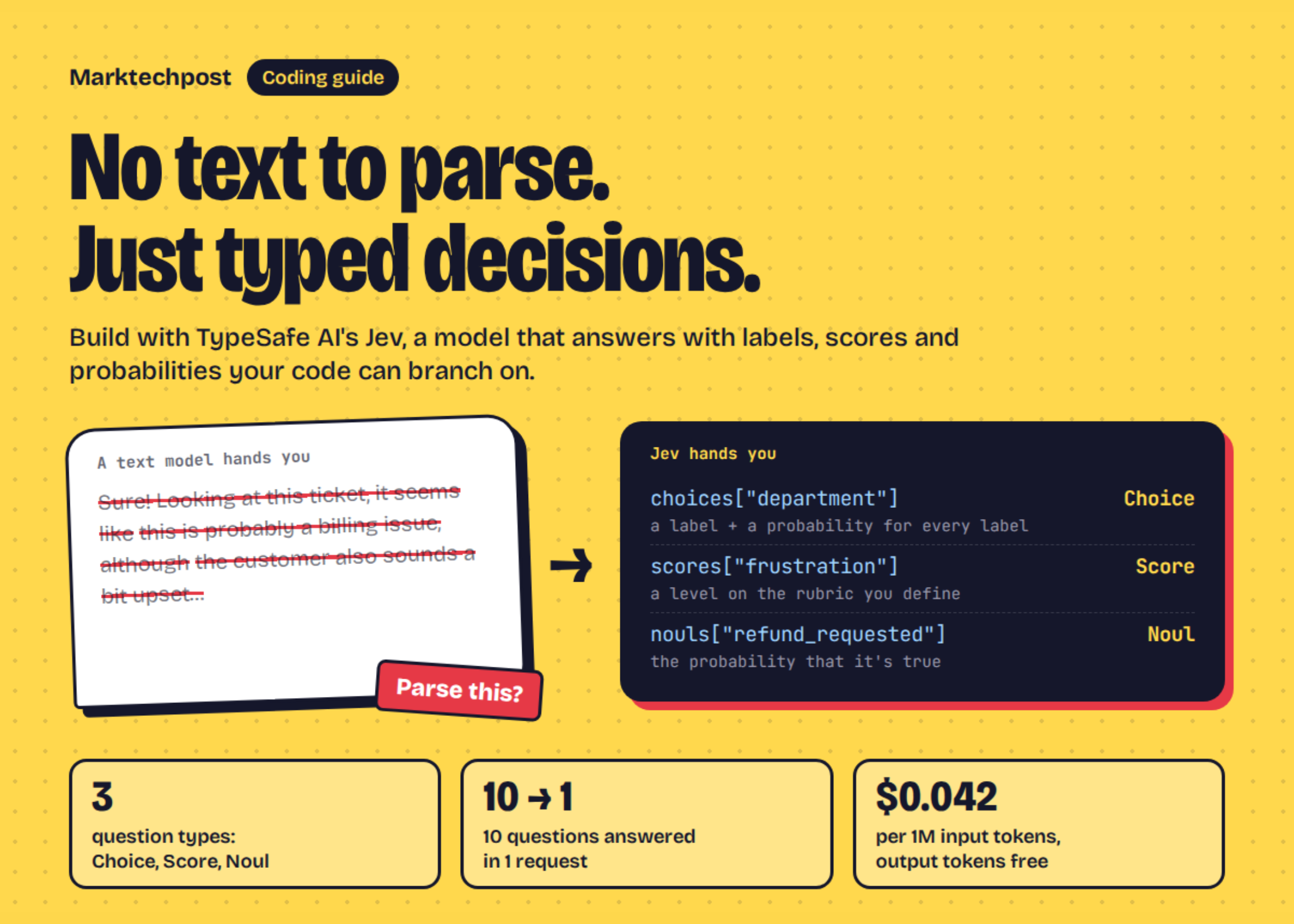
A Coding Guide to TypeSafe AI Jev: Typed Decisions, Calibrated Confidence, and Speculative Fan-Out with a System One Model
In this tutorial, we work with Jev, TypeSafe AI’s first System One model, which does not generate text at all: we send it a piece of program state and a set of typed questions, and it returns choices, scores, and yes/no probabilities that our code can branch on directly. We install the official Python SDK, make a first call that uses all three question primitives at once, and look at how the shape of the state changes what the model can know. We then recompute the published confidence sta
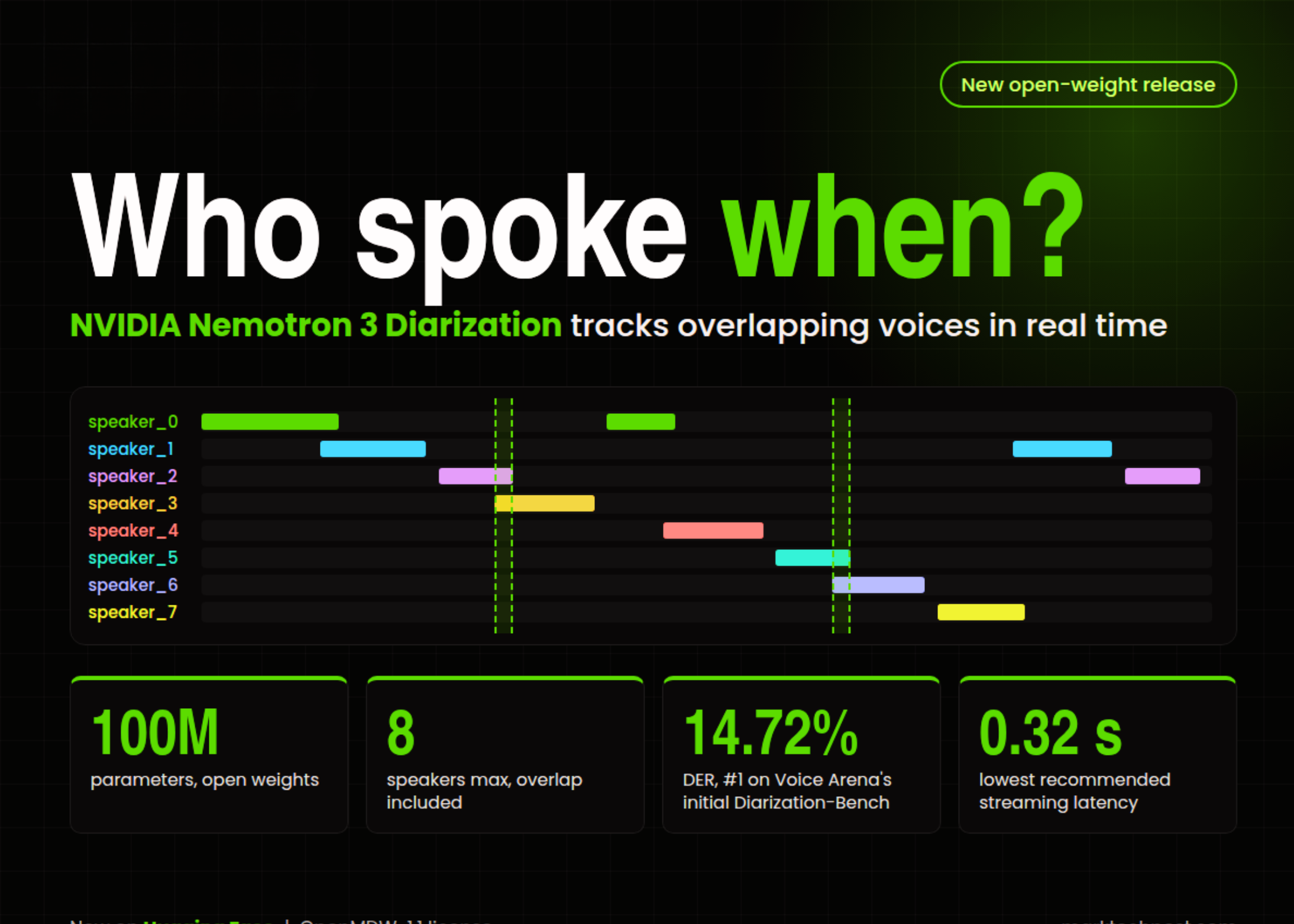
NVIDIA Releases Nemotron 3 Diarization: A 100M-Parameter Open-Weight Model That Tracks 8 Speakers in Real Time
NVIDIA has released Nemotron 3 Diarization, an open-weight speaker diarization model on Hugging Face. It answers one question about any conversation: who spoke when. The 100M-parameter model tracks up to 8 speakers, including when voices overlap. One checkpoint handles both offline recordings and real-time streaming. Is it deployable? Yes. The weights are released under the OpenMDW License 1.1, which permits commercial use. It runs on Linux through NVIDIA NeMo, using Ampere, Ada Lovelace, Ho