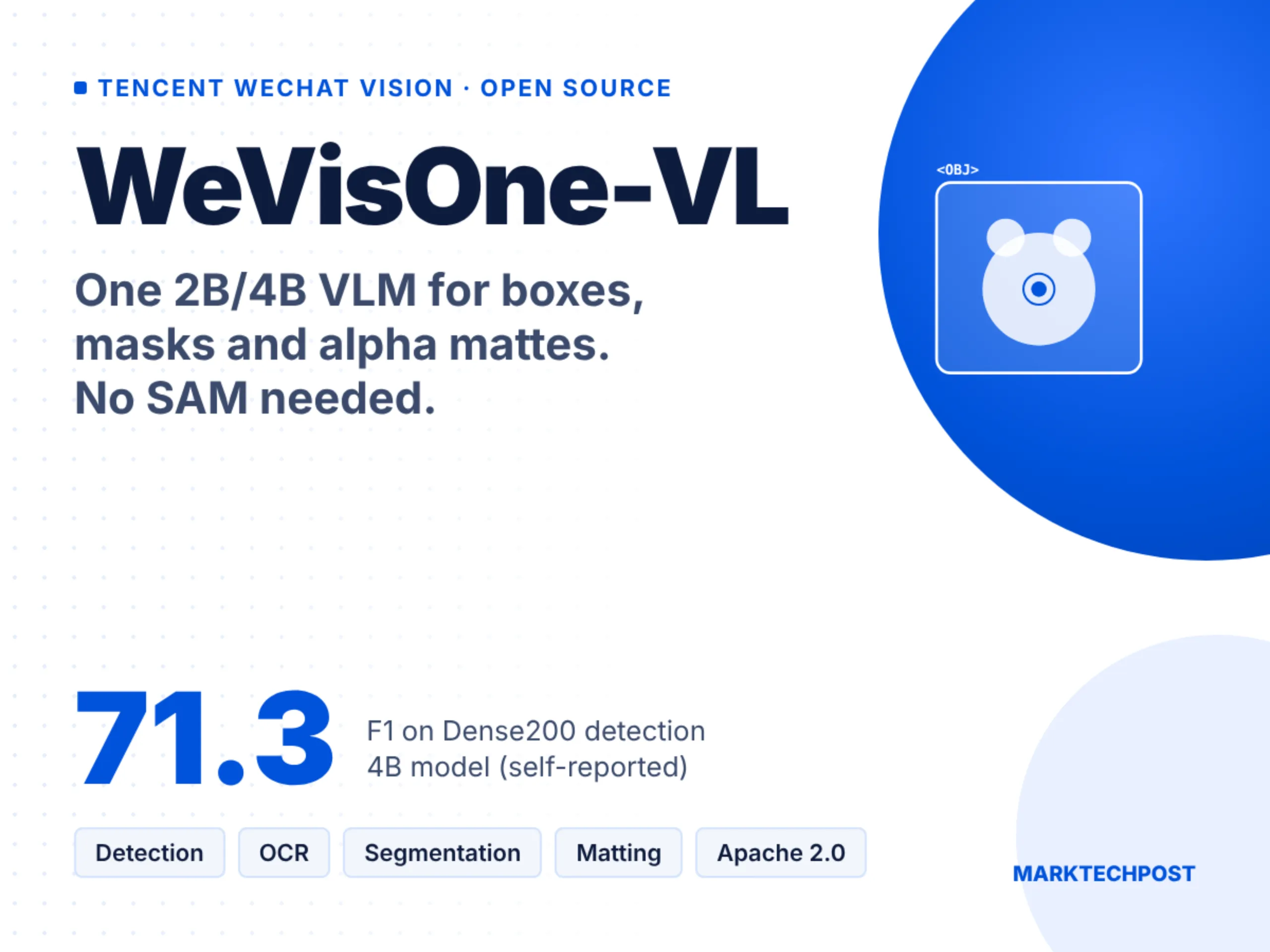
Tencent releases WeVisOne-VL vision model
MarkTechPost: Tencent WeVisOne-VL Unifies Detection, OCR, Segmentation and Matting
Tencent’s WeChat Vision team has released WeVisOne-VL, an open vision language model in 2B and 4B sizes. The WeVisOne-VL vision language model handles detection, referring, counting, pointing, OCR, segmentation and alpha matting in one model. Pixel outputs come from a 9.6M-parameter decoder, so no separate SAM is needed. It also answers “None” when a queried object is absent. For developers, that can replace a detector, an OCR engine and a segmenter with one model. TL;DR
Get smart on it
A vision language model has been released that handles multiple image understanding tasks within a single model, including object detection, text recognition, image segmentation, and alpha matting. Rather than requiring separate specialized tools for each task, this unified approach uses a small decoder component to produce pixel-level outputs without needing an additional segmentation model. The model was trained on over 100 million annotated images and can be deployed on a single GPU, offering developers a consolidated alternative to using multiple different tools for different image analysis needs.
Relevant courses
Want to go deeper than the news? Explore live, cohort-based AI courses taught by practitioners.
Browse AI courses on MavenRelated news
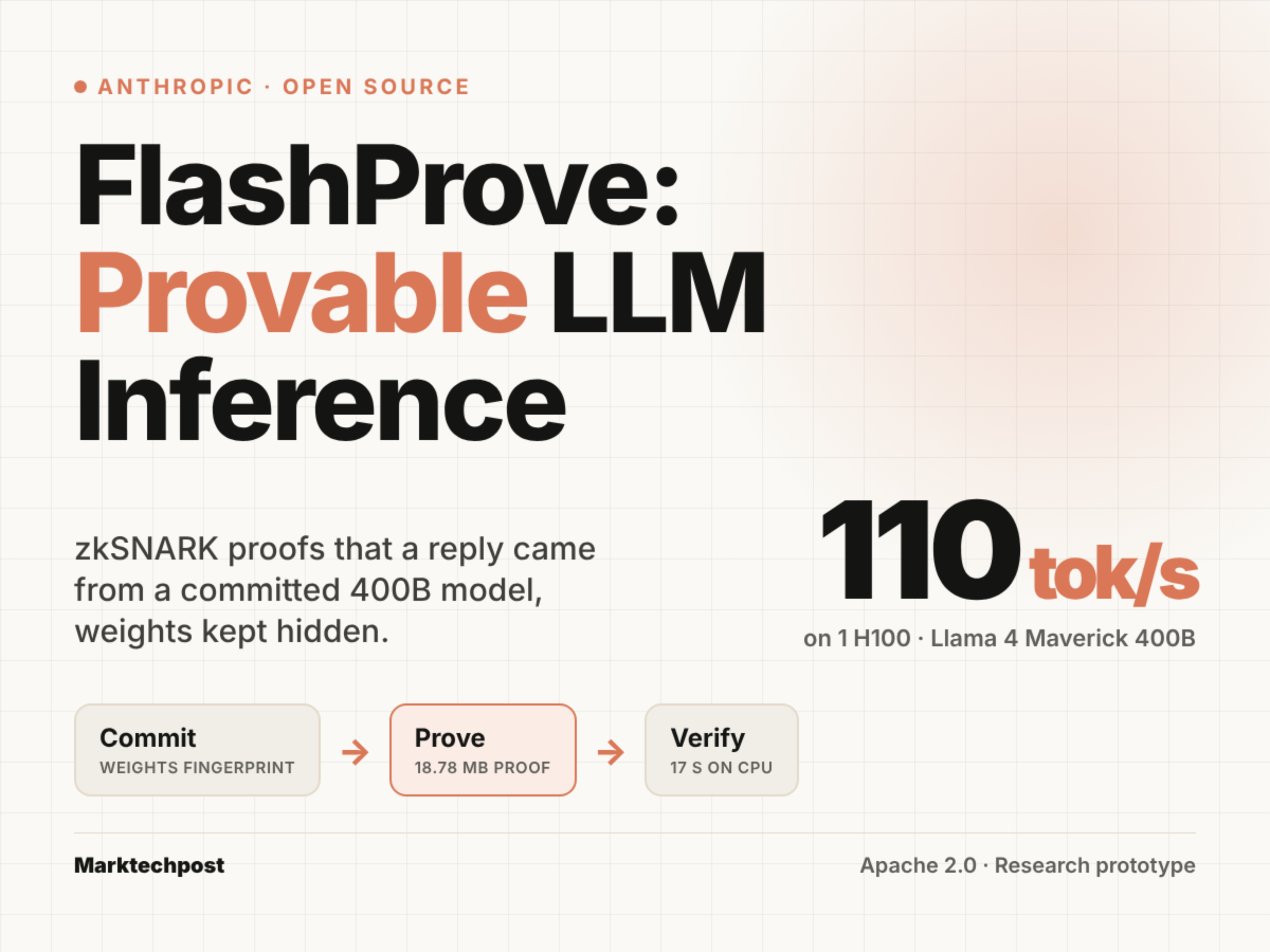
Anthropic Releases FlashProve: Cryptographic Proofs That a Reply Came From Committed Weights
Anthropic’s Frontier Red Team has released FlashProve, an open-source research prototype for provable inference. FlashProve is a zkSNARK system from Anthropic that proves a reply came from a committed model. The proof reveals nothing about the model weights. On Llama 4 Maverick, a 400B mixture-of-experts model, it proves about 110 tokens/second on 1 H100. For developers, this targets a real gap: today you cannot check which model actually answered your API call. TL;DR Size: Proves

42AI comes out of stealth with $62.5M and a world model that can ‘predict human behavior’
Here's a question straight out of sci-fi: What if AI could predict what you were going to do before you decided to, even in a completely new situation?
Also reported by SiliconANGLE

Mistral releases weights for its trillion-parameter AI model, targeting cybersecurity
Mistral says its new model can afford organizations a kind of control over its cyber defenses that closed models can't.
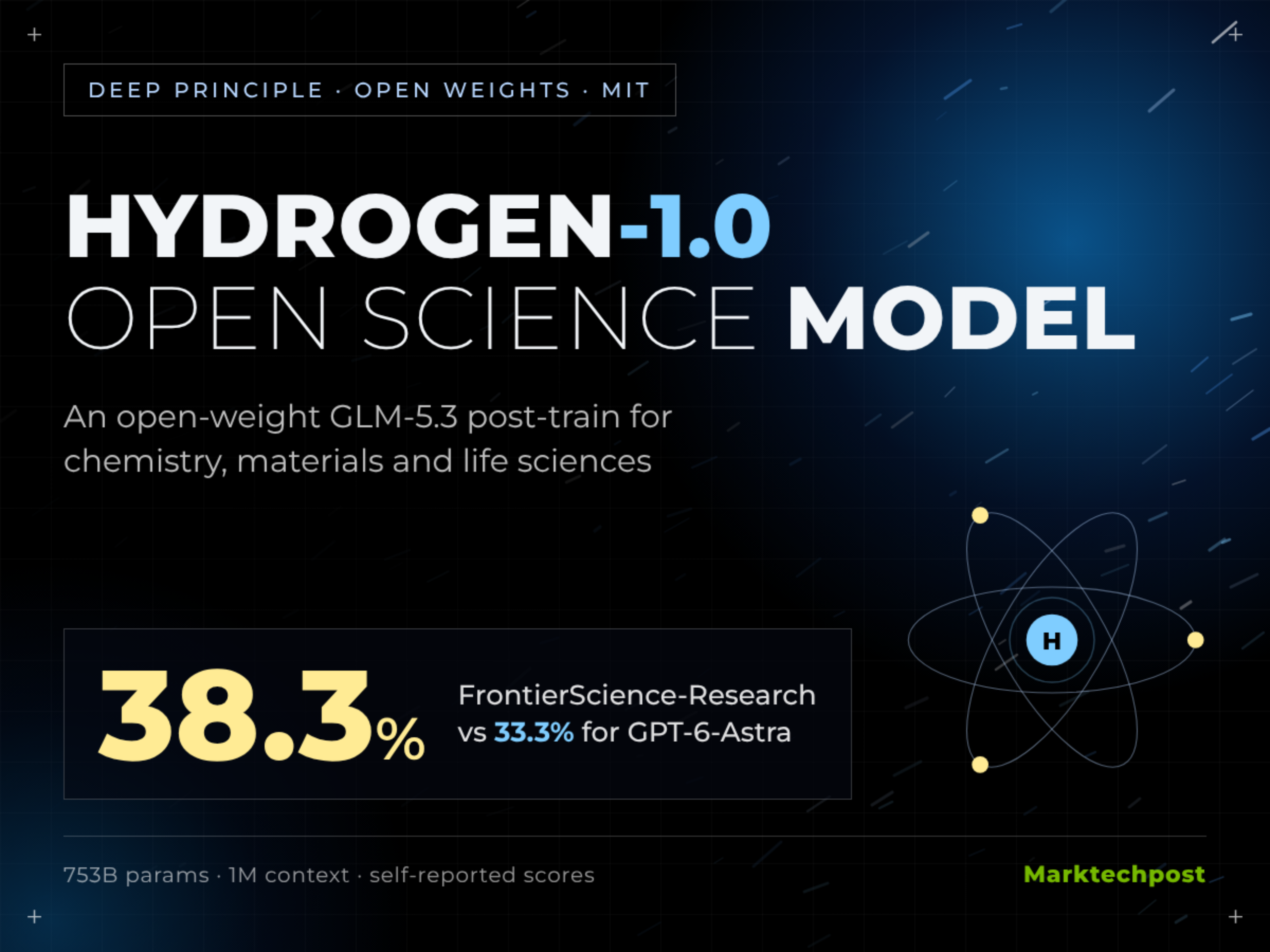
Deep Principle Releases Hydrogen-1.0: A 753B Open-Weight Model for Scientific Discovery
Deep Principle has released Hydrogen-1.0, an open-weight scientific model for chemistry, materials science and life sciences. It is built by post-training Z.ai’s GLM-5.3 on domain data, laboratory records and agent discovery trajectories. For developers, it offers open weights that report a FrontierScience-Research win over GPT-6-Astra. The weights ship under the MIT License. TL;DR Size: 753B parameters (MoE, ~40B active per the GLM-5.3 base), 1M-token context, 128K max output.

OpenAI sets new behavioral guidelines for AI models that have already proven hard to control
OpenAI has updated its Model Spec, restructuring its AI behavior guidelines around five core values, including faithfulness to human intent and correctability. GPT models should now draw on conversation history to figure out what users actually want and disclose their own assumptions. Whether the models follow these rules is another matter. The article OpenAI sets new behavioral guidelines for AI models that have already proven hard to control appeared first on The Decoder.
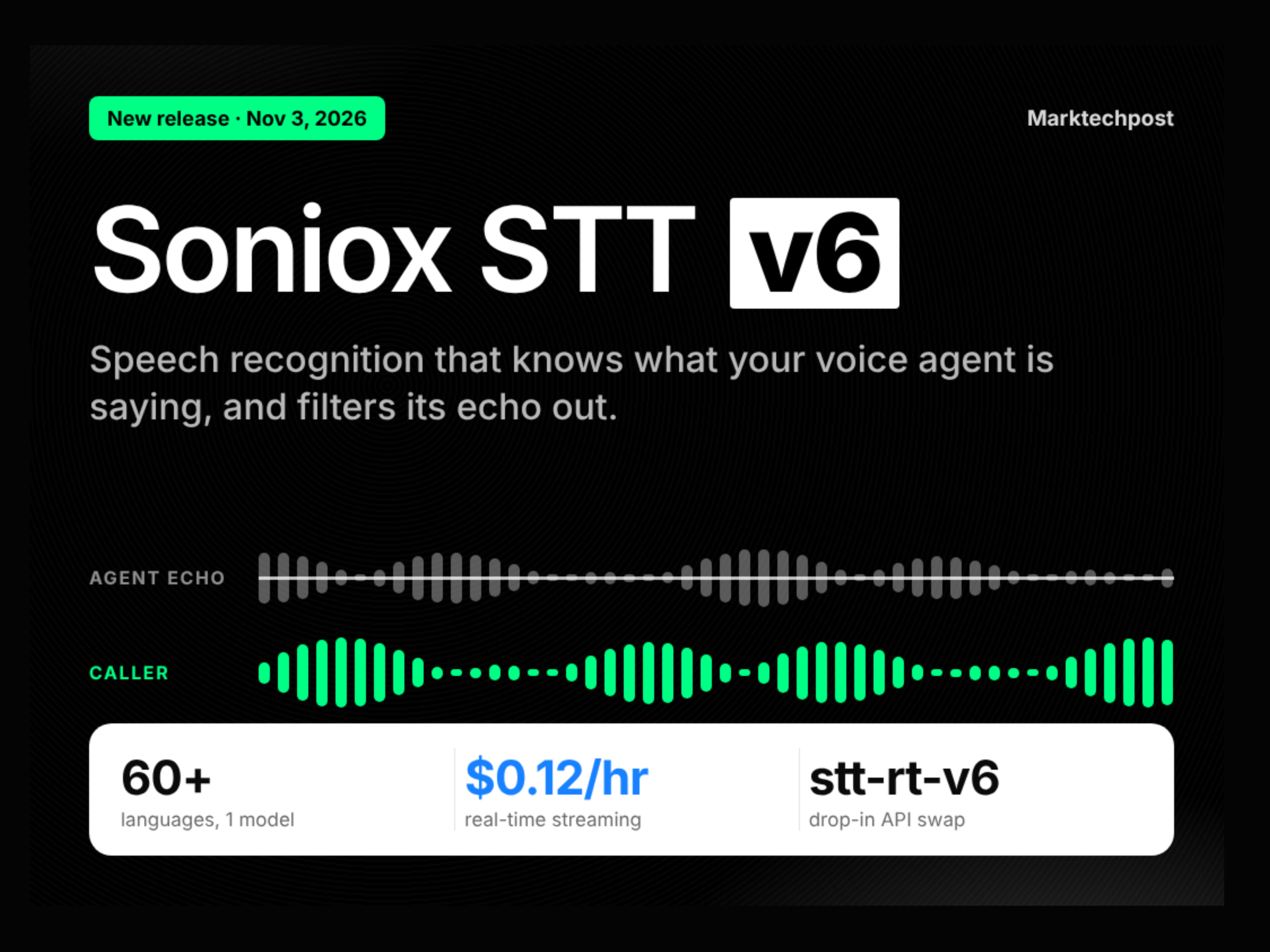
Soniox STT v6 Adds Agent Text Input and Echo Filtering for Voice Agents
Soniox has released Soniox STT v6, the latest generation of its speech-to-text API. Soniox STT v6 is a speech-to-text model that reads what a voice agent says while hearing the caller. It uses that text to recognize short replies and to drop the agent’s own voice. The release ships as stt-rt-v6 for streaming and stt-async-v6 for files, across 60+ languages. TL;DR Size: Soniox STT v6 is a proprietary hosted model, no parameter count published. Runs on: Soniox cloud API only (WebS