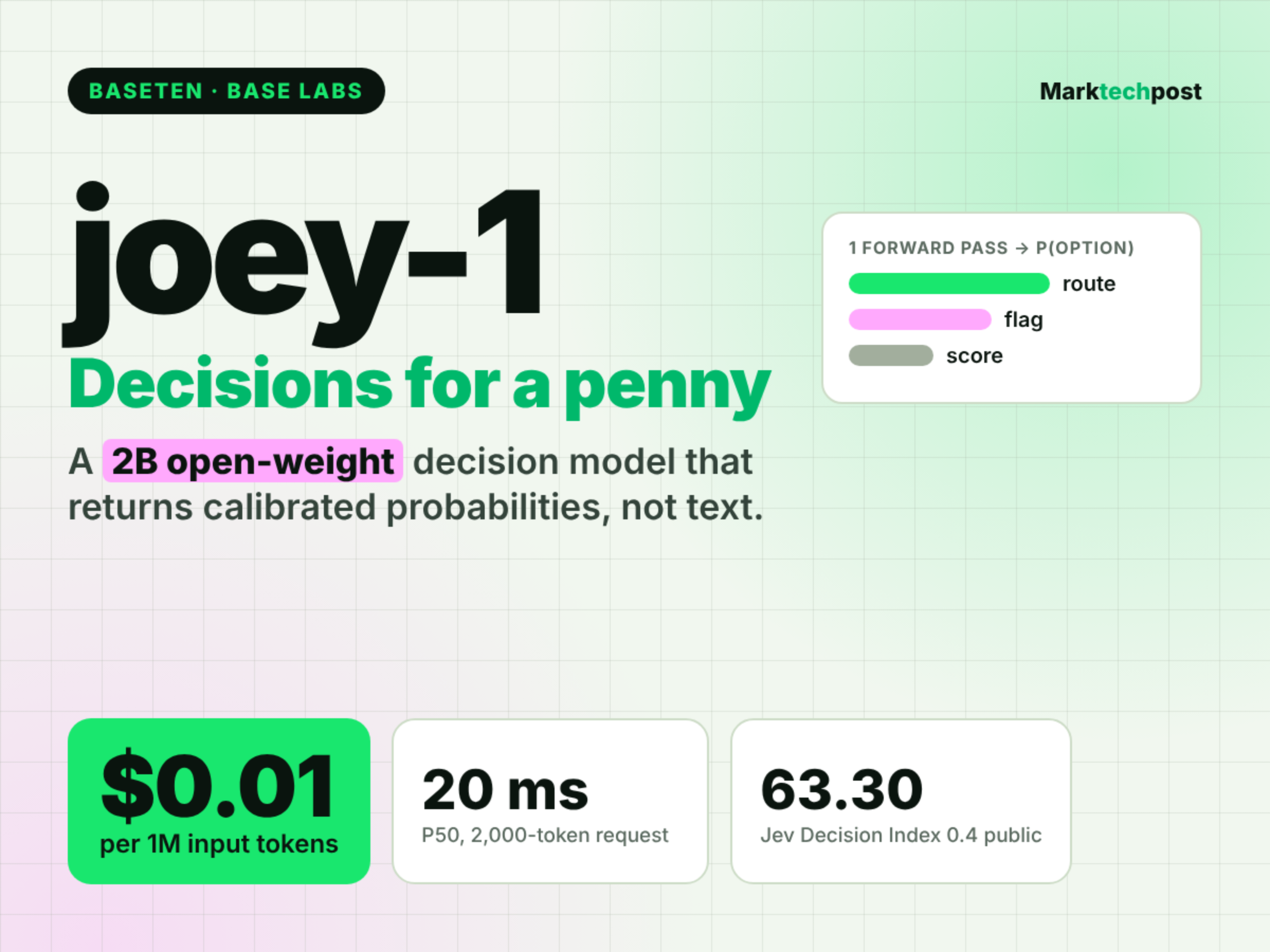
Baseten releases joey-1 decision model at $0.01
MarkTechPost: Baseten Releases joey-1, a 2B Decision Model at $0.01 per 1M Tokens
Baseten has released joey-1, a 2B model from its in-house research lab, Base Labs. The joey-1 decision model returns a label and a calibrated probability instead of generated text. It targets high-volume routing, classification and guardrail checks. Baseten prices it at $0.01 per million input tokens, with open weights on Hugging Face under MIT. TL;DR Size: 2B parameters, post-trained from Qwen3.5-2B. 16,384-token max sequence (Baseten says 262k on dedicated deployments). Runs on: Bas
Get smart on it
Baseten released joey-1, a 2 billion parameter decision model that returns categorical labels and probability scores rather than generated text, designed for tasks like routing, classification, and safety checks. The model costs $0.01 per million input tokens and operates at a reported 20 millisecond response time, making it significantly cheaper and faster than larger alternatives in its product family. joey-1 is trained on 6.21 million decision examples and ranks as the top-performing model under 4 billion parameters on the Jev Decision Index public benchmark, though it trails Baseten's larger 9 billion parameter model by nearly 9 benchmark points. The weights are publicly available under an MIT license, and the model can run on a single CUDA GPU for self-hosted deployment.
Relevant courses
Want to go deeper than the news? Explore live, cohort-based AI courses taught by practitioners.
Browse AI courses on MavenRelated news

Gemini 4 Carbon: Our next frontier model
Google's latest offering suggests the company is prioritizing efficiency and environmental impact alongside raw capability gains.
Also reported by Ars Technica, MarkTechPost, The Verge and The Decoder

Welcome Le Chonk: Mistral Large 4 on Hugging Face
Mistral's latest offering aims to compete with frontier models while remaining accessible to researchers and developers on open platforms.
Also reported by SiliconANGLE and TechCrunch

Introducing GPT-6.1 Terra
Bringing fast and capable computer use to everyone
Also reported by SiliconANGLE, MarkTechPost and The Decoder

Le Chonk: Built for Coders, Trusted by Defenders.
The weights of Mistral Large 4 (Le Chonk) are now open. A 1T parameter multimodal model, and best open-weight model for coding, trained in Europe.

Genie 4: A new generation of world simulation
Genie 4: our new world model unlocking unprecedented realism in real-time simulation.
Also reported by TechCrunch, Ars Technica, SiliconANGLE and MarkTechPost

An updated Model Spec for more capable and beneficial AI
OpenAI’s updated Model Spec outlines five core values to guide more capable AI toward sound judgment, human agency, and faithfulness to human intent.