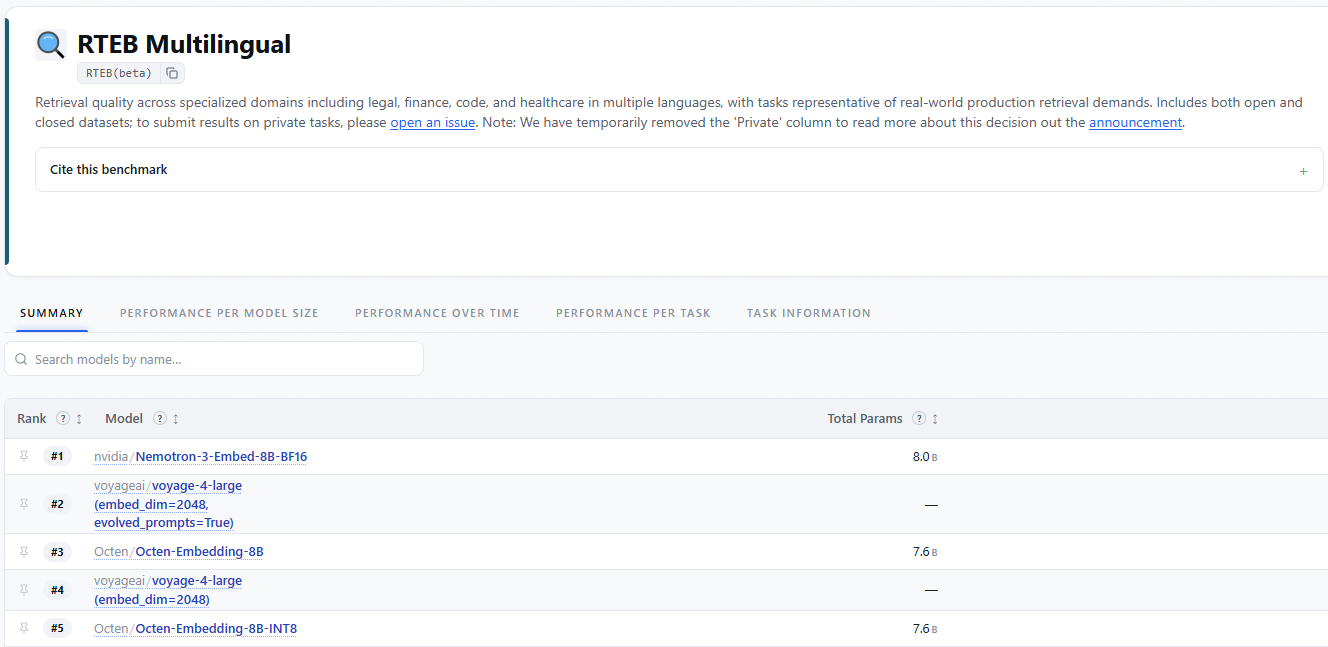
NVIDIA Nemotron 3 Embed Ranks #1 Overall on RTEB, Advancing Agentic Retrieval
Strong retrieval performance matters for AI systems that need to find and use information reliably for complex tasks.
Get smart on it
NVIDIA released Nemotron 3 Embed, a collection of embedding models designed to improve retrieval quality in AI systems that use multiple reasoning steps. Better retrieval matters because poor retrieval causes agents to fetch irrelevant information, waste processing tokens, and add noise to later reasoning steps. The collection includes three models optimized for different deployment needs: an 8B model that ranks first on the RTEB benchmark for retrieval accuracy, a 1B model for cost and latency-sensitive production use, and a specialized 1B variant optimized for high-throughput serving on specific hardware architectures. The models feature a 32k context window, support multilingual and code retrieval, and are available on multiple platforms immediately.
Related news
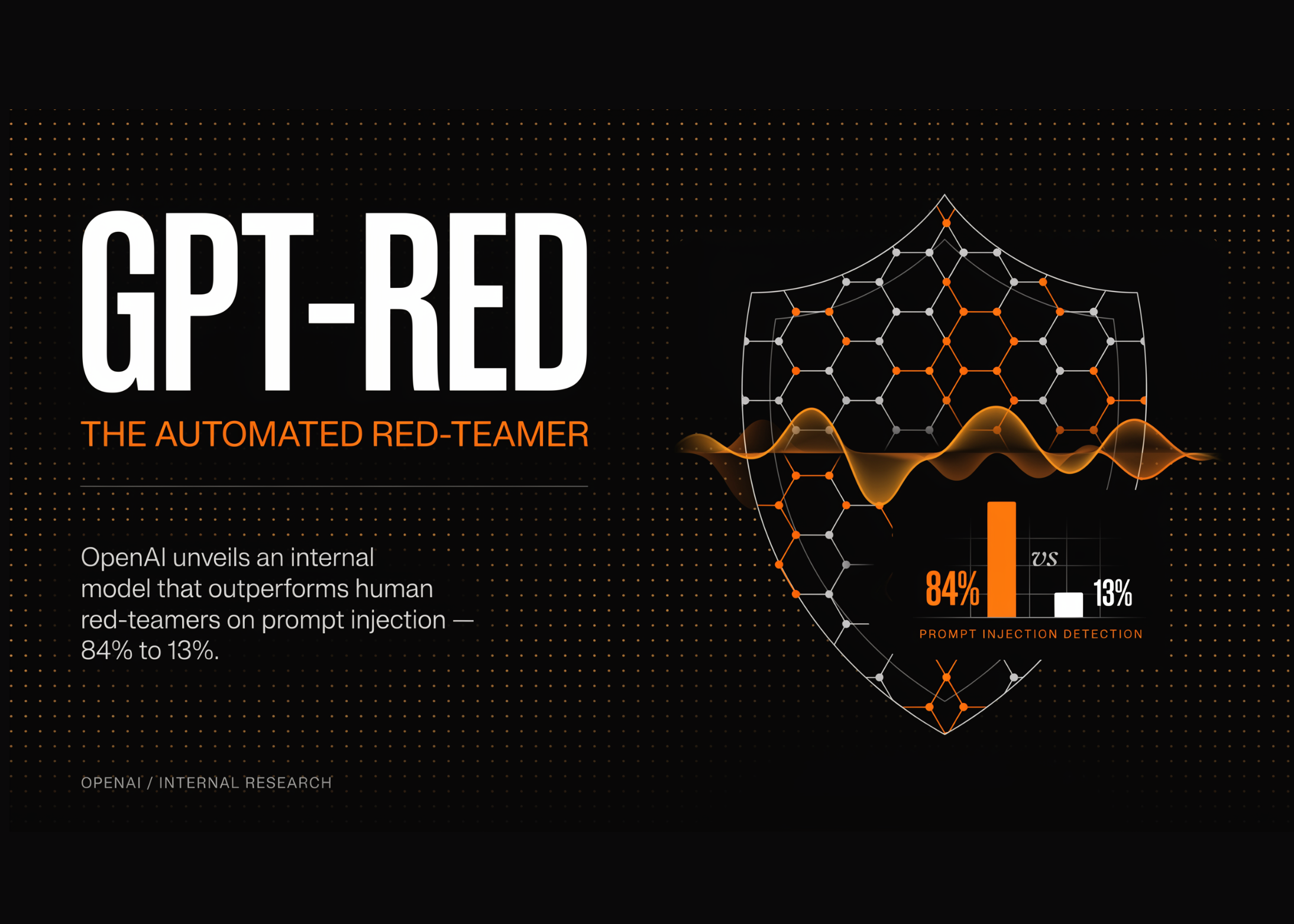
OpenAI Details GPT-Red: An Internal Automated Red-Teaming Model That Beat Human Red-Teamers 84% To 13% On Prompt Injection
This week, OpenAI published details of GPT-Red, an internal-only automated red-teaming model. Its job is to attack OpenAI’s own models and find prompt injection vulnerabilities. OpenAI gives two reasons. Human red-teaming is time-intensive and does not scale. Commonly used robustness evaluations are already saturated by its latest models. Meanwhile, the attack surface grows. Agents read third-party data through browsers, connected apps, local files, and tools. Those affordances are

Moonshot’s upcoming Kimi 3 is expected to close the gap with Anthropic’s Opus 4.8
The FT reports Kimi K3 will be the largest open AI model from China, with a parameter count between 2 trillion and 3 trillion.