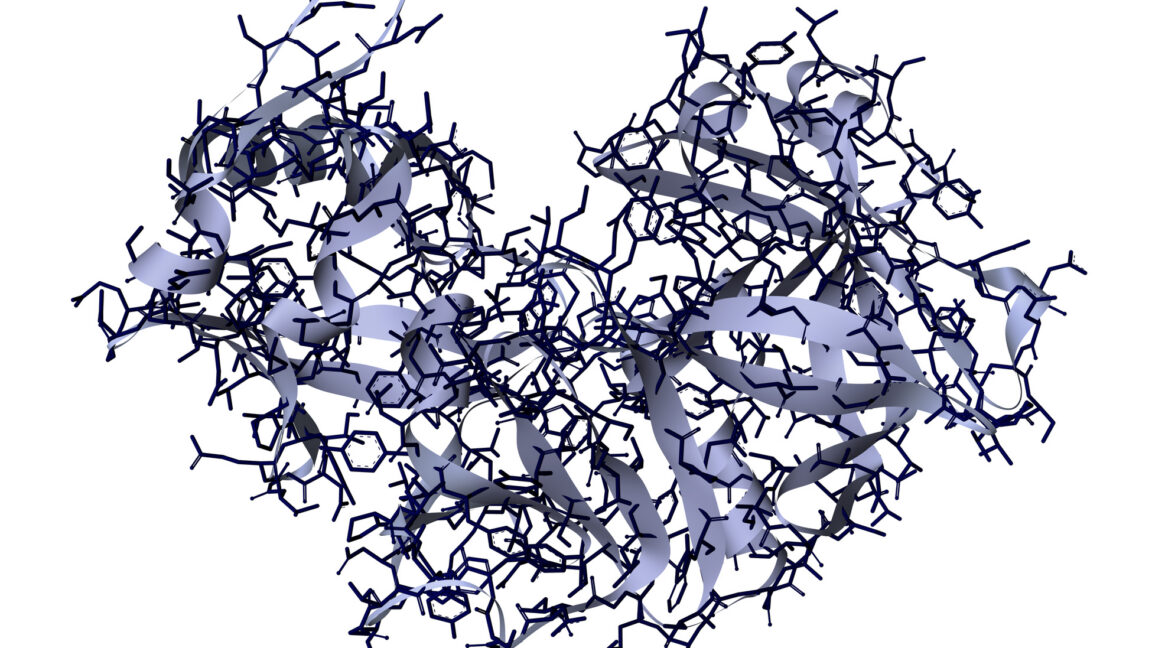
Researchers use AI to design proteins that cut up other proteins
A protein is a chain of amino acids held together by what are called peptide bonds. On their own, those bonds are extremely stable; they're estimated to have a half-life of several hundred years. But in Earth's environment, most proteins don't last nearly that long. That's because organisms have evolved a handful of ways to catalyze the break-up of peptide bonds, which have diversified into countless specialized protein-digesting enzymes. Proteases are everywhere and generally make short work of
Get smart on it
Researchers used AI protein design tools to create new enzymes capable of cutting other proteins at specific locations. Peptide bonds that hold proteins together are extremely stable on their own, so organisms evolved specialized protein-digesting enzymes called proteases to break them. By taking the catalytic cores of two existing protease types and using AI software to redesign the rest of their structure, scientists demonstrated they could create functional designer enzymes tuned to cut proteins associated with neurological diseases. While the newly designed proteases showed lower activity levels than their natural counterparts, this approach essentially accelerated through artificial design what would normally require evolutionary diversification over time.
Relevant courses
Want to go deeper than the news? Explore live, cohort-based AI courses taught by practitioners.
Browse AI courses on MavenRelated news

Gemini 4 Argon: Built to solve your hardest problems
The new model aims to handle complex reasoning tasks where current systems often struggle or fail completely.
Also reported by The Verge, Ars Technica, The Decoder and SiliconANGLE

OpenAI will reportedly ship at least one model this year but its flagship still needs alignment work
OpenAI is racing to finish its next flagship model, which uses the same looped transformer technique as Astra to boost math and coding performance. The tradeoff is that looping makes safety monitoring harder. Microsoft accidentally revealed details about how the technique works on a public page. Whether or not the flagship is ready in time, employees say one or two new models will likely ship by year's end. The article OpenAI will reportedly ship at least one model this year but its fla

Meta releases its first frontier model, Muse Wonder
Meta's Superintelligence Lab released a pair of new state-of-the-art models on Monday, Muse Wonder and Muse Wonder Full, the company's first attempt at a frontier model.
Also reported by The Verge, Wired AI, The Decoder and SiliconANGLE
AI Came for Math. Now It’s Chasing the Rest of Science
AI may soon be the default way to solve theoretical problems in economics, high-energy physics, and other fields, MIT researchers tell WIRED.

The maker of non-text AI model Jev valued at $7.5B just weeks after launch
What has users and large corporations so excited about Jev is TypeSafe’s claim that it works significantly faster and uses far fewer tokens than LLMs.

Higgsfield takes AI video from 1 minute to over 10
Higgsfield brings creators longer videos with GPT-6 Astra, precise visuals with GPT-Image-2.5, and a path to voice filmmaking with GPT-Live.