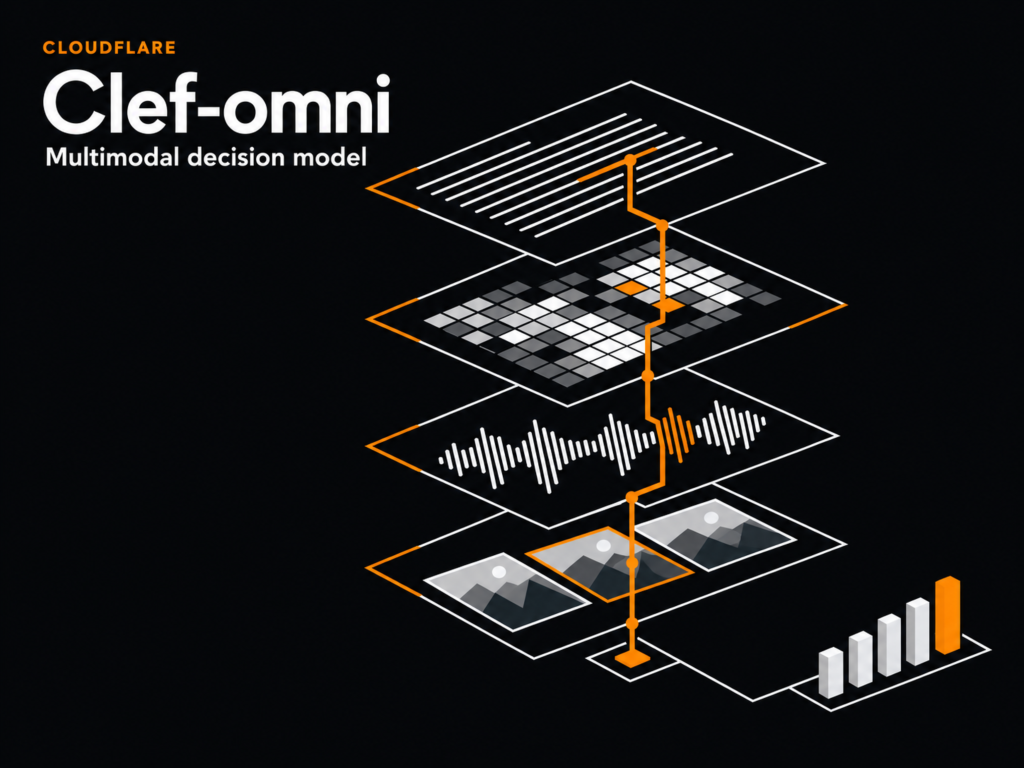
Cloudflare releases Clef-omni multimodal decision model
MarkTechPost: Meet Cloudflare Clef-omni: A 30B-A3B Multimodal Decision Model for Audio, Video, Image and Text
Cloudflare has released Clef-omni, a new open-weight member of its Clef decision model family. Clef-omni is a Cloudflare decision model that scores text, images, audio and video in 1 call. It arrived on October 9, 2026, 8 days after the original Clef and Clef-flash launch. The same update cut Clef-flash pricing below TypeSafe’s Jev and made hosted Clef roughly 2x faster. For developers, this removes the transcription and captioning steps that multimodal agent pipelines usually need. TL
A decision model is a type of AI system that returns typed answers with probabilities instead of generated text, answering questions from a predefined set of options rather than generating new content. Clef-omni is a new decision model that can process text, images, audio, and video all in a single call, removing the need for separate transcription and captioning steps that multimodal systems typically require. The model performs well on intent classification tasks but shows weaker performance on harder reasoning and workflow evaluations compared to text-focused versions. It is available as an open-source model and through a hosted service, with pricing and performance characteristics designed to serve developers building multimodal applications.
One short email a day with the stories that matter. Free. Unsubscribe with one click.
Want to go deeper than the news? Explore live, cohort-based AI courses taught by practitioners.
Browse AI courses on Maven
Introducing GPT-6.2 Astra and Sol
Introducing GPT‑6.2 Astra and Sol, with better professional outputs, coding, computer use, and efficiency at lower cost across ChatGPT Work, Codex, and the API.
Also reported by MarkTechPost and SiliconANGLE
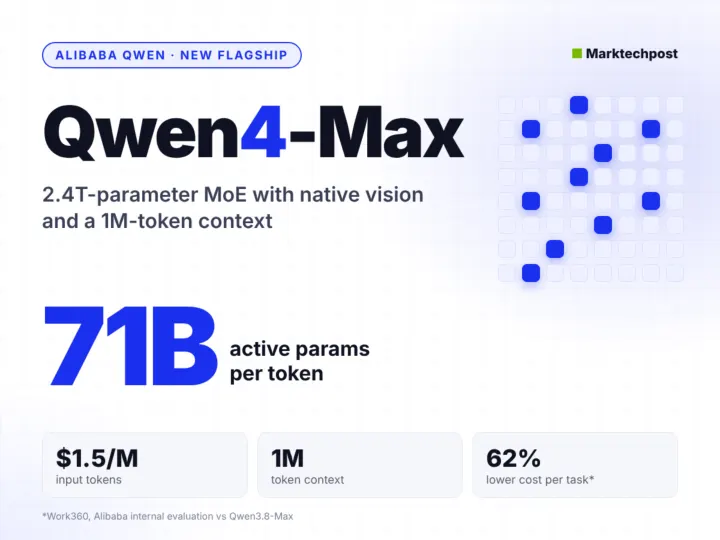
Alibaba Releases Qwen4-Max: 2.4T MoE, 71B Active, 1M Context
Alibaba’s Qwen team has released Qwen4-Max, the first model of its Qwen4 generation. Qwen4-Max is a proprietary sparse MoE model with a 2.4T-parameter backbone and 71B parameters active per token. It accepts text, images and video, and supports a 1M-token context window. Alibaba also cut API prices and reports a 62% drop in average cost per task. TL;DR Size: 2.4T backbone parameters, 71B active per token, plus 328B N-gram Embedding parameters. 1M context, 393K max output tokens.
Also reported by SiliconANGLE

Microsoft rolls out new first-party models and updates to agentic AI continuous improvement
Microsoft Corp. today rolled out new generative artificial intelligence models and updates to Foundry, the company’s unified enterprise platform that helps developers and organizations ground, test and deploy AI applications and autonomous agents. Updates to Foundry IQ, part of Microsoft IQ, now provide an enterprise knowledge graph out of the box, delivering a full estate […] The post Microsoft rolls out new first-party models and updates to agentic AI continuous improvement appeared firs
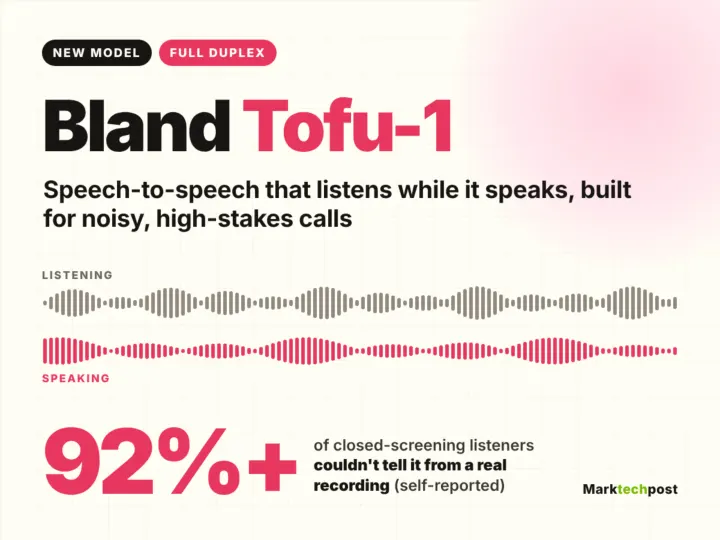
Bland Launches Tofu-1, a Full-Duplex Speech-to-Speech Model for Calls
Bland, the San Francisco voice-AI company, has released Tofu-1, a full-duplex speech-to-speech model in research preview. The Tofu-1 speech-to-speech model targets calls from moving cars, hospital rooms and weak-signal lines. It listens while it speaks and reasons while it talks. For phone-agent teams, one model now handles audio in and audio out, with no transcript between. You can check the deployment options and specs here through our GPULeaderboard.com chrome extension. What is Tofu-1?
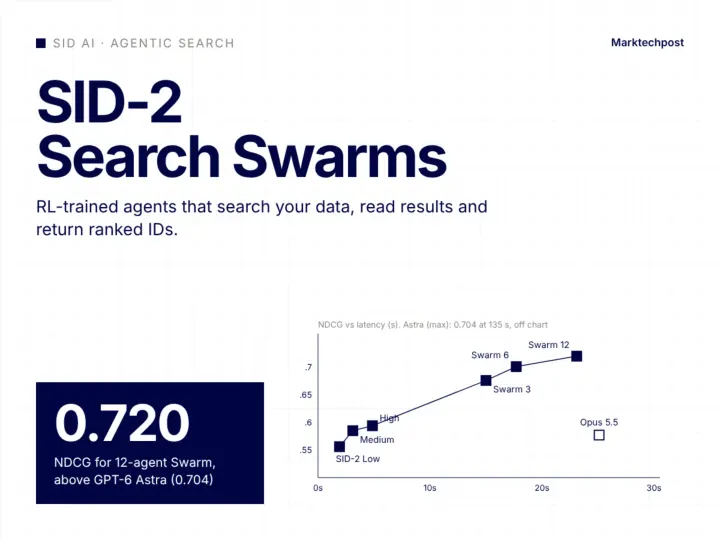
SID AI Releases SID-2 Agentic Search Model With 0.720 NDCG Swarm Mode
SID AI has released SID-2, its second-generation agentic search model, alongside SID-2 Swarm. SID-2 is an agentic search model from SID AI that searches your data, reads results and returns ranked document IDs. It replaces fixed RAG pipelines with a model that decides what to search next. TL;DR Size: Context window is 262k tokens per the report (256k on sid.ai/models). Runs on: Hosted API at platform.sid.ai, plus Baseten and SageMaker reference paths. SID’s latency figures assu

Cmpnd Releases dspy-wsp: Weight-Space Programming Comes to DSPy
Cmpnd has released dspy-wsp, a prototype optimizer that brings weight-space programming to DSPy. Weight-space programming is a technique in which a frontier LLM reads another model’s weights and edits them directly. There are no gradients, no training loop and no fine-tuning dataset. dspy-wsp packages this as WeightSpace, an optimizer that plugs into any DSPy program and metric. In Cmpnd’s tests, about $5 to $10 of GPT-6-Astra calls improved every decision model they tried. You can