**Know Who Spoke When: Build Real-Time, Multi-Speaker AI with NVIDIA Nemotron 3 Diarization**
Identifying individual speakers in conversations could improve customer service transcripts, meeting notes, and accessibility tools that currently struggle with overlapping voices.
Get smart on it
Speaker diarization is the process of identifying who spoke when in a conversation by classifying time intervals when each speaker is active, including moments when people talk over one another. This matters because transcripts without speaker attribution become less useful for search, summaries, action items, and conversation analytics, since readers cannot reliably determine who made commitments, raised objections, or interrupted. NVIDIA Nemotron 3 Diarization is an open-weight model that performs this task for up to eight speakers in both live and recorded conversations, achieving a ranking on a diarization leaderboard by reducing error rates and handling overlapping speech. The model works by converting audio into speaker-activity probabilities across multiple channels, with a memory system that allows it to maintain consistent speaker assignments across chunks of audio in real-time streaming scenarios.
Related news
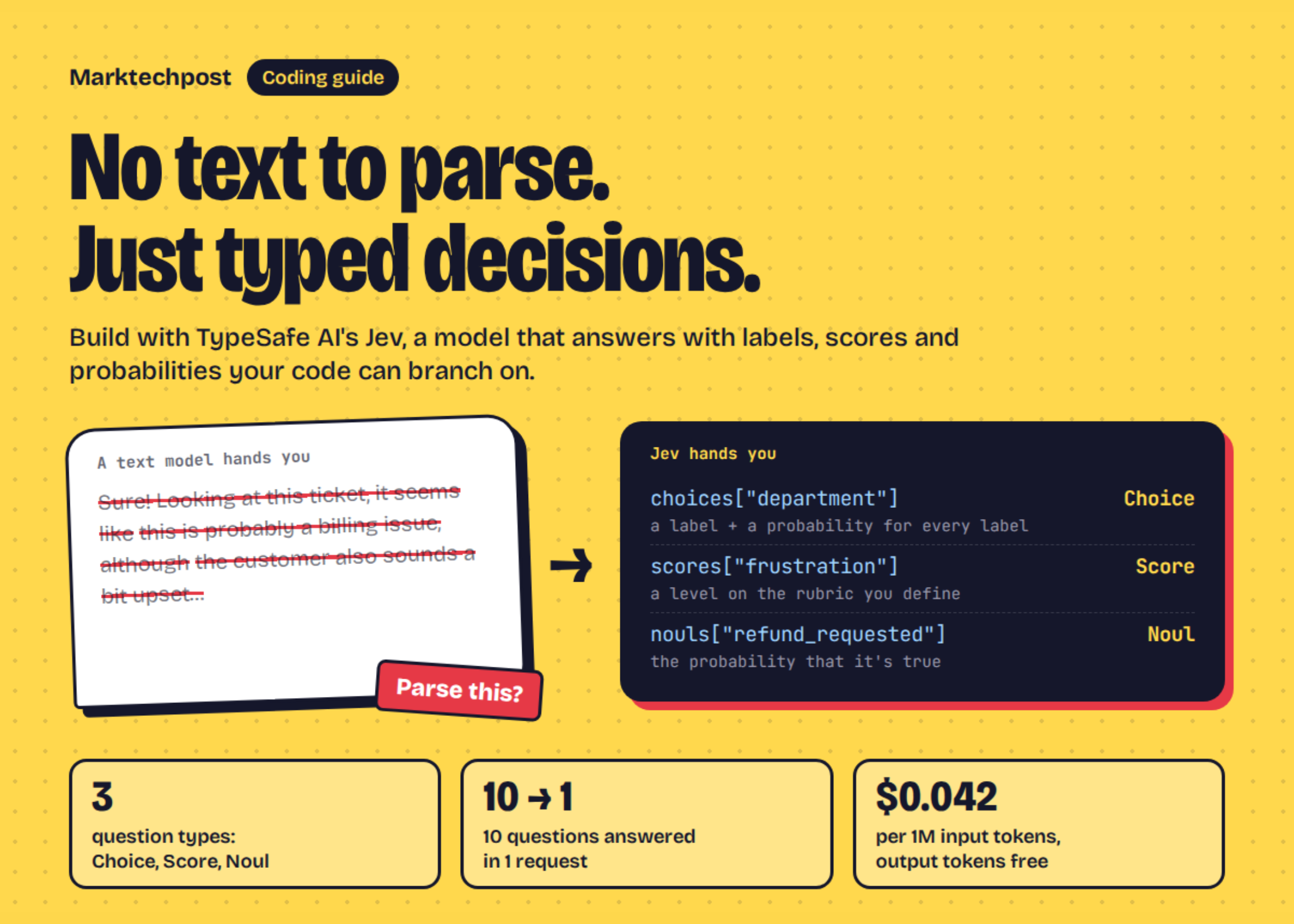
A Coding Guide to TypeSafe AI Jev: Typed Decisions, Calibrated Confidence, and Speculative Fan-Out with a System One Model
In this tutorial, we work with Jev, TypeSafe AI’s first System One model, which does not generate text at all: we send it a piece of program state and a set of typed questions, and it returns choices, scores, and yes/no probabilities that our code can branch on directly. We install the official Python SDK, make a first call that uses all three question primitives at once, and look at how the shape of the state changes what the model can know. We then recompute the published confidence sta
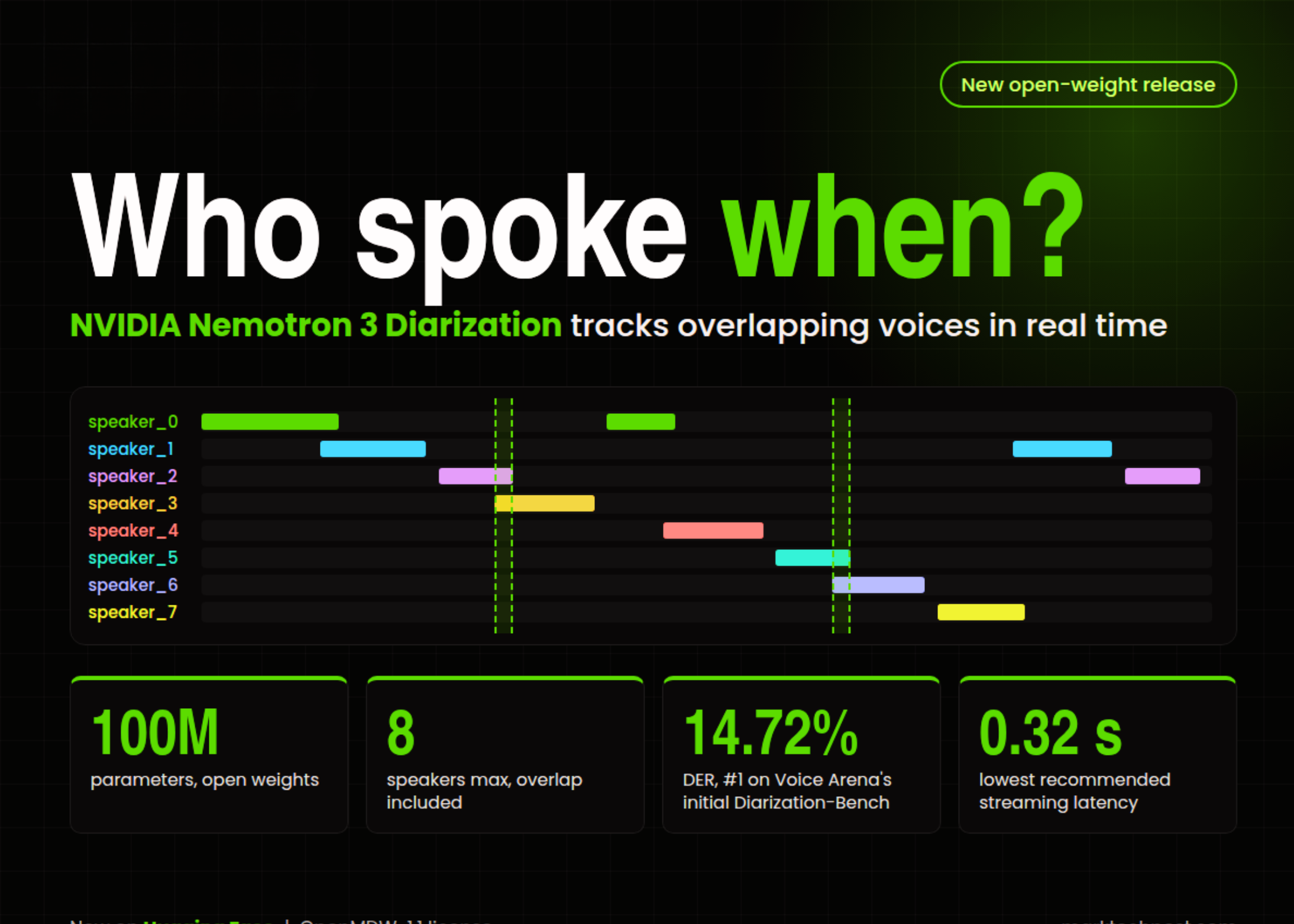
NVIDIA Releases Nemotron 3 Diarization: A 100M-Parameter Open-Weight Model That Tracks 8 Speakers in Real Time
NVIDIA has released Nemotron 3 Diarization, an open-weight speaker diarization model on Hugging Face. It answers one question about any conversation: who spoke when. The 100M-parameter model tracks up to 8 speakers, including when voices overlap. One checkpoint handles both offline recordings and real-time streaming. Is it deployable? Yes. The weights are released under the OpenMDW License 1.1, which permits commercial use. It runs on Linux through NVIDIA NeMo, using Ampere, Ada Lovelace, Ho