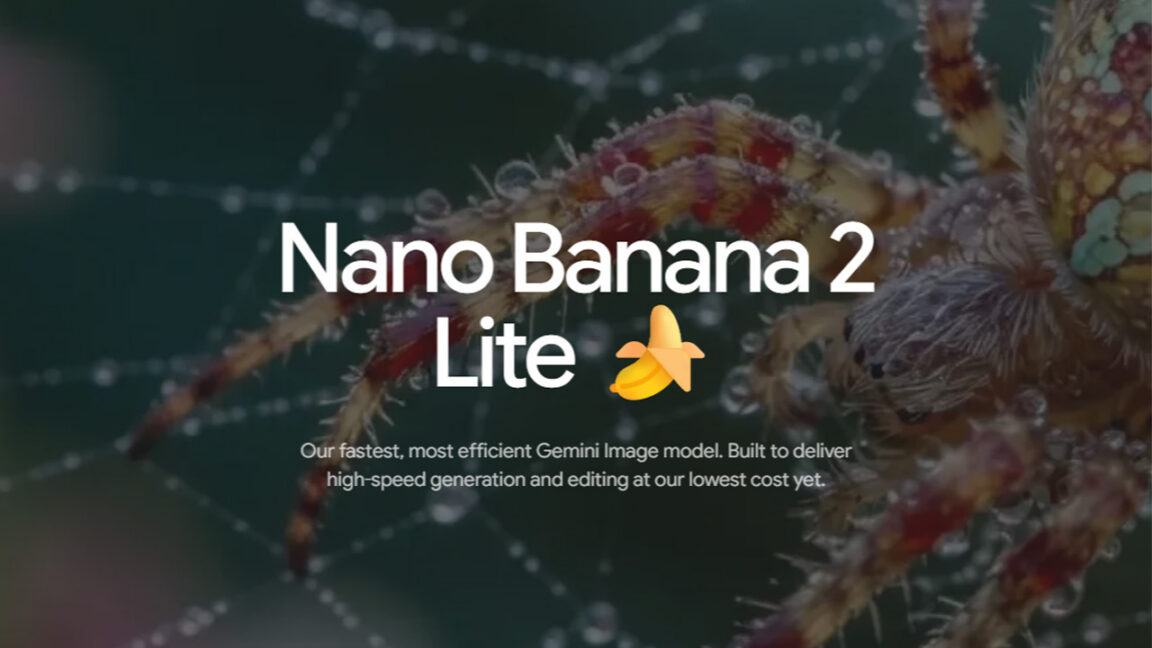
Google's new Nano Banana 2 Lite image model is its fastest and cheapest yet
There are plenty of AI image-generation models these days, but the ones capable of quality outputs tend to be slow and expensive. Google DeepMind says its new image model, known as Nano Banana 2 Lite, offers the best balance of quality and speed. It's available today across the Google ecosystem, creating images in a fraction of the time it takes Google's beefier models. The new model is part of the Gemini 3.1 family—it's technically called Gemini 3.1 Flash Lite Image. On one hand, Google says th
Make your prediction
Will Google's Gemini 3.1 Flash Lite Image model appear on the Gemini models page by July 8, 2026?
Resolves by Jul 8, 2026
Your prediction
50% · 50/50 coin flip
NOYES
Get smart on it
Google DeepMind has released a new image-generation model called Nano Banana 2 Lite that prioritizes speed and cost over image quality. The model can generate images in about 4 seconds compared to 20 seconds for the standard version, and costs half as much to use via API at an average of $0.034 per 1,000 images. While the model produces lower quality outputs, particularly with small text and infographics, it is designed for rapid prototyping and exploration where speed matters more than perfection. The model is available across Google's ecosystem and all images it produces include watermarks to identify them as AI-generated.
Related news
Google AI Introduces TabFM: A Hybrid-Attention Tabular Foundation Model for Zero-Shot Classification and Regression
Google Research introduced TabFM, a foundation model built for tabular data. TabFM performs classification and regression without dataset-specific training. Every prediction comes from a single forward pass. The model reframes tabular prediction as an in-context learning problem. It is available now on Hugging Face and GitHub. TL;DR TabFM predicts on unseen tables with no training, tuning, or feature engineering. It reads the full dataset as one prompt, then predicts via in-context le
NVIDIA Releases Nemotron-Labs-TwoTower: an Open-Weight Diffusion Language Model Built on a Frozen Autoregressive Nemotron-3-Nano-30B-A3B Backbone
NVIDIA has released Nemotron-Labs-TwoTower, a diffusion language model built on a pretrained autoregressive backbone. It ships as open weights under the NVIDIA Nemotron Open Model License. The release targets a throughput bottleneck in text generation. Autoregressive (AR) models decode one token at a time. That serial process caps generation throughput. Discrete diffusion language models take another route. They generate tokens in parallel and refine them iteratively. Most diffusion langu