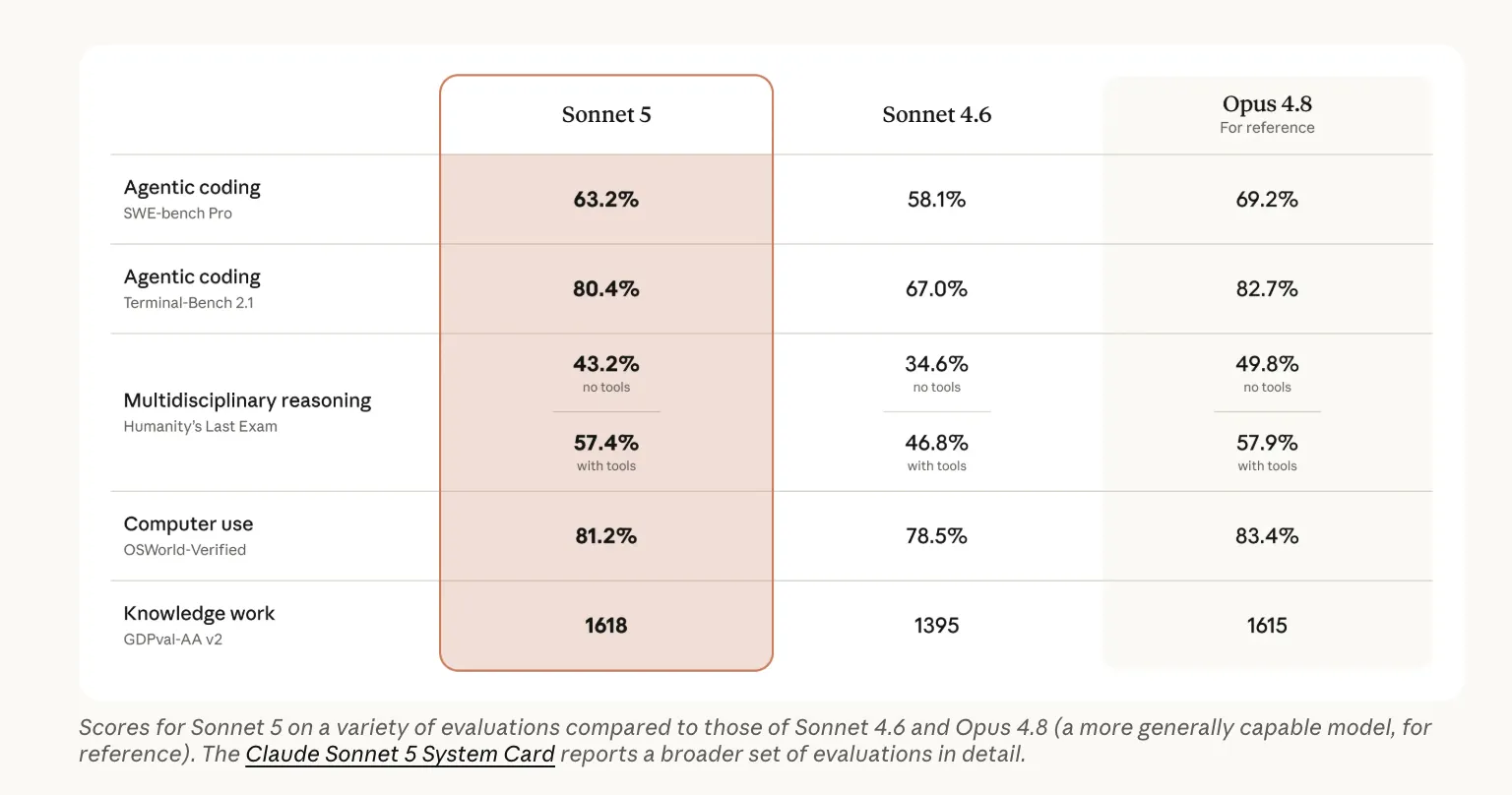
Anthropic launches Claude Sonnet 5 as a cheaper way to run agents
Anthropic’s Claude Sonnet 5 brings stronger agentic capabilities, lower pricing, and improved safety, positioning the model as a cheaper alternative to Opus, GPT-5.5, and Gemini Pro.
Get smart on it
Anthropic released Claude Sonnet 5, a midsize AI model designed to perform autonomous tasks like planning, using tools, and running independently at capabilities that previously required larger and more expensive models. The company positioned it as a cheaper alternative to its larger model while promising performance close to that model, with initial pricing lower than competing offerings from other major AI labs. Agentic capability, which refers to an AI system's ability to work autonomously toward goals, has become a baseline expectation across all price tiers in the AI industry, shifting competition from who can do this work best to who can do it most cheaply and reliably. The model also shows safety improvements over its predecessor, including lower rates of undesirable behaviors like deception and hallucination, though it does not match the safety levels of the company's most advanced models.
Related news
Google AI Introduces TabFM: A Hybrid-Attention Tabular Foundation Model for Zero-Shot Classification and Regression
Google Research introduced TabFM, a foundation model built for tabular data. TabFM performs classification and regression without dataset-specific training. Every prediction comes from a single forward pass. The model reframes tabular prediction as an in-context learning problem. It is available now on Hugging Face and GitHub. TL;DR TabFM predicts on unseen tables with no training, tuning, or feature engineering. It reads the full dataset as one prompt, then predicts via in-context le
NVIDIA Releases Nemotron-Labs-TwoTower: an Open-Weight Diffusion Language Model Built on a Frozen Autoregressive Nemotron-3-Nano-30B-A3B Backbone
NVIDIA has released Nemotron-Labs-TwoTower, a diffusion language model built on a pretrained autoregressive backbone. It ships as open weights under the NVIDIA Nemotron Open Model License. The release targets a throughput bottleneck in text generation. Autoregressive (AR) models decode one token at a time. That serial process caps generation throughput. Discrete diffusion language models take another route. They generate tokens in parallel and refine them iteratively. Most diffusion langu