Google AI Introduces TabFM: A Hybrid-Attention Tabular Foundation Model for Zero-Shot Classification and Regression
Google Research introduced TabFM, a foundation model built for tabular data. TabFM performs classification and regression without dataset-specific training. Every prediction comes from a single forward pass. The model reframes tabular prediction as an in-context learning problem. It is available now on Hugging Face and GitHub. TL;DR TabFM predicts on unseen tables with no training, tuning, or feature engineering. It reads the full dataset as one prompt, then predicts via in-context le
Get smart on it
TabFM is a foundation model designed to make predictions on tabular data without requiring dataset-specific training, hyperparameter tuning, or feature engineering. It works by reading an entire dataset as a single prompt and generating predictions in one forward pass using a technique called in-context learning, which combines alternating row-and-column attention with a transformer-based approach. This matters because tabular data forms the backbone of enterprise operations for tasks like customer churn and fraud detection, yet traditional methods like XGBoost require extensive manual preparation work before they can produce reliable results. TabFM was trained on hundreds of millions of synthetically generated datasets using structural causal models and is available on Hugging Face and GitHub, with plans for integration into BigQuery through a SQL command.
Related news
NVIDIA Releases Nemotron-Labs-TwoTower: an Open-Weight Diffusion Language Model Built on a Frozen Autoregressive Nemotron-3-Nano-30B-A3B Backbone
NVIDIA has released Nemotron-Labs-TwoTower, a diffusion language model built on a pretrained autoregressive backbone. It ships as open weights under the NVIDIA Nemotron Open Model License. The release targets a throughput bottleneck in text generation. Autoregressive (AR) models decode one token at a time. That serial process caps generation throughput. Discrete diffusion language models take another route. They generate tokens in parallel and refine them iteratively. Most diffusion langu
Anthropic Claude Sonnet 5 vs Sonnet 4.6 vs Opus 4.8: Agentic Coding Benchmarks, API Pricing, and Cost-Performance Tradeoffs Compared
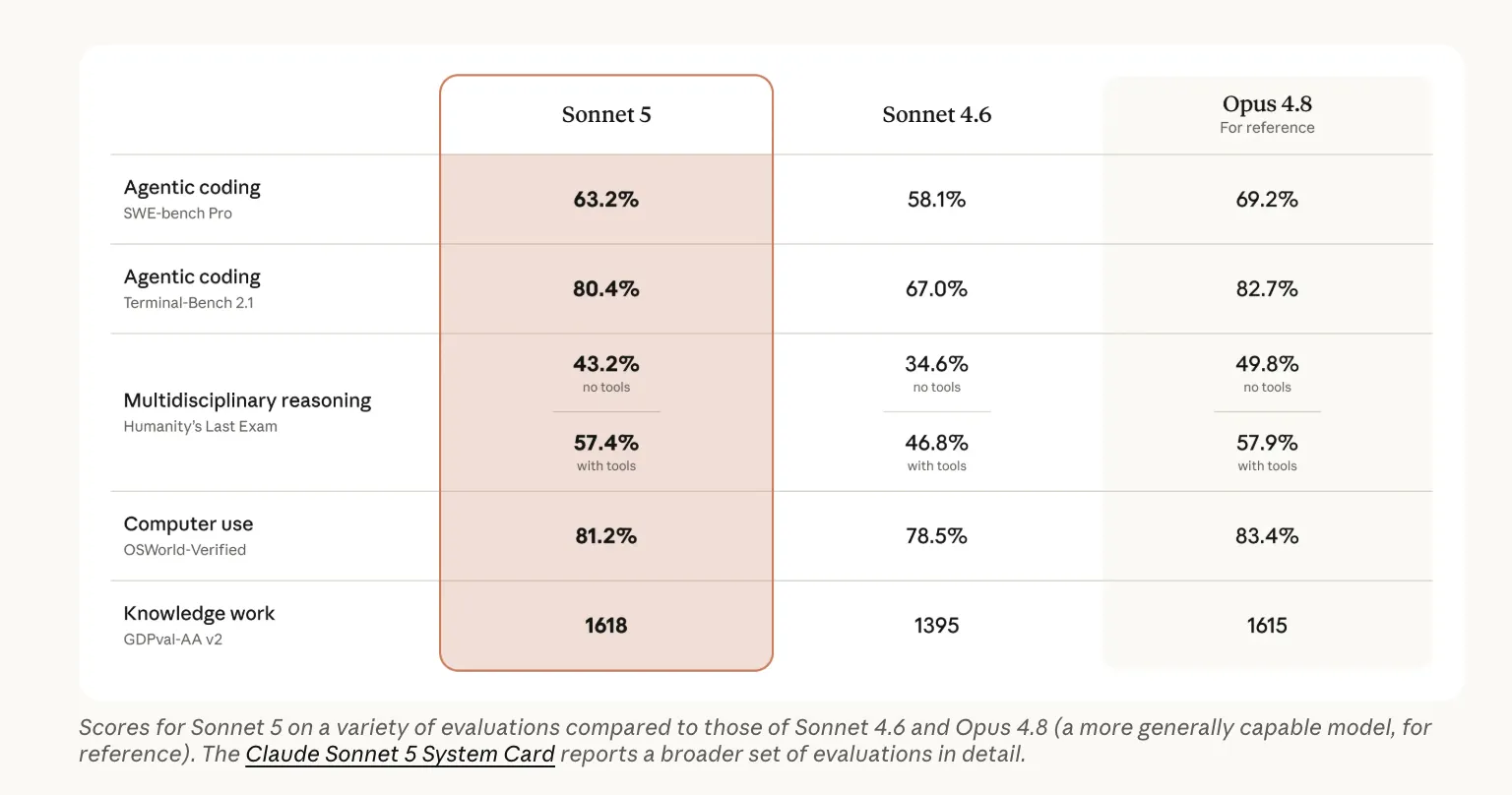
Anthropic just shipped Claude Sonnet 5. They call it its most agentic Sonnet model yet. It plans, drives browsers and terminals, and runs autonomously across long tasks. Sonnet 5 is the default model for Free and Pro plans today. Max, Team, and Enterprise users can select it. It is also live in Claude Code and on the Claude Platform. TL;DR Sonnet 5 is Anthropic’s most agentic mid-tier model, closing much of the gap to Opus 4.8. Beats Sonnet 4.6 on every published benchmark: 6