
StateBench measures how models track information
Hugging Face: StateBench: Testing how language models track state changes over long documents
Tracking state across extended text is crucial for real-world applications like document analysis and multi-turn reasoning.
Get smart on it
StateBench is a benchmark that measures how well language models track changes to information about entities across long documents. The benchmark matters because state tracking underlies important tasks like reading code where variables are reassigned and following narratives where objects and their locations change. Different model architectures have theoretical limits on state tracking, with transformers predicted to struggle on the most complex types while hybrid and recurrent models are designed to handle them better. Testing shows that frontier models perform well on simpler state-tracking problems but accuracy drops sharply on harder problems as documents grow longer, though models trained directly on state-tracking tasks show architectural differences in their ability to generalize beyond their training length.
Relevant courses
Want to go deeper than the news? Explore live, cohort-based AI courses taught by practitioners.
Browse AI courses on MavenRelated news

LifeVal
Introducing LifeVal, a benchmark measuring how well AI helps people complete everyday tasks, from finding childcare to managing finances and government paperwork.

GDPx: Measuring Frontier Model Capabilities Across the Most Valuable Domains
GDPx is a benchmark that covers the most valuable domains for frontier intelligence. It aims to be the world’s best benchmark for measuring general agentic capabilities.We believe the first trillion dollars of AI revenue will be concentrated in sectors that can deploy frontier intelligence at high ROI, not broadly diffused throughout the whole economy. Building a general-purpose benchmark based on share of GDP or the SOC/O*NET occupational taxonomy is therefore a mistake. If your goal is t
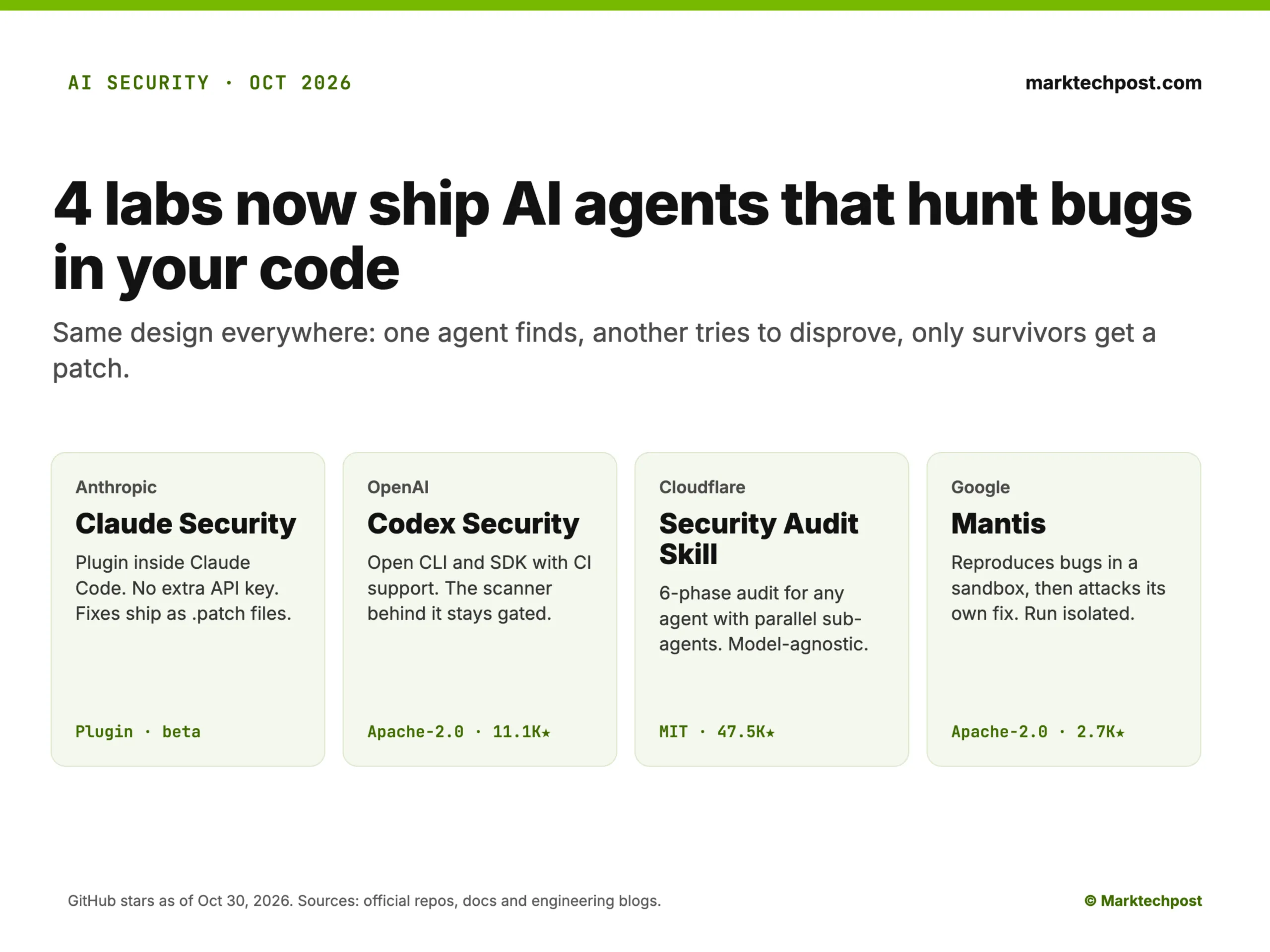
AI Security Agents Compared: Claude, Codex, Mantis, Cloudflare
Anthropic, OpenAI, Cloudflare and Google now each ship an AI agent that hunts security bugs in source code. We checked the repos, docs and technical details behind each one. The key finding: all 4 tools converge on one design. One agent finds a bug, a separate agent tries to disprove it, and only survivors get a patch. The differences are in where they run, who can use them and how much proof they demand. Key Takeaways 4 labs, 1 pattern: find, independently disprove, then patch. Cl
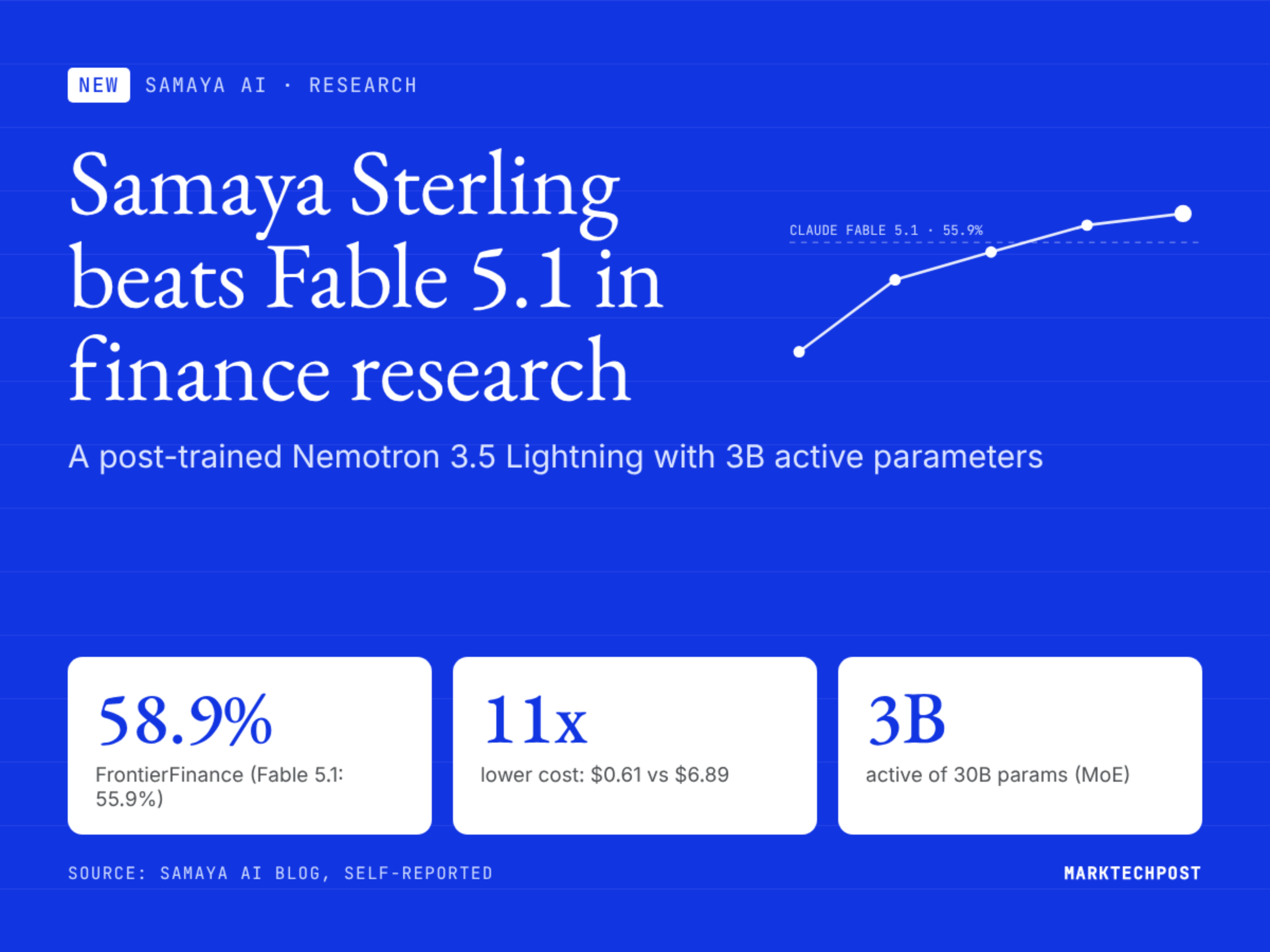
Samaya AI Releases Sterling: A 3B-Active Finance Research Agent Model that Beats Claude Fable 5.1 on FrontierFinance at 11x Lower Cost
Samaya AI has released Samaya Sterling, a post-trained model for agentic financial research. Sterling is built on NVIDIA’s Nemotron 3.5 Lightning, a 30B mixture-of-experts model with 3B active parameters. On Samaya’s FrontierFinance benchmark, it scores 58.9%. Claude Fable 5.1 scores 55.9%. Each Sterling question costs $0.61, against $6.89 for Fable 5.1. For developers, the takeaway is a concrete recipe: co-train a small model with its harness, and it can win in a narrow domain.

CWE-bench v2: More coverage, quality, and transparency
Better evaluation of software vulnerabilities helps developers identify and fix security flaws before they reach production.
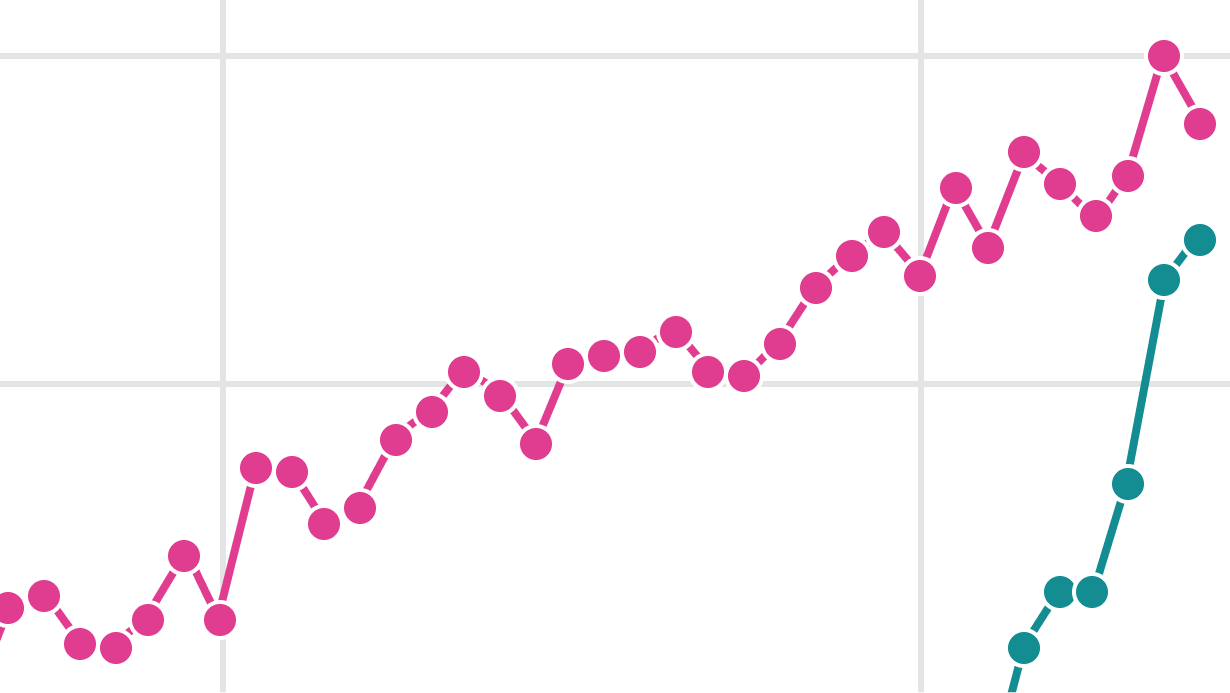
LLM use is acknowledged almost as often as specialized AI tools in biology preprints
17% of biology preprints acknowledge LLM use, nearly matching specialized tools like AlphaFold. Epoch AI analyzes trends in AI acknowledgment in research.