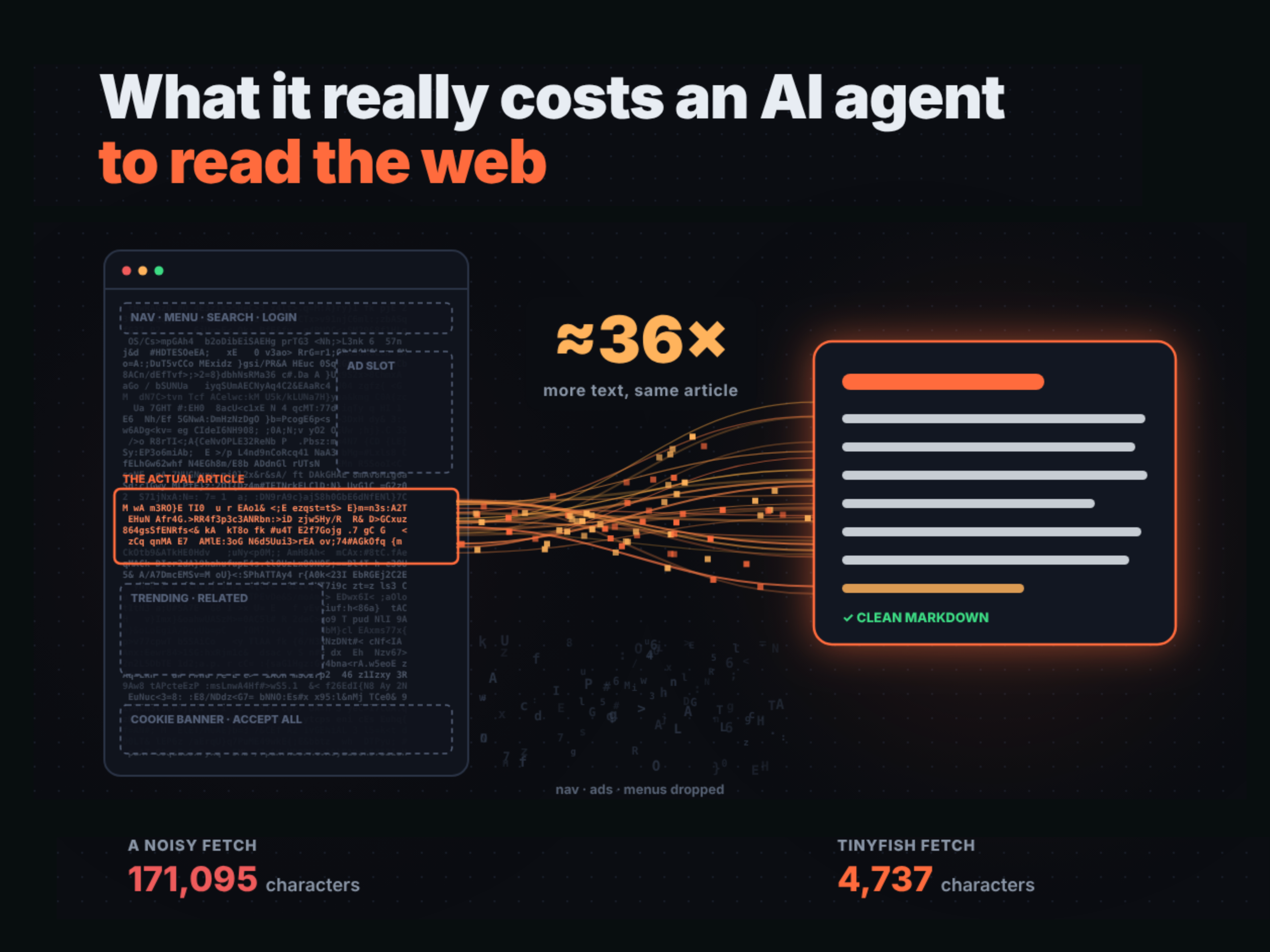
TinyFish Makes Search Free: What It Really Costs an AI Agent to Read the Web
An AI agent that reads the web pays 2 kinds of cost. The first is the retrieval charge: what a search or fetch API bills per request. The second is model processing: content passed from retrieved pages into an AI model consumes tokens, while reasoning and generated responses add further costs. TinyFish, a web infrastructure company for AI agents, argues that teams budget for the model and underestimate how much retrieved content drives it. This article walks through the token math, the conte
Get smart on it
When AI agents search the web, they pay two kinds of costs: fees for retrieving pages and fees for processing those pages as tokens through an AI model. A web infrastructure company has made its search and retrieval free within rate limits, arguing that teams underestimate how much the size of retrieved content drives model processing costs. The larger the web pages returned by a search provider, the more tokens consumed and the higher the downstream model bill, which matters because an agent looping through multiple pages can quickly exhaust a model's context window even with token caching. This approach trades lower retrieval charges for slower performance compared to some competitors, while reducing total cost per task.
Relevant courses
Want to go deeper than the news? Explore live, cohort-based AI courses taught by practitioners.
Browse AI courses on MavenRelated news

NVIDIA Advances Agentic Security for Media, From European Public Service Broadcasting to Global Content Production
At a creative industry event that took place today in Berlin — hosted in collaboration with Adobe, Bertelsmann, NVIDIA and UFA — the latest advancements in intelligent media were on display. Key to the news: the European Broadcasting Union (EBU) is collaborating with NVIDIA to expand its sovereign framework with cloud, open models and integration partners, while Adobe Frame.io is accelerating video agent search capabilities with NVIDIA GPUs, helping German TV and film producer UFA find the right

Disney agrees to hire the majority of Character.AI’s workforce
After chatbot startup Character.AI filed for bankruptcy earlier this week, many of its employees will have the opportunity to take jobs at Disney. Character.AI’s former CEO Karandeep Anand recently became the entertainment giant’s first CTO, and the startup previously said that Disney had agreed to acquire some of its assets for $20 million. A legal […]
Also reported by Wired AI and Ars Technica

Motive brings agentic AI to physical operations with agents that act before problems escalate
Motive Inc., the San Francisco-based artificial intelligence platform provider for physical operations, today announced the launch of Agents, a new capability that automatically responds to safety, maintenance and operational issues before they escalate into accidents, costly breakdowns or business disruptions. The new Agents platform moves beyond alerts to automatically contact drivers, initiate maintenance and coordinate […] The post Motive brings agentic AI to physical operations with a
Anthropic has nearly stopped hiring junior staff because AI agents now work six times as many hours
Anthropic is hiring fewer and fewer junior staff in technical roles. The share of junior positions among new hires dropped from 27 to 9 percent since early 2025. By August 2026, AI agents across the company were already logging six times as many hours as humans. Researchers warn of a "tragedy of the cognitive commons": if junior positions disappear, experienced specialists will be in short supply down the road. That is, assuming such specialists are even needed anymore. The article Anth

ChatGPT can peek at your Chrome tabs now
OpenAI's ChatGPT Atlas browser is gone, but now ChatGPT's Google Chrome extension is getting some upgrades that allow it to use the browser tabs you already have open. With the extension installed, OpenAI says ChatGPT can now view your browser tabs when you tag Chrome in ChatGPT's web or desktop app, posting a demo video showing someone asking ChatGPT to compare the three tabs they have open with sofas they're considering. A few big upgrades for Chrome users today! We're bring
Also reported by The Decoder

Bringing GPT-Rosalind to academic research labs
Introducing the Rosalind Academic Plan, offering eligible academic labs sponsored access to GPT-Rosalind and tools to advance life sciences research.
Also reported by The Decoder