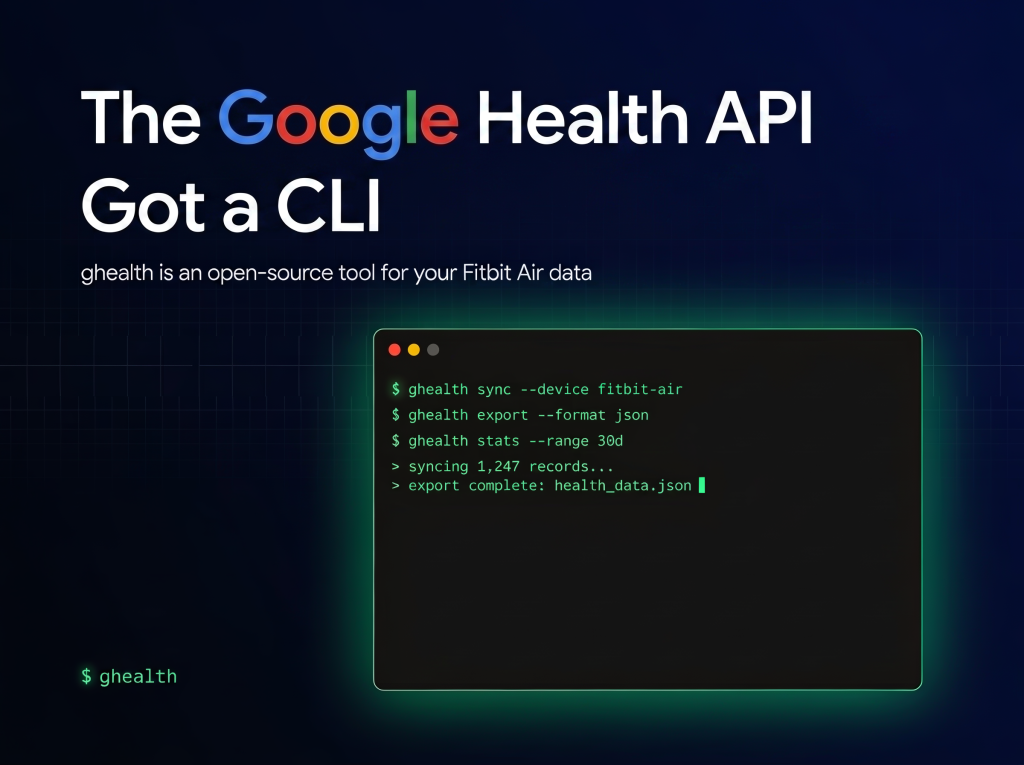
The Google Health API Got a CLI: ghealth is an Open-Source Tool for Your Fitbit Air Data
The Google Health API is the official successor to the Fitbit Web API. It targets the Google Health API v4 and moves developers onto Google OAuth 2.0. Now an open-source CLI command-line tool called ghealth wraps that API for terminals and AI agents. The tool is a single Go binary under the Apache 2.0 license. It exposes 40 verified data types as structured JSON. That design lets you pipe sleep, heart rate, and step data into an agent’s context. What is ghealth? ghealth is a wrap
Get smart on it
ghealth is an open-source command-line tool that wraps the Google Health API v4, which is the official successor to the Fitbit Web API. The tool exposes 40 verified data types as structured JSON, allowing developers and AI agents to access health data from Fitbit, Pixel Watch, and connected third-party sources through a simplified interface rather than directly using the raw API. ghealth matters because it reduces authentication and formatting boilerplate for terminal and agent use, providing deterministic exit codes and agent-first design patterns alongside documentation. The tool requires users to bring their own OAuth credentials and set up a Desktop-type OAuth client, with all Google Health API scopes classified as Restricted and requiring a privacy and security review for production access.
Related news

Anthropic wants to develop its own drugs
At the event "The Briefing: AI for Science" earlier this week, Anthropic announced Claude Science, a new "AI workbench for scientists" that pulls fragmented tools and datasets into one environment, and generates figures and visuals. Anthropic, already dominating the industry with its popular coding tools and powerful AI models, framed the launch around what it says is AI's potential to "dramatically accelerate the pace of scientific discovery and the development of healthcare i

A behind-the-scenes look at Midjourney’s medical scanner leaves many questions unanswered
A scan of an imaging phantom, segmented to validate how cleanly structures separate under controlled conditions. | Image: Midjourney Medical Midjourney has shown more of its futuristic medical scanner. It still hasn't shown much proof it works. The AI startup, best known for generating images, released a behind-the-scenes video of its dunk-tank ultrasound scanner, which it plans to deploy in spas and hopes will transform medicine with cheap, detailed, radiation-free imaging. Th