SensorFM: Towards a general intelligence and interface for wearable health data
Generative AI
Get smart on it
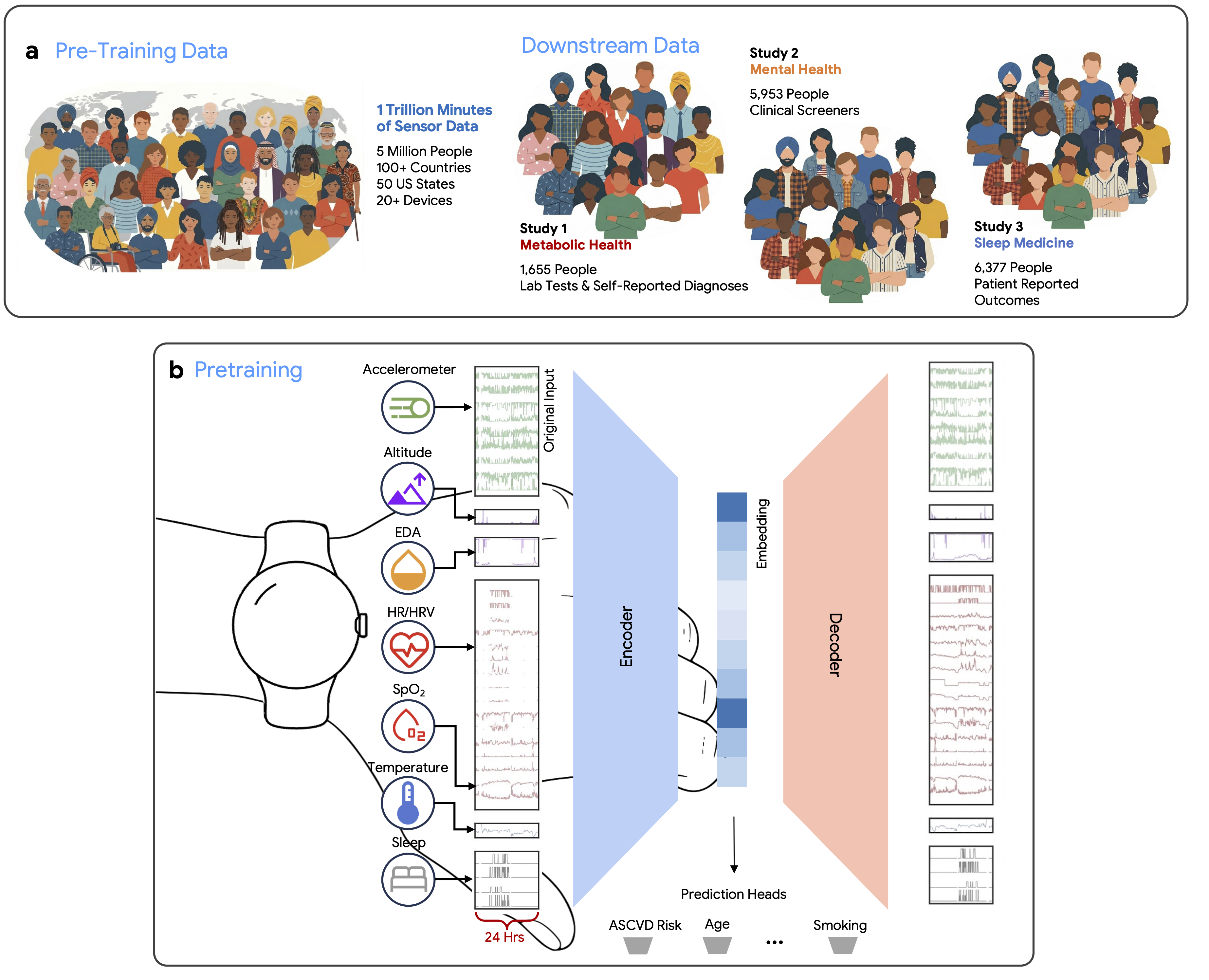
A foundation model called SensorFM has been trained on over one trillion minutes of wearable sensor data from five million people to learn general patterns of human physiology. The model addresses a key challenge in wearable health: that individuals' baseline physiology varies greatly, labeled health data is expensive to obtain, and most current models target only single health outcomes rather than generalizing broadly. SensorFM learns from unlabeled data using a method that treats missing or fragmented sensor readings as natural artifacts rather than problems to solve, and its learned representation transfers across 35 different health prediction tasks spanning cardiovascular, metabolic, sleep, and mental health domains. The research demonstrates that scaling both the model size and training data together produces consistent improvements in performance, with larger models increasingly capturing physiologically relevant traits without requiring explicit demographic information.
Related news

OpenAI says GPT 5.6 is the ‘preferred model’ for Microsoft Copilot 365 amid breakup chatter
OpenAI's new family of models will continue to power Microsoft's suite of workplace and productivity apps.
Meta Superintelligence Labs Releases Muse Spark 1.1: A Multimodal Reasoning Model for Agentic Tasks on Meta Model API
Today, Meta Superintelligence Labs released Muse Spark 1.1. Alongside it, Meta opened a public preview of the Meta Model API. That second part is the structural change. Meta’s models previously reached developers mainly as open weights. Muse Spark 1.1 is closed, hosted, and metered per token. So the question is narrow. Where does it belong in a stack you already run? What is Muse Spark 1.1? Meta describes it as a multimodal reasoning model built for agentic tasks. Reported gains ove