OpenAI Releases GPT-5.6 (Sol, Terra, Luna): A Three-Tier Model Family With Programmatic Tool Calling in the Responses API
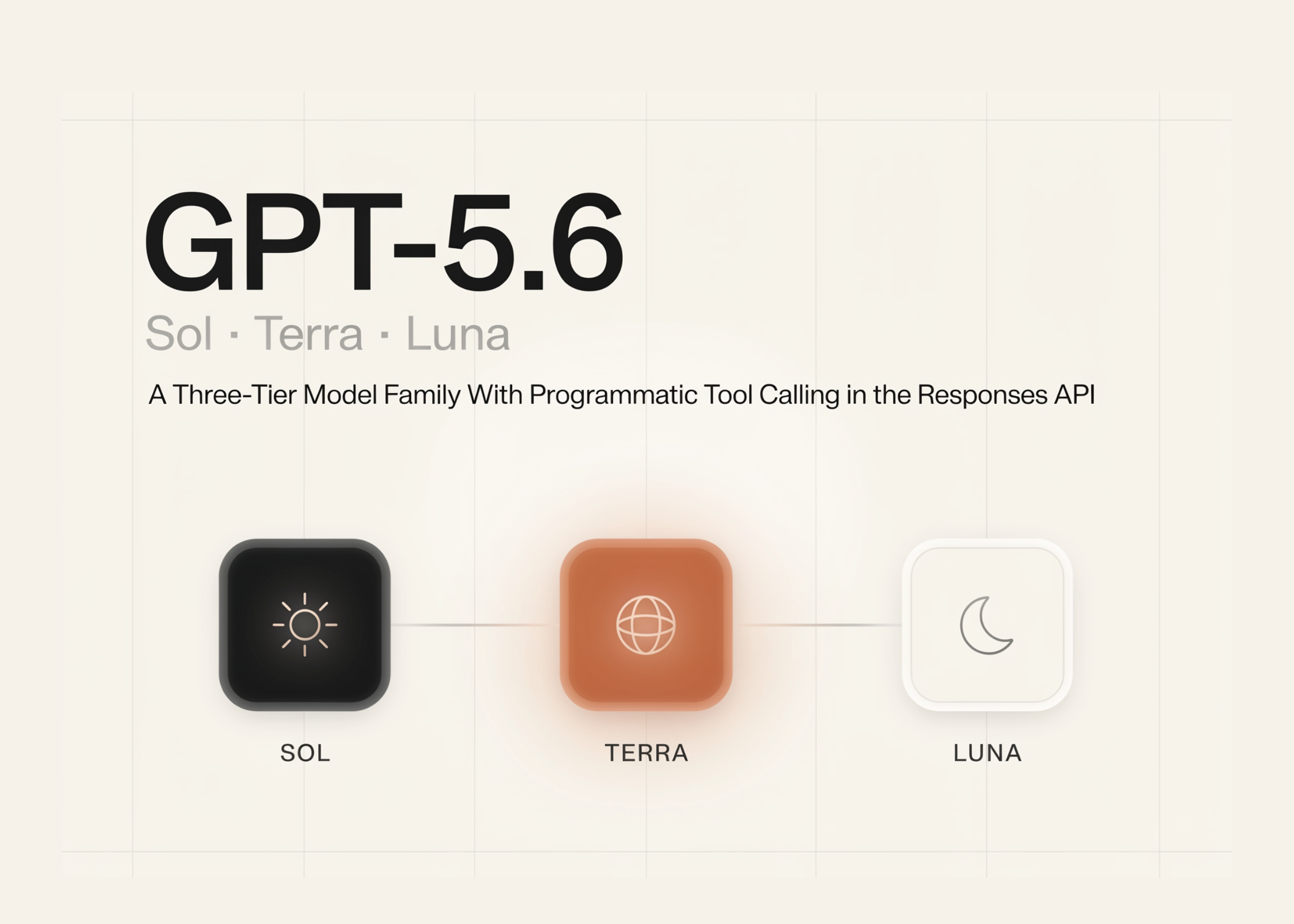
OpenAI just moved the GPT-5.6 family to general availability, following a limited preview. The release ships three models rather than one. Sol is the flagship, Terra is the balanced everyday tier, and Luna is the most cost-efficient. To sum up GPT-5.6 ships three tiers — Sol, Terra, Luna — priced from $1/$6 to $5/$30 per 1M tokens. Sol leads the Artificial Analysis Coding Agent Index at 80, 2.8 points above Claude Fable 5. Programmatic Tool Calling runs model-written JavaScript in
Get smart on it
OpenAI has released GPT-5.6, a family of three AI models at different capability and price tiers: Sol (flagship), Terra (balanced), and Luna (most cost-efficient). The release introduces Programmatic Tool Calling, a feature that runs model-written code in an isolated environment, and includes performance improvements across several coding and task benchmarks compared to previous versions. Sol leads on the Artificial Analysis Coding Agent Index and shows strong results on several evaluations, though it trails competing models on some widely-watched coding tests like SWE-Bench Pro and on general intelligence measures.
Related news

OpenAI says GPT 5.6 is the ‘preferred model’ for Microsoft Copilot 365 amid breakup chatter
OpenAI's new family of models will continue to power Microsoft's suite of workplace and productivity apps.
Meta Superintelligence Labs Releases Muse Spark 1.1: A Multimodal Reasoning Model for Agentic Tasks on Meta Model API
Today, Meta Superintelligence Labs released Muse Spark 1.1. Alongside it, Meta opened a public preview of the Meta Model API. That second part is the structural change. Meta’s models previously reached developers mainly as open weights. Muse Spark 1.1 is closed, hosted, and metered per token. So the question is narrow. Where does it belong in a stack you already run? What is Muse Spark 1.1? Meta describes it as a multimodal reasoning model built for agentic tasks. Reported gains ove