Meet Nemotron Labs 3 Puzzle 75B A9B: A Compressed Hybrid MoE LLM Delivering 2.03x Server Throughput
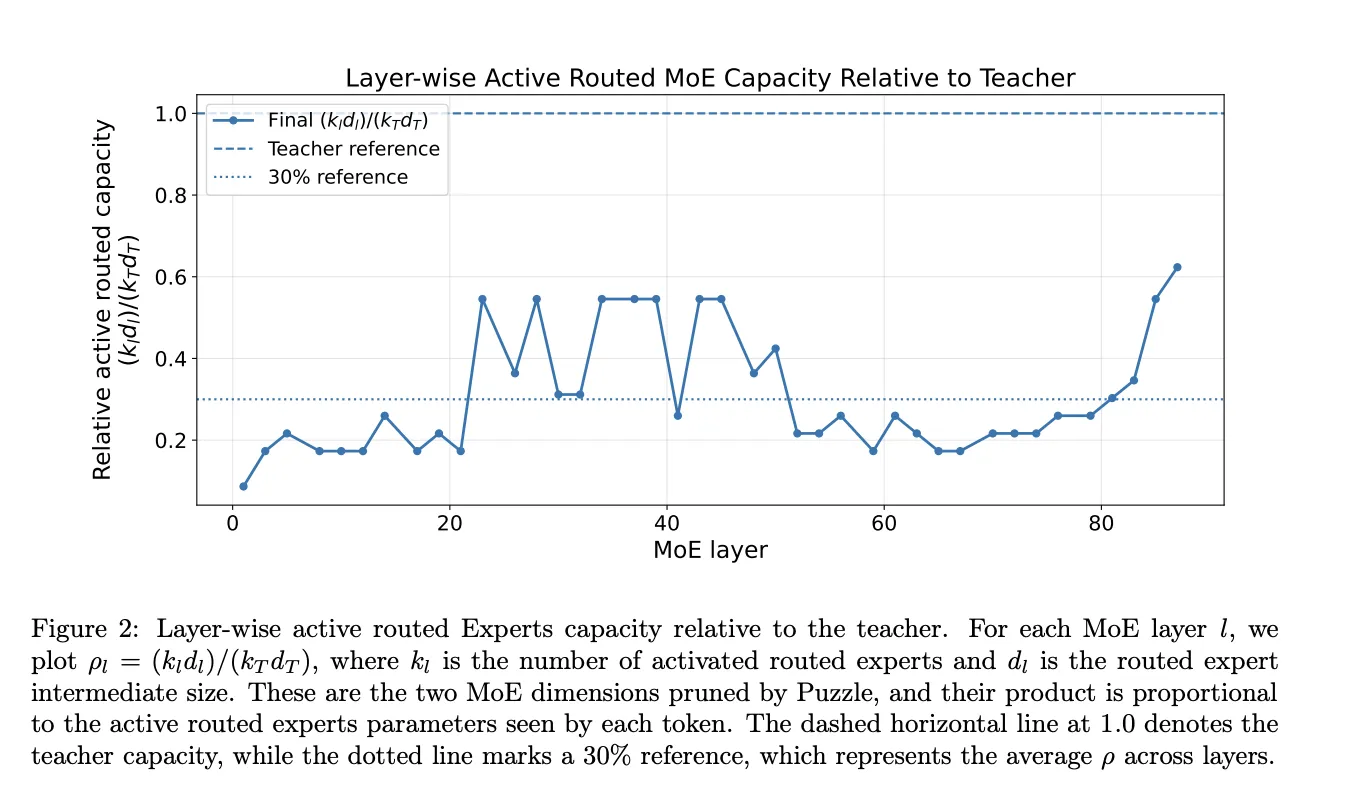
Large hybrid MoE models like Nemotron-3-Super are accurate but expensive to serve. Their active parameters, KV cache, and Mamba state cap how many users a node can hold at a given per-user token rate. NVIDIA AI team has released Nemotron-Labs-3-Puzzle-75B-A9B, a compressed variant of Nemotron-3-Super. The parent model has 120.7B total and 12.8B active parameters. The compressed model has 75.3B total and 9.3B active parameters. The deployment target was fixed before the architecture search be
Get smart on it
A compressed hybrid MoE language model has been released that reduces the total and active parameters of its parent model while preserving the same 88-block architecture. The compression matters because it enables significantly higher server throughput, with gains ranging from 1.60x to 2.14x on multi-GPU nodes and allowing a single GPU to handle 8 concurrent large-context requests instead of 1. The model was created using an iterative neural architecture search framework that selectively pruned different layer types at varying depths rather than uniformly scaling down the original, then recovered quality through knowledge distillation across multiple stages.
Related news

OpenAI says GPT 5.6 is the ‘preferred model’ for Microsoft Copilot 365 amid breakup chatter
OpenAI's new family of models will continue to power Microsoft's suite of workplace and productivity apps.
Meta Superintelligence Labs Releases Muse Spark 1.1: A Multimodal Reasoning Model for Agentic Tasks on Meta Model API
Today, Meta Superintelligence Labs released Muse Spark 1.1. Alongside it, Meta opened a public preview of the Meta Model API. That second part is the structural change. Meta’s models previously reached developers mainly as open weights. Muse Spark 1.1 is closed, hosted, and metered per token. So the question is narrow. Where does it belong in a stack you already run? What is Muse Spark 1.1? Meta describes it as a multimodal reasoning model built for agentic tasks. Reported gains ove