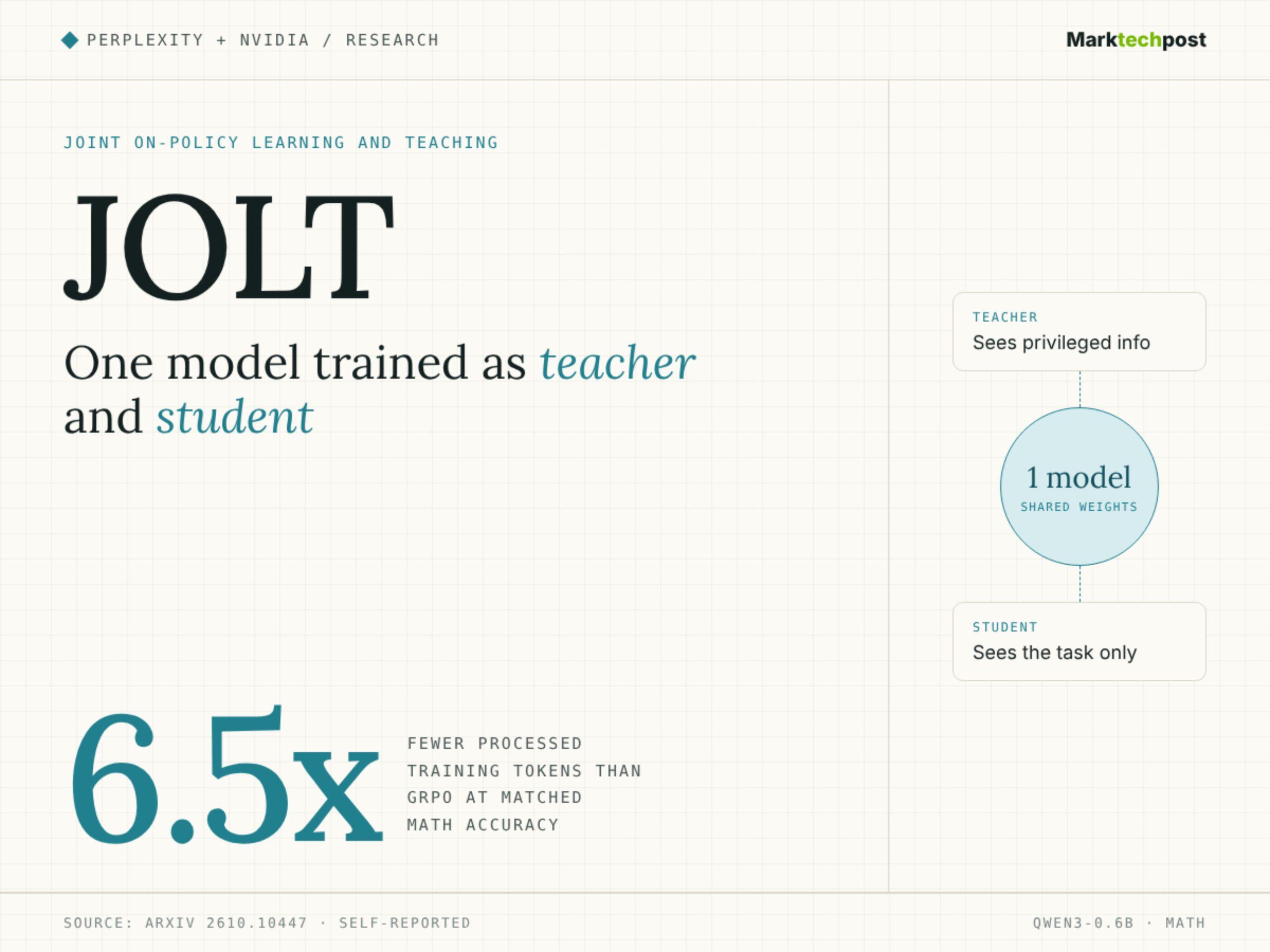
Perplexity and NVIDIA introduce JOLT language model training method
MarkTechPost: Perplexity and NVIDIA Researchers Introduce JOLT: a Joint Teacher-Student Reinforcement Learning Method
Perplexity, along with NVIDIA team, has introduced JOLT, a new post-training method for language models. JOLT stands for Joint On-policy Learning and Teaching. It trains a single model in 2 roles. The teacher sees privileged information; the student does not. The key change is that the teacher is trained too, so its feedback stays usable. On MATH, JOLT matched GRPO’s accuracy with 6.5x fewer processed training tokens. For teams running RL post-training, that is a direct compute question.
Get smart on it
JOLT is a post-training method that trains a single language model in two simultaneous roles: a teacher that receives privileged information like verified answers, and a student that sees only the task. The method addresses a limitation in outcome-reward reinforcement learning, which provides sparse feedback that does not indicate which specific tokens helped the model succeed. JOLT trains both roles together, with the teacher learning from outcome rewards plus a penalty keeping it aligned with the student, while the student learns from the teacher's token-level guidance. In testing on mathematical problem-solving, JOLT achieved the same accuracy as a competing method called GRPO while using 6.5 times fewer processed training tokens, which represents a direct reduction in computational cost.
Relevant courses
Want to go deeper than the news? Explore live, cohort-based AI courses taught by practitioners.
Browse AI courses on MavenRelated news

Mistral AI launches Voxtral 3, a full voice agent stack that listens, thinks, and talks in real time
Mistral AI launched Voxtral 3, a new family of language models built for real-time voice agents. The system combines speech-to-text, text-to-speech, and a voice agent SDK, supports more than 50 languages, and lets agents tap into external tools during live conversations. It can run on your own infrastructure or through EU-hosted APIs to keep data under your control. The article Mistral AI launches Voxtral 3, a full voice agent stack that listens, thinks, and talks in real time appeared
Also reported by MarkTechPost

Recursive launches Flint, a laptop coding model it says was largely built by AI
Startup Recursive has released Flint, a free, laptop-sized coding model built largely by its own AI research system, as an early test of AI that improves itself.
Also reported by Wired AI and MarkTechPost

NVIDIA Cosmos Opens New Tools to Train, Evaluate and Deploy World Models
To help developers rapidly build world models, which help physical AI systems understand and simulate the real world, NVIDIA has expanded the Cosmos platform with new training tools, simulation checkpoints and Cosmos Data Factory blueprints. Ranking top five on six different open models leaderboards, the NVIDIA Cosmos platform gives world model builders the frontier open models — as well as data, training and optimization tools and recipes — to scale training data, adapt models, test behavior a

Voxtral 3
Voxtral 3: Mistral's voice agent SDK for real-time speech in 50+ languages — accurate transcription, emotional TTS, deep tool use. EU-hosted or self-deployed.
Granite Speech 5.0: Transcribe, Translate, and Attribute more Accurately and Faster
Faster, more accurate speech processing could reduce costs and errors for businesses handling multilingual customer interactions and audio archives.
Also reported by MarkTechPost
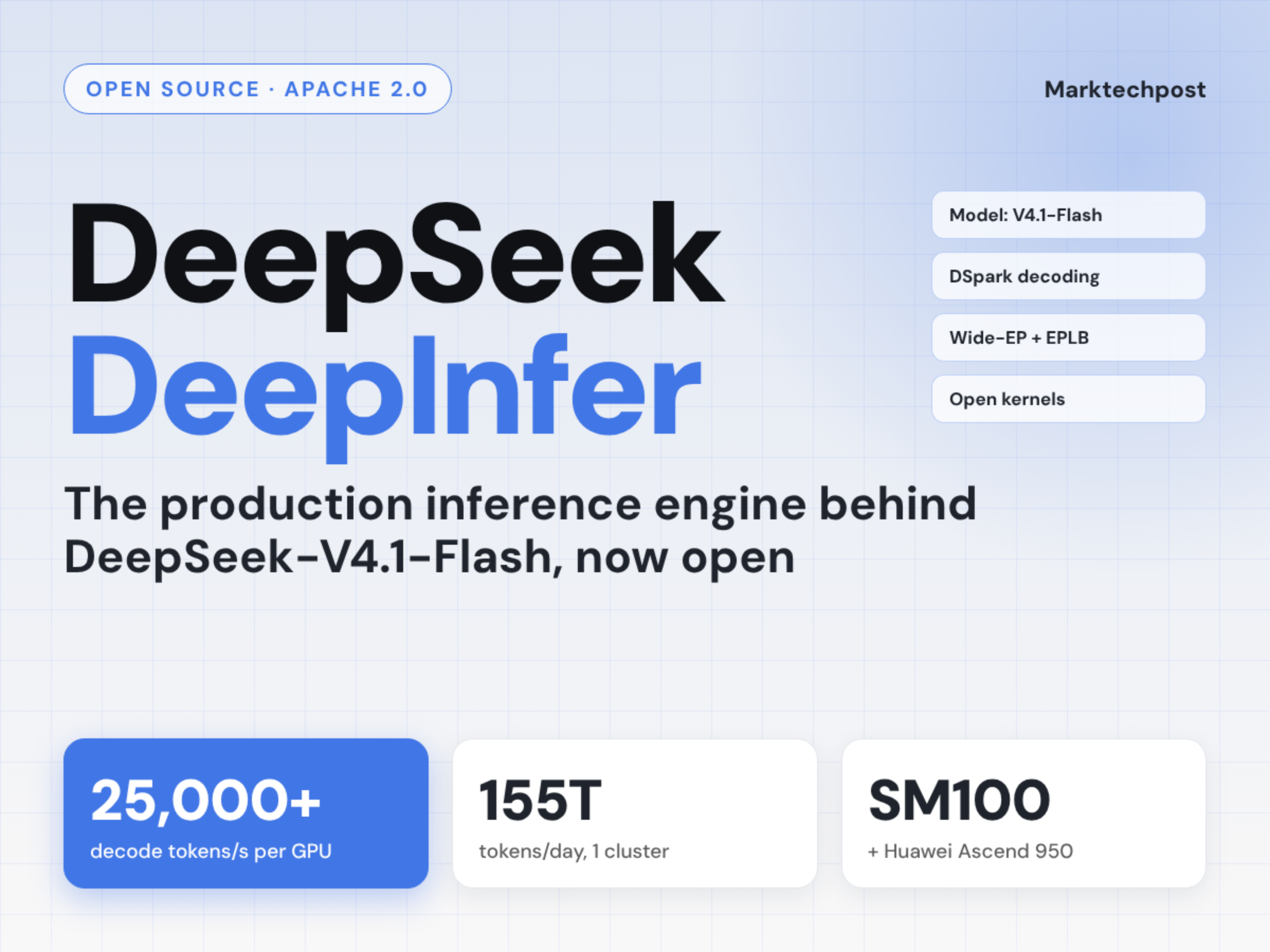
DeepSeek Open-Sources DeepInfer, the Inference Framework Behind DeepSeek-V4.1-Flash
DeepSeek has open-sourced DeepInfer, the inference framework that runs its production services. The DeepSeek DeepInfer inference framework is the engine behind DeepSeek-V4.1-Flash. It ships under the Apache 2.0 license. DeepSeek also released deepseek-recipe, its MIT-licensed token encoding and decoding layer. For developers, this is a rare look at a frontier lab’s real serving stack. TL;DR Size / scope: 1 supported model (DeepSeek-V4.1-Flash), 1M-token context window per the model
Also reported by The Decoder and SiliconANGLE