IBM releases updated Granite speech models
Hugging Face: Granite Speech 5.0: Transcribe, Translate, and Attribute more Accurately and Faster
Faster, more accurate speech processing could reduce costs and errors for businesses handling multilingual customer interactions and audio archives.
Get smart on it
IBM released three updated speech recognition models that handle transcription, translation, and speaker identification. The new models cover different use cases: one prioritizes accuracy and translation capability, one emphasizes speed for edge computing, and one specializes in multi-speaker recordings like meetings and calls. These models were trained on hundreds of thousands of hours of audio and can process multiple languages including English, French, German, Spanish, Portuguese, Japanese, Italian, and Mandarin. The improvements include better noise handling, native punctuation and capitalization, more accurate speaker attribution, and support for keyword biasing to recognize specific terms.
Relevant courses
Want to go deeper than the news? Explore live, cohort-based AI courses taught by practitioners.
Browse AI courses on MavenRelated news

Mistral AI launches Voxtral 3, a full voice agent stack that listens, thinks, and talks in real time
Mistral AI launched Voxtral 3, a new family of language models built for real-time voice agents. The system combines speech-to-text, text-to-speech, and a voice agent SDK, supports more than 50 languages, and lets agents tap into external tools during live conversations. It can run on your own infrastructure or through EU-hosted APIs to keep data under your control. The article Mistral AI launches Voxtral 3, a full voice agent stack that listens, thinks, and talks in real time appeared
Also reported by MarkTechPost

Voxtral 3
Voxtral 3: Mistral's voice agent SDK for real-time speech in 50+ languages — accurate transcription, emotional TTS, deep tool use. EU-hosted or self-deployed.

This Startup Is All In on Recursive Self-Improvement. Its Latest Model Is Scary Good
Recursive makes the case that the benefits of using AI to build AI outweigh the risks.
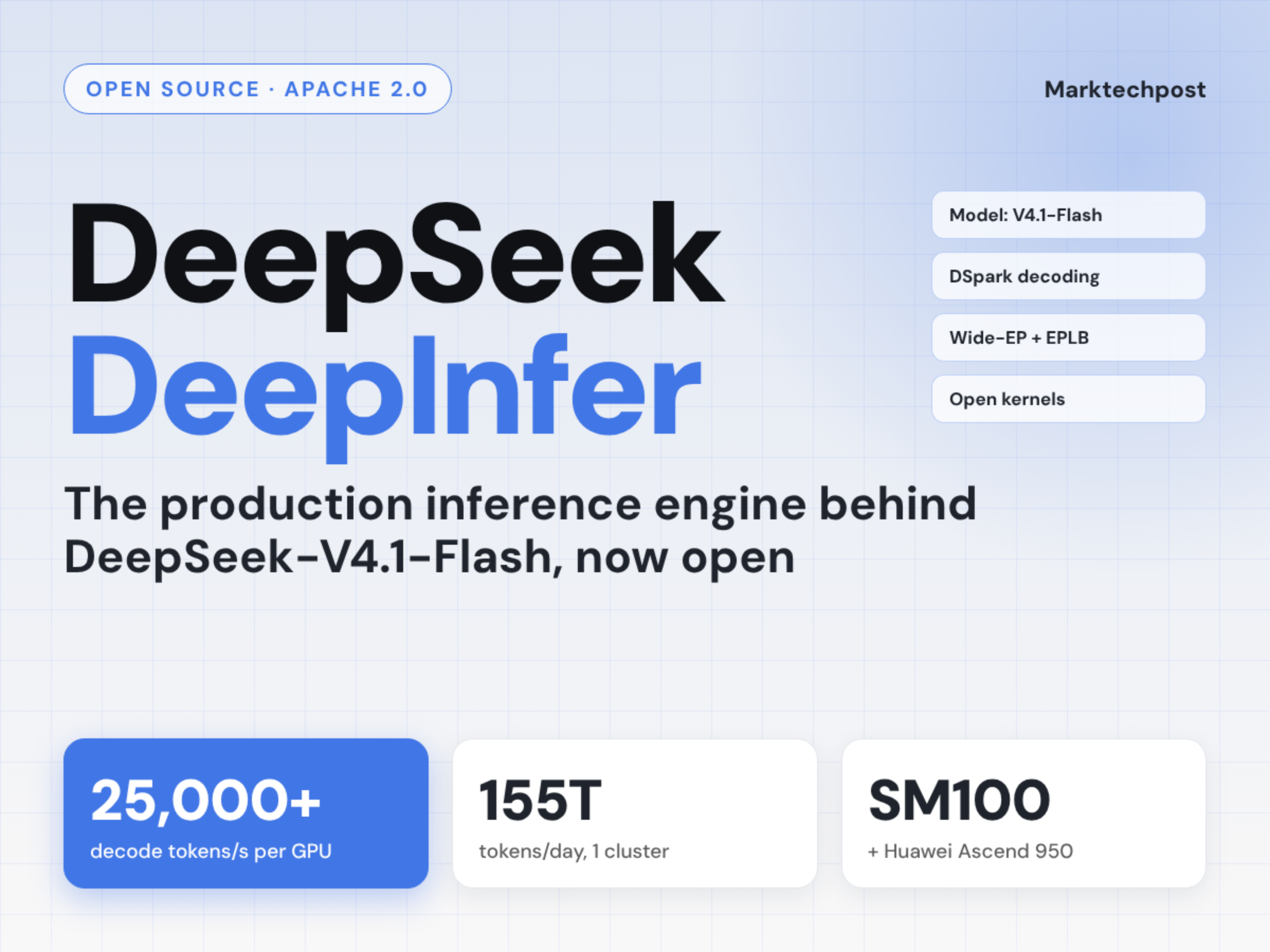
DeepSeek Open-Sources DeepInfer, the Inference Framework Behind DeepSeek-V4.1-Flash
DeepSeek has open-sourced DeepInfer, the inference framework that runs its production services. The DeepSeek DeepInfer inference framework is the engine behind DeepSeek-V4.1-Flash. It ships under the Apache 2.0 license. DeepSeek also released deepseek-recipe, its MIT-licensed token encoding and decoding layer. For developers, this is a rare look at a frontier lab’s real serving stack. TL;DR Size / scope: 1 supported model (DeepSeek-V4.1-Flash), 1M-token context window per the model
Also reported by The Decoder and SiliconANGLE

Nvidia launches new open models to run agents in the enterprise and on PCs
Nvidia is leaning hard into the trend of enterprise companies wanting to run their own open models in their own data centers and also trying to make on-device, private AI agents a thing.

NVIDIA Open Models Advance Europe’s Sovereign Intelligence Across Industries
NVIDIA is expanding its family of open models across language, robotics, biology, and quantum computing, giving developers, researchers and enterprises what they need to build applications tailored to local languages and industries The portfolio includes the new NVIDIA Nemotron 3.5 Super VL and Nemotron 3.5 Bolt models; new NVIDIA Nemotron Retriever models for embedding, reranking and document parsing; the new NVIDIA Kumo family open weight foundation models and libraries for structured business