OpenAI Releases GPT-6 Astra: A 1.05M-Context Computer-Use Model Gated Behind a ‘Critical’ Cyber Threshold
Today, OpenAI released GPT-6 Astra. The company calls it its most intelligent and aligned model, and positions it primarily as a computer-use system rather than a chat model. The pitch is that Astra operates software the way a person does, across browsers, spreadsheets, desktop applications and terminals, and finishes multi-step jobs instead of describing how to do them. Is it deployable? Partly, and not on your own hardware. Astra is a closed, hosted model with no released weights, so self
Make your prediction
Will OpenAI publish a system card for GPT-6 Astra by September 11, 2026?
Resolves by Sep 11, 2026
Your prediction
50% · 50/50 coin flip
NOYES
Get smart on it
OpenAI released a new model designed primarily to operate software by performing multi-step tasks across browsers, spreadsheets, applications, and terminals rather than simply describing how to complete them. The model handles context differently than previous versions by keeping detailed notes across long conversations instead of summarizing and discarding information, which allows it to retain details about failed fixes and earlier requirements. Access to the model is restricted to organizations in OpenAI's trusted programs because it has demonstrated cybersecurity capabilities classified as "critical," including the ability to discover exploits for hardened systems, and standard users face limitations on accessing advanced cybersecurity work. The model has a 1.05-million-token context window and costs $10 per million input tokens and $50 per million output tokens.
Related news
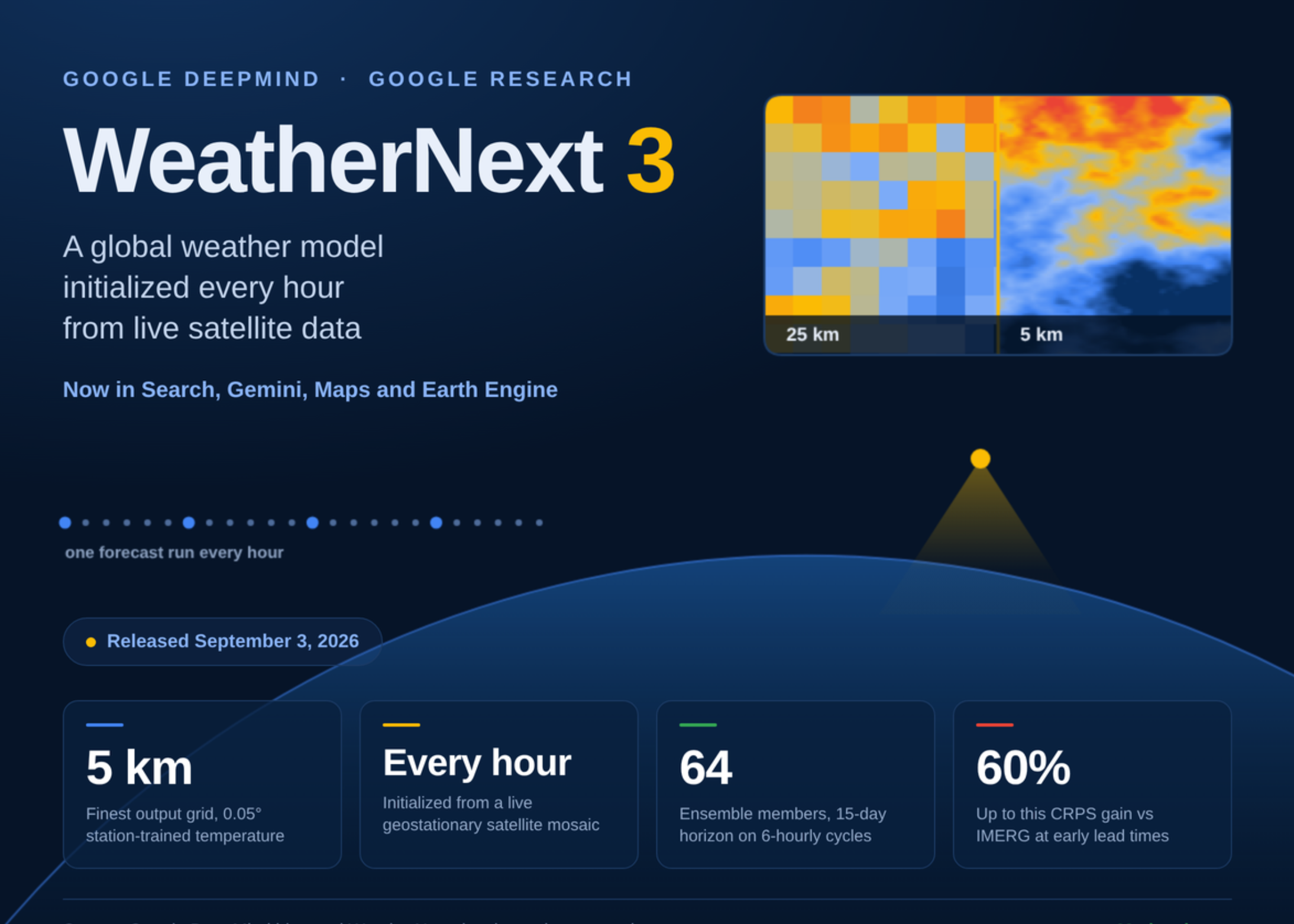
Google DeepMind’s WeatherNext 3 Trains on Weather Station Observations to Deliver 5 km Global Forecasts, Refreshed Every Hour
AI weather models have spent three years closing the gap with physics-based forecasting, but two problems stayed open: resolution too coarse for local terrain, and initialization tied to numerical weather prediction (NWP) analysis that arrives about six hours late. WeatherNext 3, released by Google DeepMind and Google Research, attacks both. It takes a live global geostationary satellite mosaic as a direct model input, re-initializes every hour, and emits forecasts down to 0.05° (~5 km) while t

GPT-6 Astra Is Here, and OpenAI Thinks It May Kick Off the AGI Era
OpenAI leaders think the company’s next generation model, which excels at computer use and coding, may mark a major milestone in AI development.