Meta AI Releases Brain2Qwerty v2: A Non-Invasive MEG Brain-to-Text Pipeline Decoding Typed Sentences at 61% Word Accuracy
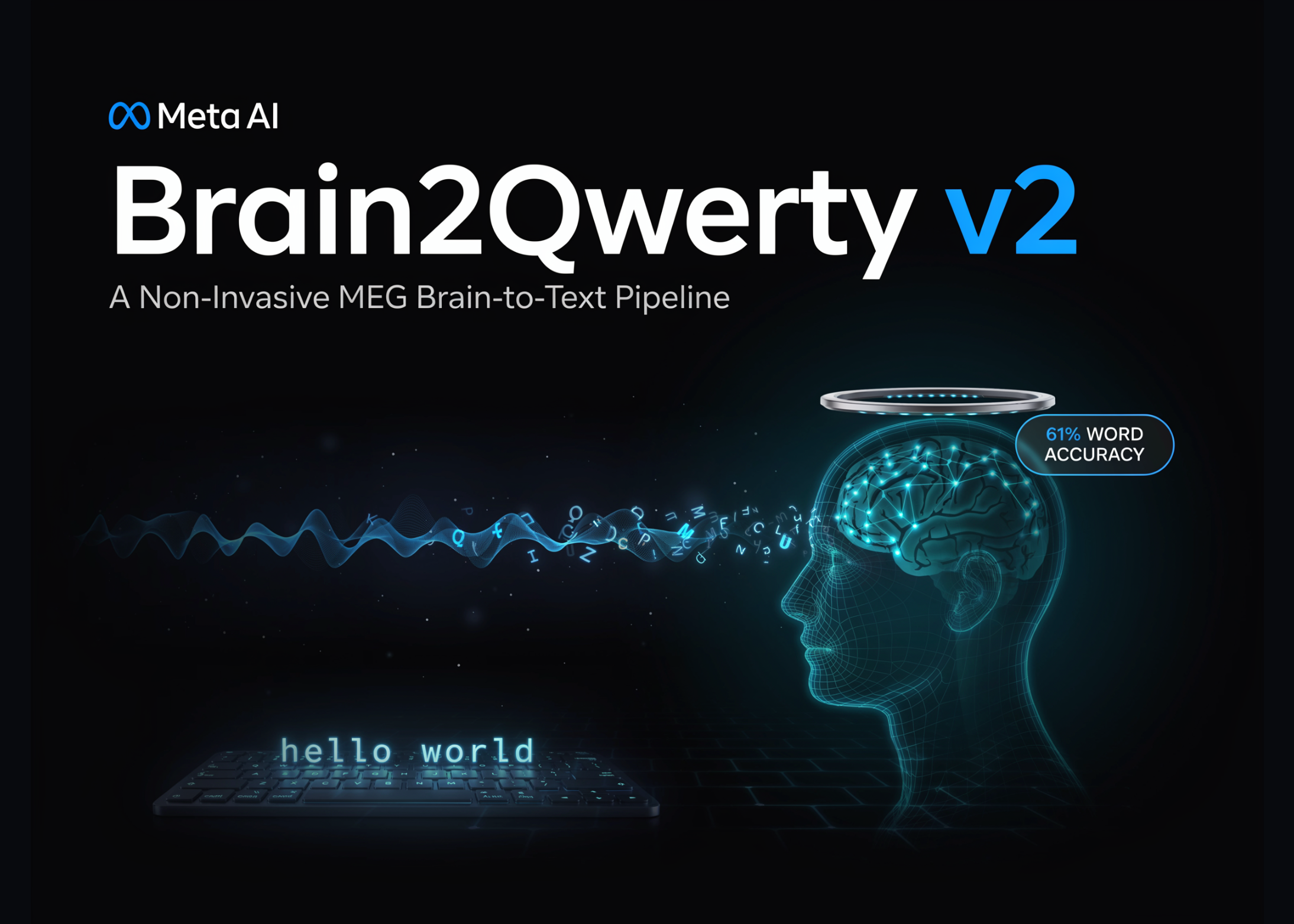
Meta AI just introduced Brain2Qwerty v2. It decodes natural sentences from non-invasive brain recordings in real time. The system reads magnetoencephalography (MEG) signals while a person types. It reconstructs what they typed, with no implant and no surgery. This is the follow-up to Brain2Qwerty v1, released in February 2025. Meta is also releasing the full training code for both versions. The pipeline combines a convolutional encoder, a transformer, and a character-level language model. TL
Get smart on it
Brain2Qwerty v2 is a system that decodes what a person is typing by reading non-invasive brain signals called magnetoencephalography (MEG), without requiring surgery or implants. The system achieved 61% average word accuracy in decoding typed sentences, a major improvement over the 8% accuracy of prior non-invasive methods. It works by combining three components: a convolutional encoder that processes raw brain signals, a transformer that models longer-range patterns, and a language model that constrains output toward plausible text. This matters because it could eventually help people with brain injuries restore communication abilities, though the current system is research tested on a small group of volunteers rather than a consumer product or clinical treatment.
Related news

Vibe coding platform Base44 launches own model as AI startups seek defensibility
Wix-owned vibe coding platform Base44 has started rolling out its own AI model — with hopes that it will eventually outperform frontier models.

DiScoFormer: One transformer for density and score, across distributions
DiScoFormer is a transformer model that estimates both the density and score of a data distribution in a single forward pass without requiring retraining for new distributions. The density describes where data points cluster, while the score, the gradient of log-density, points toward more probable regions and is used in diffusion-based generative models, Bayesian sampling, and scientific simulations. Existing methods force a trade-off: classical kernel density estimation works on any distribution but loses accuracy in high dimensions, while neural score-matching models stay accurate in high dimensions but must be retrained for each new distribution. DiScoFormer significantly outperforms kernel density estimation, cutting score error by 6.5 times and density error by more than 37 times in 100 dimensions, while generalizing to distributions with shapes and complexities not seen during training.