DeepReinforce Open Sources Ornith-1.0 Coding Models - Open Source For You
DeepReinforce has open sourced its Ornith-1.0 coding model family, releasing model weights and research on Hugging Face to help developers build, study and
Get smart on it
A company has open-sourced a family of coding models called Ornith-1.0, ranging from a compact 9 billion parameter model to a much larger 397 billion parameter model, and made the model weights and technical details available for developers and researchers to study and build upon. The models use a reinforcement learning approach where the AI generates both coding solutions and the instructions that guide them, allowing task-specific strategies to develop automatically rather than being manually designed. According to the company, the largest model matches the performance of a leading commercial model on coding benchmarks while outperforming other open-source alternatives, and the smallest model performs competitively even on devices with limited computing resources. The company has implemented safeguards against reward hacking, including an isolated execution environment, monitoring for attempts to game the system, and a frozen AI judge that can override verification mechanisms when suspicious behavior is detected.
Related news

China’s Z.ai claims it can match Mythos on cybersecurity
China's Zhipu AI (Z.ai) released its open-weight GLM-5.2, and some researchers have claimed that it matches Mythos in certain bug-finding and cybersecurity scenarios. While GLM lags behind models from Anthropic and OpenAI in other, more general tasks, it seems that China has dramatically reduced the gap in the capabilities between its models and those of the US. This level of advancement is particularly concerning to the US government, which has worked to restrict China's acces
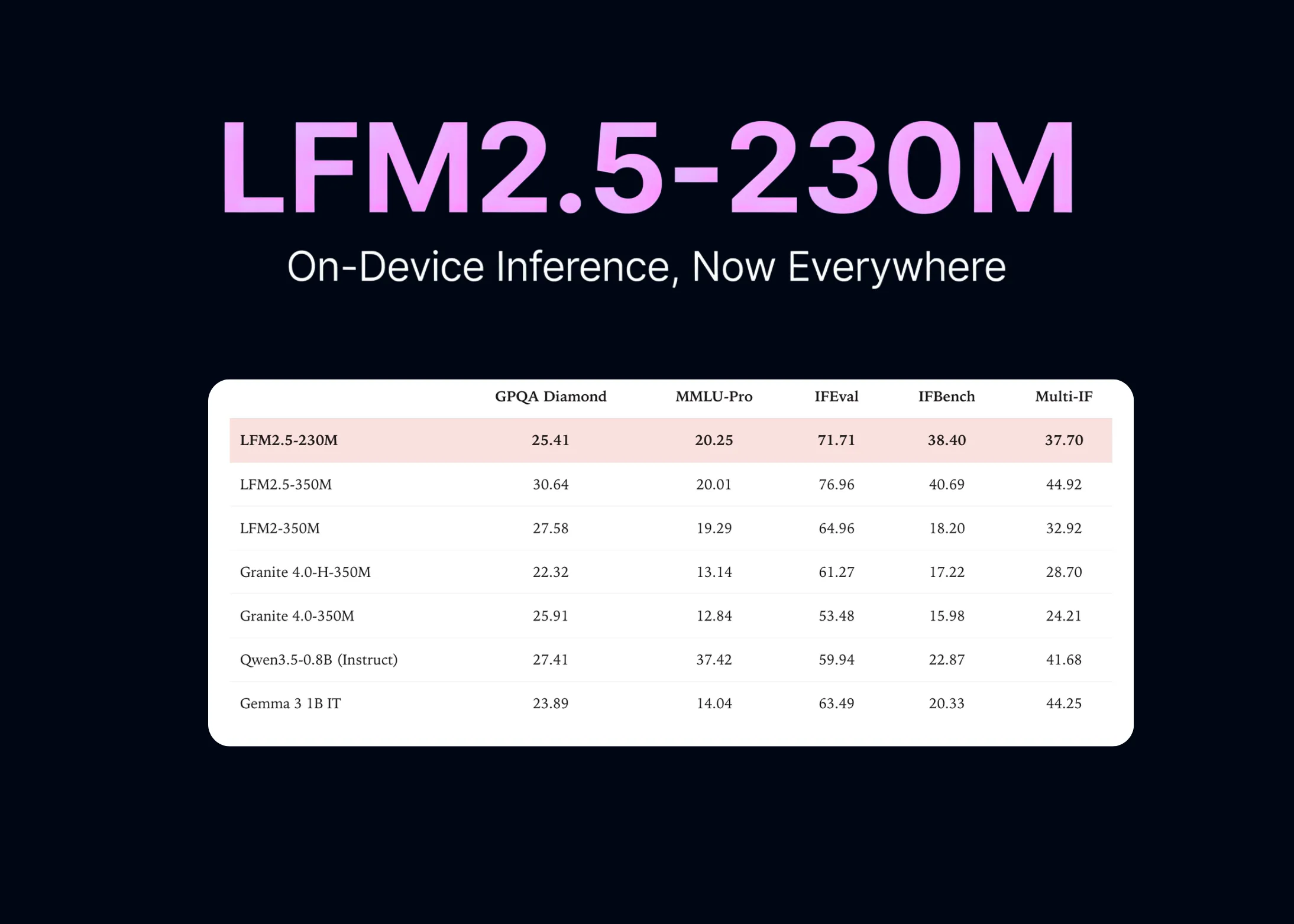
Liquid AI Ships LFM2.5-230M with llama.cpp, MLX, vLLM, SGLang, and ONNX Support for On-Device Inference
Liquid AI shipped LFM2.5-230M, it’s the company’s smallest model to date. The release targets a specific job: running agentic tasks on phones, robots, and automation devices. Both the base and instruction-tuned checkpoints are open-weight on Hugging Face. The pitch is narrow on purpose. This is not a general reasoning model. It is built for data extraction and tool use on edge hardware. TL;DR Liquid AI’s LFM2.5-230M is its smallest model yet: 230M params, open-weight