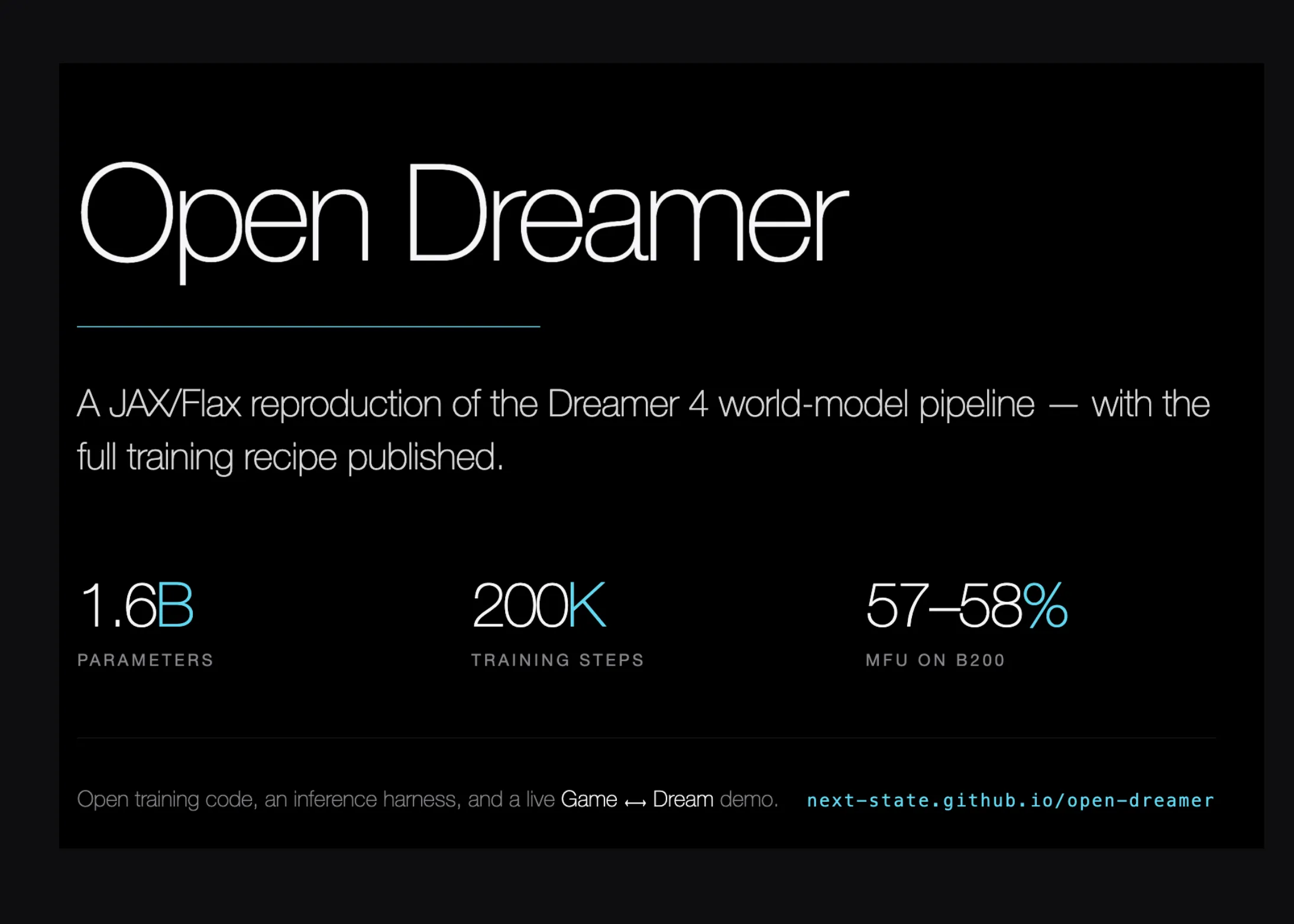
Meet Open Dreamer: A JAX/Flax Reproduction of the Dreamer 4 World Model Pipeline, With the Full Training Recipe Published
A small group of AI researchers (Reactor) have released Open Dreamer, an open implementation of the Dreamer 4 world-model pipeline written in JAX and Flax NNX. What actually shipped Two repositories were released. next-state/open-dreamer holds the training pipeline: a causal video tokenizer, an action-conditioned latent dynamics model, rollout generation, and FVD scoring. reactor-team/open-dreamer holds a minimal local rollout harness that generates frames from an MP4 and a matching acti
Make your prediction
Will the Open Dreamer GitHub repository reach 500 stars by August 9, 2026?
Resolves by Aug 9, 2026
Your prediction
50% · 50/50 coin flip
NOYES
Get smart on it
A group of AI researchers released Open Dreamer, an open-source implementation of the Dreamer 4 world-model pipeline written in JAX and Flax NNX that can generate video frames from games like Minecraft. The project includes training code for the full pipeline, a local inference tool, and a browser demo that streams generated gameplay in real time. The researchers documented that stability during training was the primary challenge rather than computational efficiency, with most generation-quality problems occurring despite loss metrics improving smoothly. The work provides the complete training recipe and configuration details needed to reproduce the Dreamer 4 research, though it does not include reinforcement learning or behavior-cloning agent training loops.
Related news
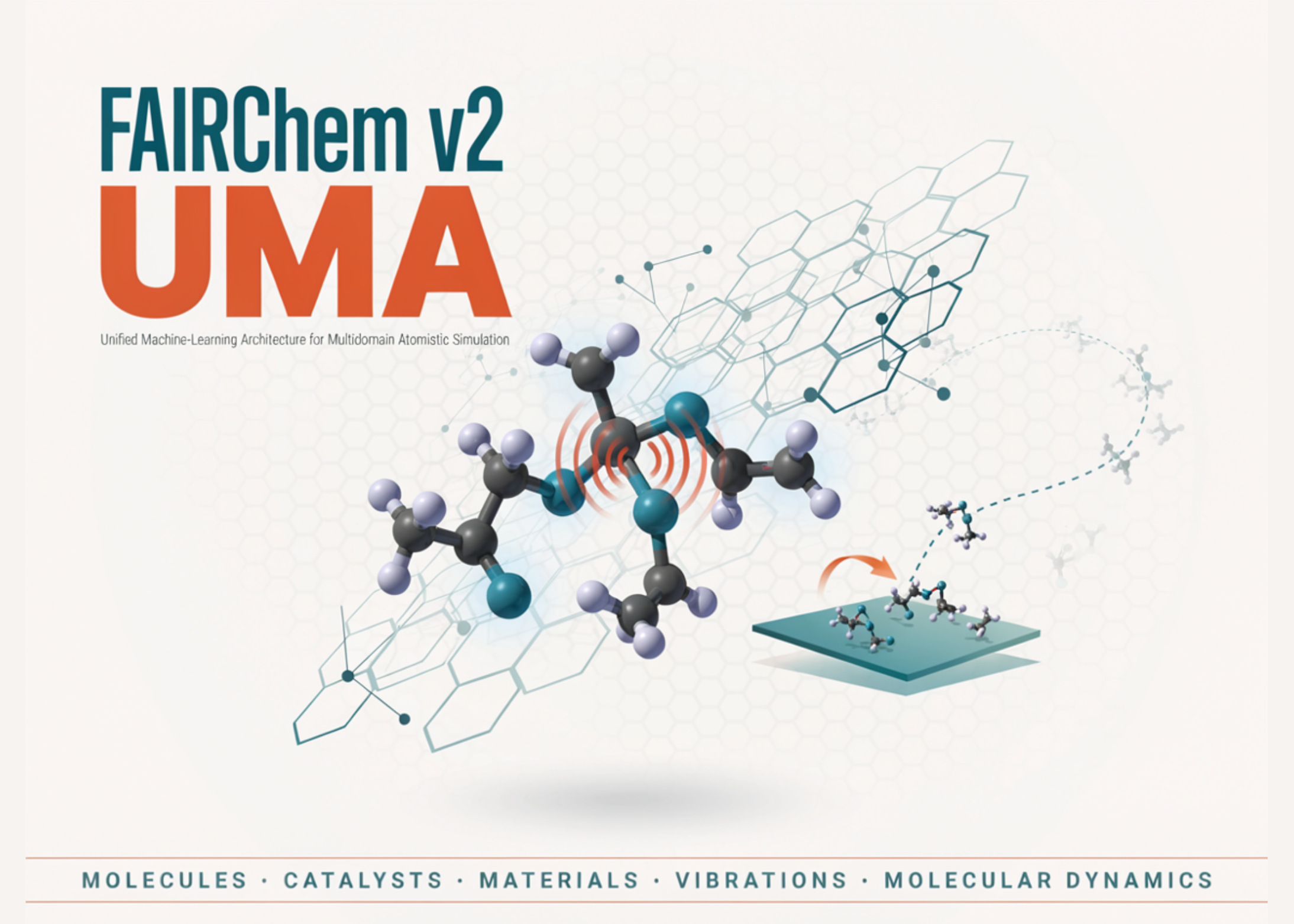
FAIRChem v2 UMA for Multidomain Atomistic Simulation across Molecules, Catalysts, Materials, Vibrations, and Molecular Dynamics
In this tutorial, we explore FAIRChem v2 and the UMA universal machine-learning interatomic potential as a unified framework for atomistic simulation across molecular chemistry, catalysis, and inorganic materials. We configure an environment, authenticate with Hugging Face to access the gated UMA model weights, and initialize task-specific calculators for the omol, oc20, and omat domains. We then apply the same pretrained potential to a broad set of computational chemistry workflows, including
Induction Labs Photon-1 Simulates Desktops, Plays Checkers, and Models Billiard Physics From One Pretraining Run
Most agents that learn from video need to know what action produced each frame. Induction Labs is arguing that this requirement is the bottleneck. Last week, they released imagination models, a foundation model architecture that pretrains on raw video with no action labels at all. Their test system is Photon-1, a sparse 106B-A5B mixture-of-experts (MoE) transformer trained on 18 years of computer demonstration video. On an internal computer use benchmark, Induction Labs reports that Photon-1