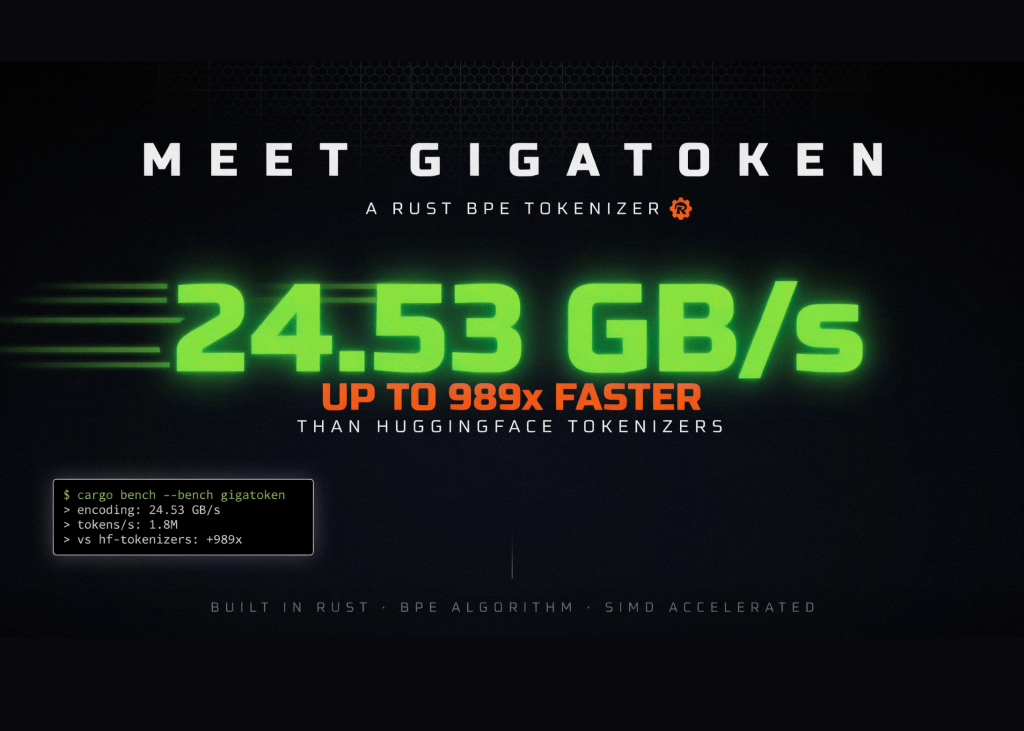
Meet Gigatoken: A Rust BPE Tokenizer that Encodes Text at 24.53 GB/s, up to 989x Faster than HuggingFace Tokenizers
Tokenization is the one part of the language modeling stack that almost nobody profiles. Gigatoken, released by Marcel Rød (a PhD student from Stanford) under an MIT license, argues that this was a mistake. The library encodes text at gigabytes per second on a single machine, against baselines that are already multithreaded Rust. The GPT-2 tokenizer benchmarking yields remarkable results: evaluated on the 11.9 GB owt_train.txt corpus using a 144-core AMD EPYC 9565 dual-socket setup, Gi
Get smart on it
Gigatoken is a tokenizer written in Rust that converts text into numerical tokens for language models, operating at significantly higher speeds than existing tools. Tokenization is a foundational step in language modeling that has traditionally received little performance optimization. The tool achieves its speed through two main techniques: hand-written pretokenization logic instead of regex engines, and caching of previously encoded words to avoid recomputation. Performance gains vary by setup, ranging from roughly 20x faster on consumer hardware to nearly 1,000x faster on high-core-count systems compared to existing tokenizers, though gains are substantially lower for certain vocabulary types.
Related news
FAIRChem v2 UMA for Multidomain Atomistic Simulation across Molecules, Catalysts, Materials, Vibrations, and Molecular Dynamics
In this tutorial, we explore FAIRChem v2 and the UMA universal machine-learning interatomic potential as a unified framework for atomistic simulation across molecular chemistry, catalysis, and inorganic materials. We configure an environment, authenticate with Hugging Face to access the gated UMA model weights, and initialize task-specific calculators for the omol, oc20, and omat domains. We then apply the same pretrained potential to a broad set of computational chemistry workflows, including
Induction Labs Photon-1 Simulates Desktops, Plays Checkers, and Models Billiard Physics From One Pretraining Run
Most agents that learn from video need to know what action produced each frame. Induction Labs is arguing that this requirement is the bottleneck. Last week, they released imagination models, a foundation model architecture that pretrains on raw video with no action labels at all. Their test system is Photon-1, a sparse 106B-A5B mixture-of-experts (MoE) transformer trained on 18 years of computer demonstration video. On an internal computer use benchmark, Induction Labs reports that Photon-1