Meet ‘Code-as-World’: An Agentic Loop That Rewrites Real Videos Into Executable MuJoCo Physics Programs
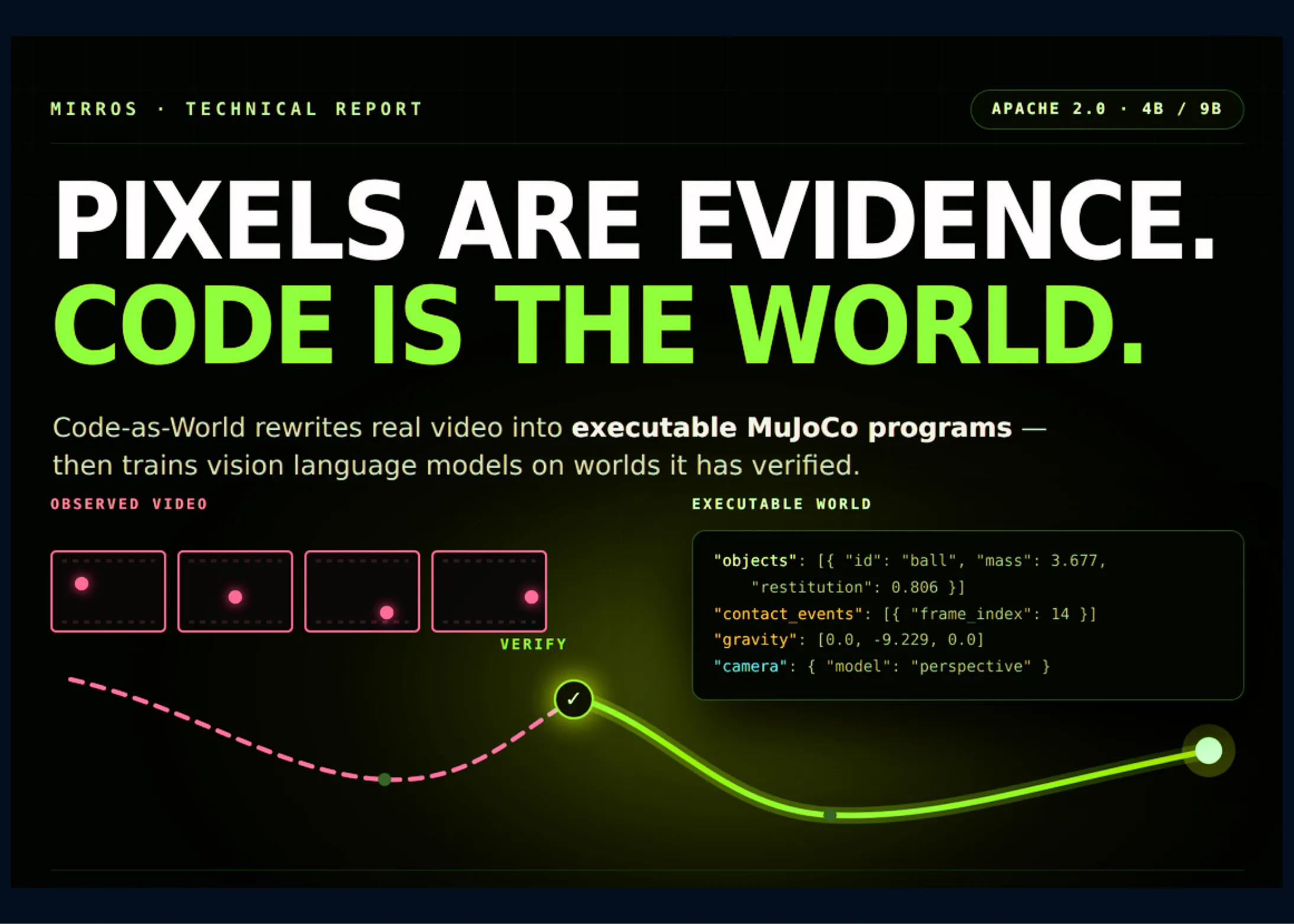
MirroS released Code-as-World: a paradigm that represents physical worlds through executable world representations. The argument is narrow and testable: pixels are evidence of a physical scene, not its ontology. A video model can predict plausible frames without ever representing mass, contact, or gravity. So instead of pixels, latents, or captions, Code-as-World represents a scene as executable code — a scene.json that MuJoCo can run, that an agent can verify against the source video, and that
Make your prediction
Will MirroS release the Code-as-World MuJoCo codebase publicly on GitHub by September 6, 2026?
Resolves by Sep 6, 2026
Your prediction
50% · 50/50 coin flip
NOYES
Get smart on it
Code-as-World is a system that converts real videos into executable physics simulations by representing scenes as code rather than images or descriptions. The approach argues that video pixels show evidence of physical events but do not capture the underlying physics like mass, gravity, and collisions, which are needed for accurate simulation and training. The system uses an iterative loop that proposes a physics program, executes it, renders the result, and compares it against the original video across multiple rounds to refine accuracy. This verified simulation data provides exact physical labels that real video alone cannot supply, allowing machine learning models trained on it to score higher on physics reasoning benchmarks than comparable systems.
Related news
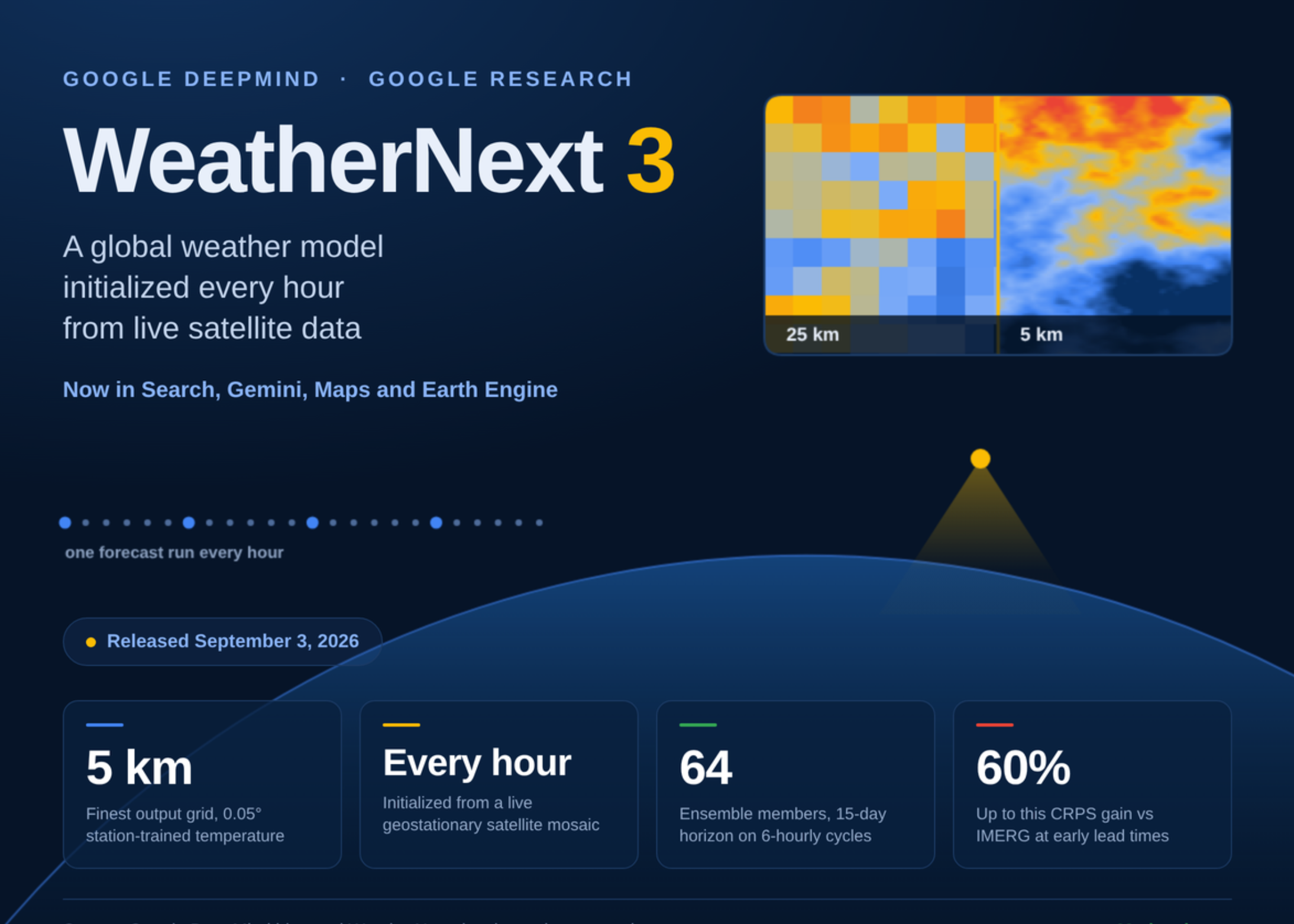
Google DeepMind’s WeatherNext 3 Trains on Weather Station Observations to Deliver 5 km Global Forecasts, Refreshed Every Hour
AI weather models have spent three years closing the gap with physics-based forecasting, but two problems stayed open: resolution too coarse for local terrain, and initialization tied to numerical weather prediction (NWP) analysis that arrives about six hours late. WeatherNext 3, released by Google DeepMind and Google Research, attacks both. It takes a live global geostationary satellite mosaic as a direct model input, re-initializes every hour, and emits forecasts down to 0.05° (~5 km) while t

OpenAI Releases GPT-6 Astra: A 1.05M-Context Computer-Use Model Gated Behind a ‘Critical’ Cyber Threshold
Today, OpenAI released GPT-6 Astra. The company calls it its most intelligent and aligned model, and positions it primarily as a computer-use system rather than a chat model. The pitch is that Astra operates software the way a person does, across browsers, spreadsheets, desktop applications and terminals, and finishes multi-step jobs instead of describing how to do them. Is it deployable? Partly, and not on your own hardware. Astra is a closed, hosted model with no released weights, so self