Making Knowledge Distillation Cheap Enough to Run at Scale
Reducing the computational cost of knowledge distillation makes it practical for organizations to create smaller, efficient models from larger ones.
Get smart on it
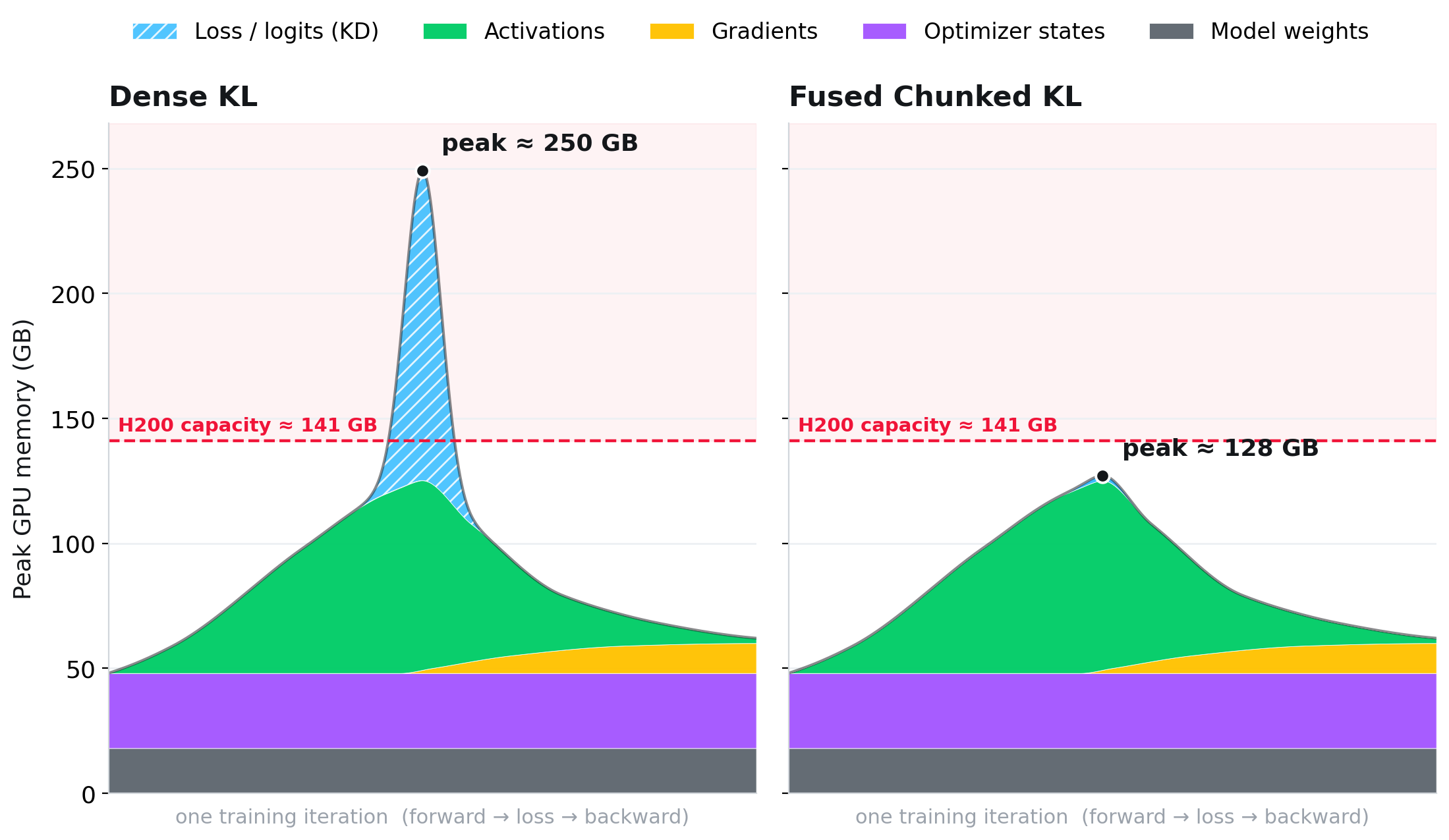
Knowledge distillation is a machine learning technique where a smaller model is trained to match the performance of a much larger model, which matters because deploying very large language models requires enormous computing resources and memory. The distillation process itself has been prohibitively expensive, typically requiring hundreds of GPUs and careful memory management strategies because it must keep both the large teacher model and smaller student model loaded simultaneously while computing probability distributions across the entire vocabulary. Researchers have developed two system changes to reduce this cost: caching the teacher model's output once so it never needs to be loaded during training, and using a memory-efficient loss calculation method that processes data in chunks rather than building massive grids in memory all at once. These changes make it possible to run knowledge distillation on a single GPU and allow large-scale experimentation that was previously impractical.
Related news
Fine-Tuning Tool-Calling LLMs: A Complete Guide Using XYZ-Aquila-SFT and Qwen3
In this tutorial, we implement an end-to-end supervised fine-tuning pipeline for the XYZ-Aquila-SFT dataset, Hugging Face Transformers, PyTorch, and PEFT. We stream and inspect the dataset, parse multi-turn tool-use trajectories, extract structured tool calls, analyze corpus characteristics, and preserve embedded reasoning and observation patterns. We then convert tool schemas between message-embedded and structured formats, render Qwen-compatible ChatML with assistant-only loss masking, prepar

Meta’s ‘open’ AI, and a $250M deal gone very wrong
Meta released Glimmer this week, an open-weight AI model anyone can download and run on their own hardware — a contrast to Muse Spark, the company’s more powerful model that stays locked behind its own APIs. The release landed alongside a letter from Mark Zuckerberg arguing AI should be “for everyone” rather than controlled by a handful of labs, but as Equity’s […]