Kyutai Releases Voice of Reason: A Speech-Native Model that Solves Spoken Math with Reinforcement Learning
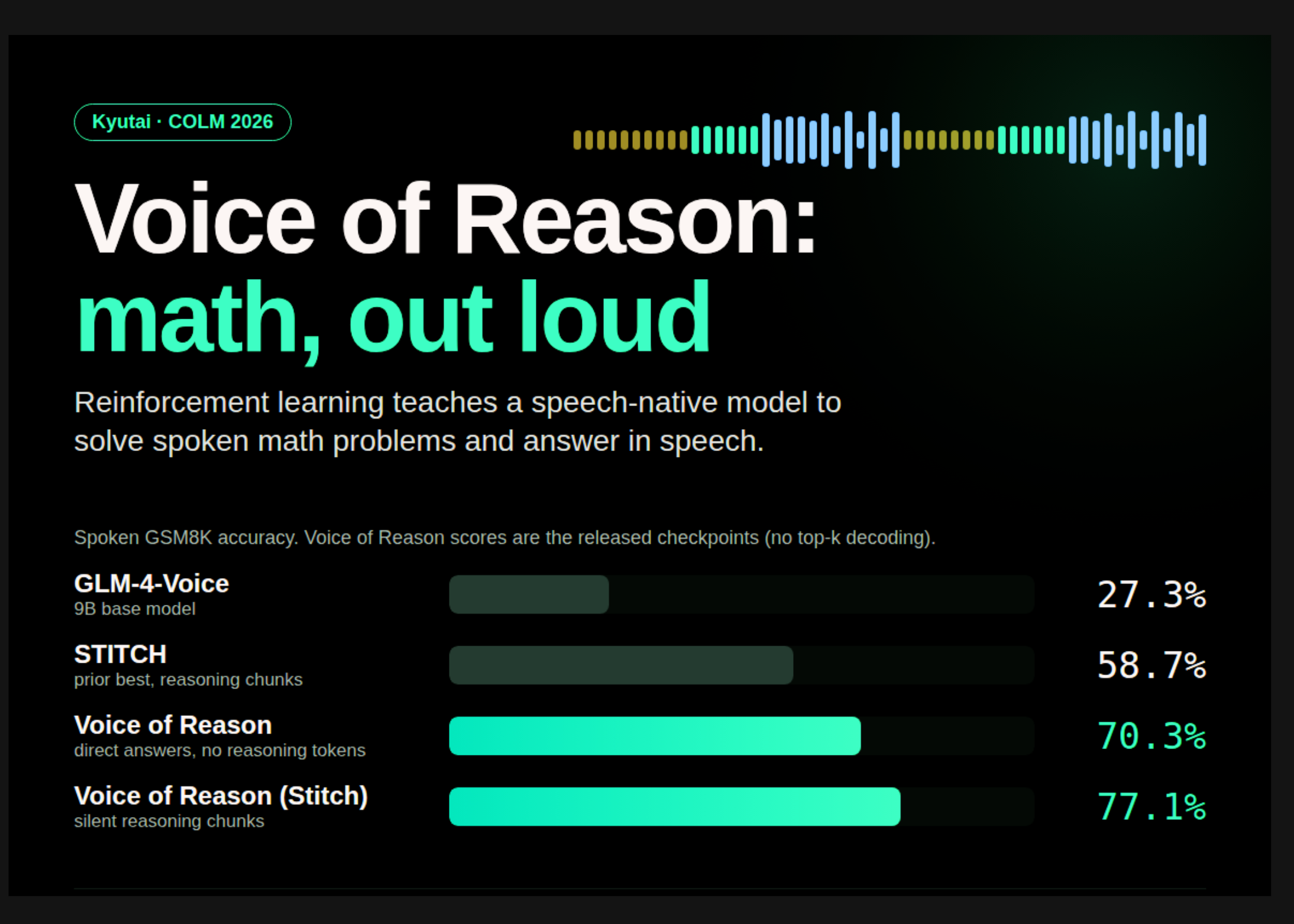
Kyutai has released Voice of Reason, 2 open-weight speech-to-speech models that solve math problems out loud. Both start from GLM-4-Voice-9B and add supervised fine-tuning (SFT) and reinforcement learning (RL). There is no transcription step and no separate text LLM in the loop. On spoken GSM8K, accuracy climbs from 27.3% for the base model to 77.1%. Is it deployable? Yes, for self-hosting. Kyutai ran both BF16 checkpoints on a single H100. You also need the GLM-4-Voice repo for its speech t
Get smart on it
Kyutai released open-weight speech models that solve math problems spoken aloud without converting speech to text first. The models combine supervised fine-tuning and reinforcement learning to improve math reasoning accuracy from 27.3% to 77.1% on a spoken math benchmark. Speech-native models face challenges because they must emit audio at regular intervals to stay interactive, which limits how much hidden reasoning they can do, whereas traditional cascaded pipelines that convert speech to text, process it, and convert back to speech can reason longer but add latency and lose tone cues. The two released checkpoints run on a single graphics processor and are available as open weights.
Related news
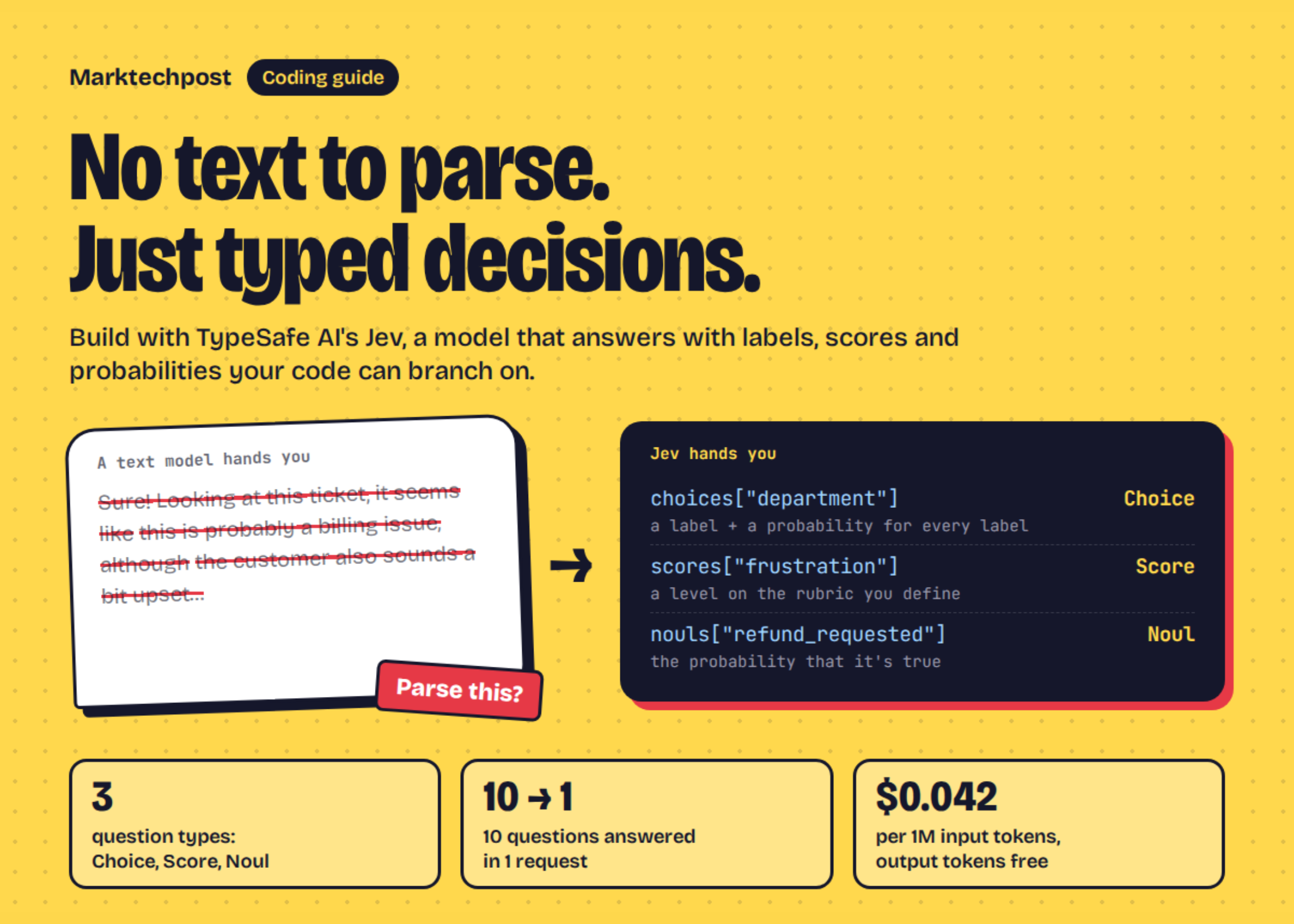
A Coding Guide to TypeSafe AI Jev: Typed Decisions, Calibrated Confidence, and Speculative Fan-Out with a System One Model
In this tutorial, we work with Jev, TypeSafe AI’s first System One model, which does not generate text at all: we send it a piece of program state and a set of typed questions, and it returns choices, scores, and yes/no probabilities that our code can branch on directly. We install the official Python SDK, make a first call that uses all three question primitives at once, and look at how the shape of the state changes what the model can know. We then recompute the published confidence sta
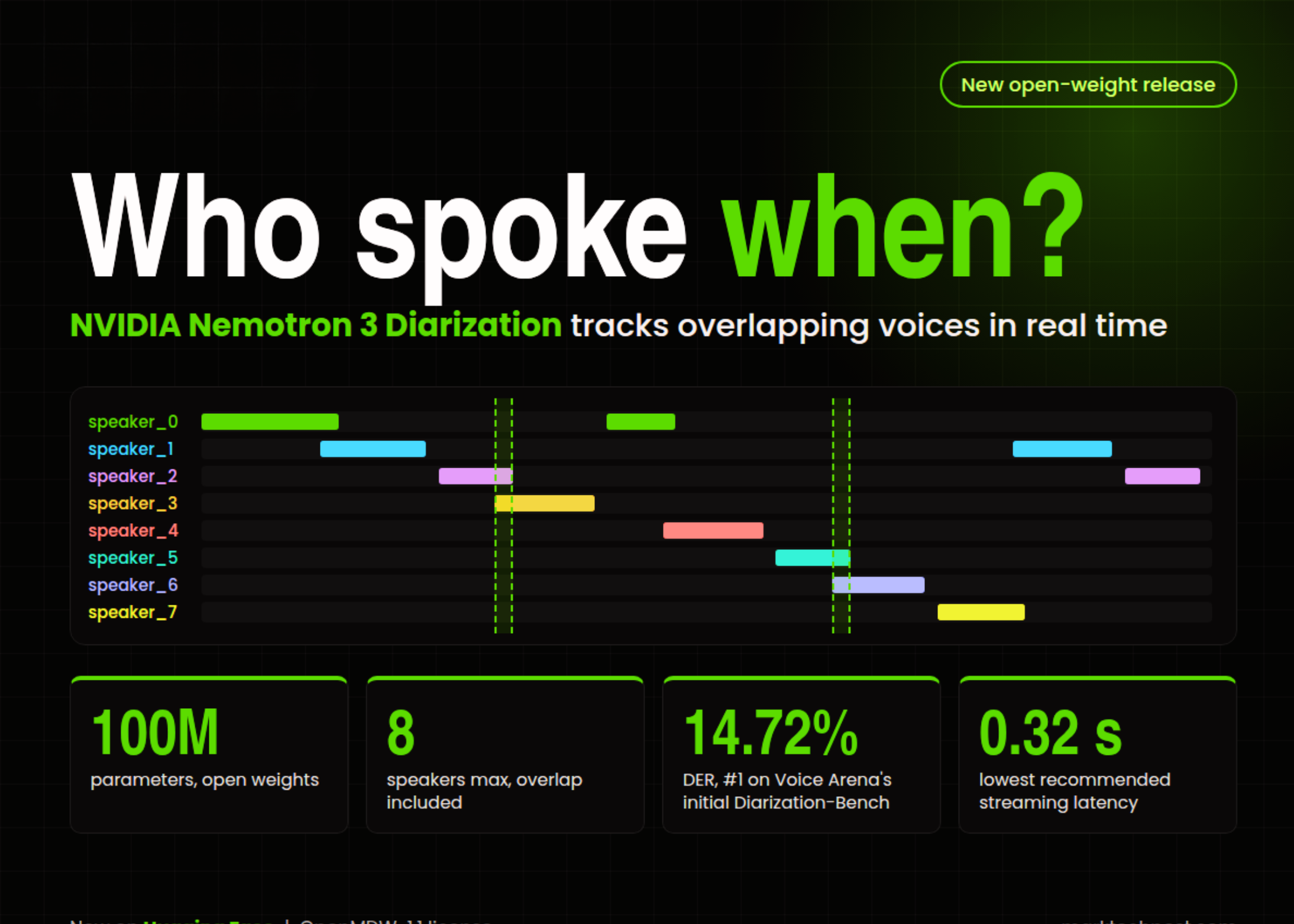
NVIDIA Releases Nemotron 3 Diarization: A 100M-Parameter Open-Weight Model That Tracks 8 Speakers in Real Time
NVIDIA has released Nemotron 3 Diarization, an open-weight speaker diarization model on Hugging Face. It answers one question about any conversation: who spoke when. The 100M-parameter model tracks up to 8 speakers, including when voices overlap. One checkpoint handles both offline recordings and real-time streaming. Is it deployable? Yes. The weights are released under the OpenMDW License 1.1, which permits commercial use. It runs on Linux through NVIDIA NeMo, using Ampere, Ada Lovelace, Ho