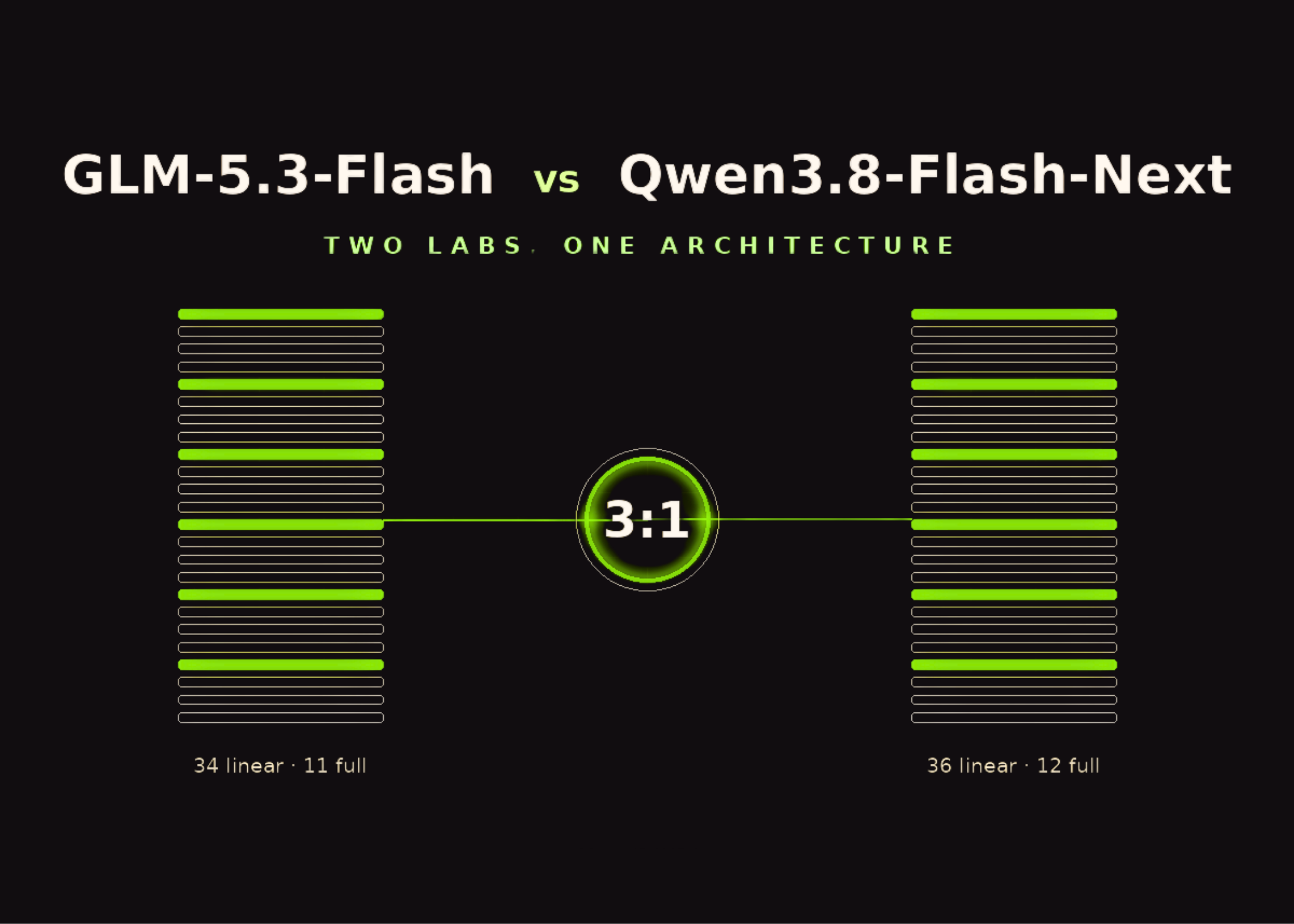
GLM-5.3-Flash vs Qwen3.8-Flash-Next: Two Chinese AI Labs Independently Converge on the Same Model Architecture
Two frontier open-weight models shipped within a day of each other this week. Z.ai released GLM-5.3-Flash, a 320B-parameter multimodal MoE model with 18B active parameters. Alibaba’s Qwen team released Qwen3.8-Flash-Next, a 125B model with 6B active parameters that previews the Qwen4 architecture. The two teams designed these systems independently. Yet their configs read like near-copies of each other. Both use a 3:1 hybrid of linear and full attention. Both select context with a compr
Two independent Chinese AI research labs released fast, efficient language models within a day of each other that use nearly identical internal designs, despite developing them separately. Both models use a hybrid approach combining cheaper linear attention layers with selective full attention, compress context before processing it, replace the traditional single data pathway with four parallel gated branches, and train with the same optimizer and matrix-splitting technique. This convergence suggests the field is settling on shared architectural principles for building efficient models, though the labs disagreed on one component: how to encode position information in the attention layers, with one approach later showing problems after additional training stages that weren't visible during initial development.
Explainer: GLM 5.2: How a 744B Open Model Is Closing the Gap With Claude Opus on Code
One short email a day with the stories that matter. Free. Unsubscribe with one click.
Want to go deeper than the news? Explore live, cohort-based AI courses taught by practitioners.
Browse AI courses on Maven
Anthropic releases new Mythos and Fable models amid RSI concerns
Anthropic says the new models "show improvements in areas like coding, reasoning, and vision," as well as in communicating more clearly with users.
Also reported by The Verge, SiliconANGLE and MarkTechPost
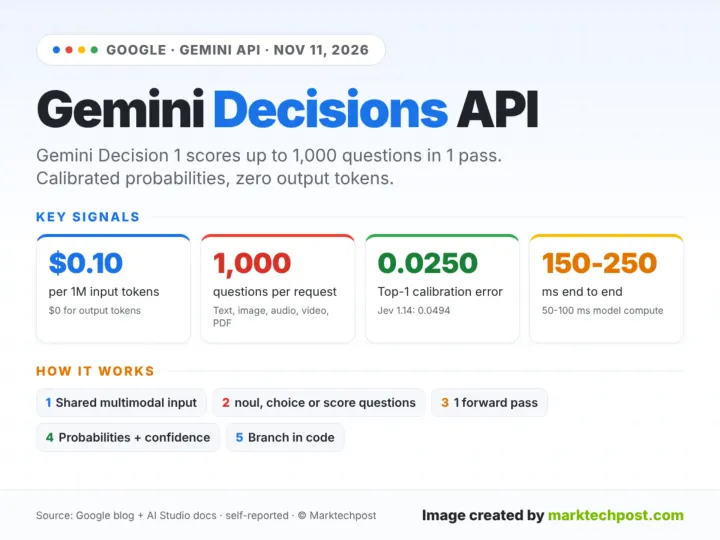
Google Launches Gemini Decisions API With Gemini Decision 1 at $0.10/M Tokens
Google has launched the Gemini Decisions API, powered by a new model, Gemini Decision 1 (gemini-decision-1). The Gemini Decisions API does not generate text. It scores up to 1,000 typed questions against one shared input and returns calibrated probabilities. For developers, this targets the small branching calls inside agents: routing, policy checks, tool selection and grading. Google prices it at $0.10 per 1M input tokens, with zero output tokens billed. TL;DR Size: Context is 262,144 t
Also reported by SiliconANGLE

Google releases Gemini 4 Carbon with agent ‘swarm’ feature
Google is rolling out its latest AI model, Gemini 4 Carbon, to the general public after releasing it to a select group of "cybersecurity defenders" two weeks ago. Google claims Carbon is its "strongest model" yet, and capable of competing with the very best systems from Anthropic and OpenAI. Google says Gemini 4 Carbon "pushes the frontier even further" than Argon, referring to the company's other frontier model that launched only last month. The company said Argon will likely
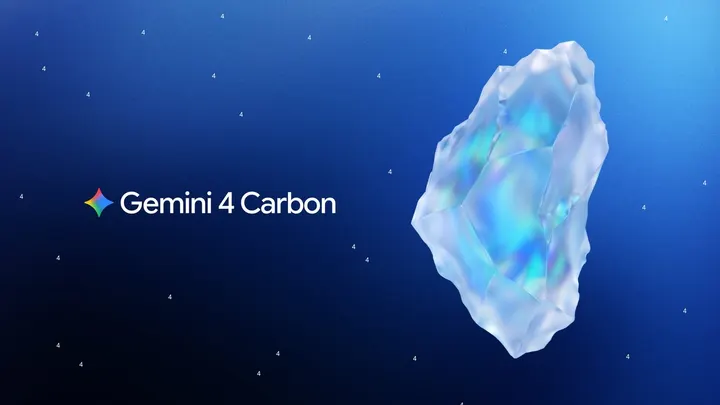
Gemini 4 Carbon is now available
The latest version aims to deliver improved performance while reducing the computational resources and energy required for AI operations.

Introducing AlphaProof Code: a breakthrough in verifying complex software at depth
AlphaProof Code agents wrote three million lines of proofs in Lean to verify Signal’s core encryption.
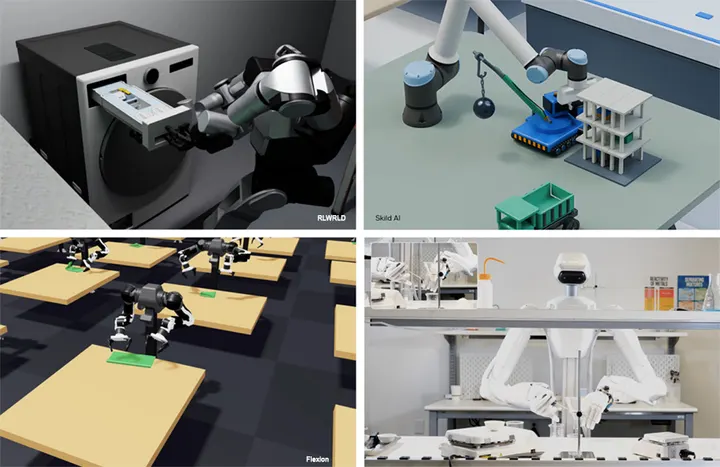
NVIDIA launches GR00T 2 and Isaac Lab 3.0 at CoRL
A range of developers, including RLWRLD, Skild AI, and Flexion, are already using NVIDIA’s latest technology. | Source: NVIDIA NVIDIA Corp. today introduced GR00T 2, its updated open frontier world action model, and Isaac Lab 3.0, the latest version of its open-source robot learning framework. The company made these announcements at the Conference on Robot Learning, or CoRL, in Austin, Texas. NVIDIA also gave a look at how its partners, like Ambi Robotics, Bosch Research, Dexmate, Dyna Rob