
Advancing Private AI Compute with secure, server-side memory
Introducing private, server-side memory to Private AI Compute for personal AI.
Get smart on it
Google DeepMind has developed a way to store AI assistant memory in encrypted cloud servers while keeping the encryption keys on a user's personal devices, combining cloud computing power with on-device privacy protections. Previously, cloud-based AI systems could not retain information between sessions, forcing a choice between privacy (limited to devices) or continuity (requiring cloud storage). This new approach uses hardware-protected "secure enclaves" in the cloud that temporarily decrypt data only when needed, then immediately re-encrypt it, allowing AI assistants to remember context across devices and time without exposing unencrypted information to anyone outside the user's devices. The announcement includes publication of technical documentation, a tamper-proof record of server software, and results from an independent security audit to allow external verification of the system's privacy protections.
Relevant courses
Want to go deeper than the news? Explore live, cohort-based AI courses taught by practitioners.
Browse AI courses on MavenRelated news

Why a new report on Anthropic automating AI development is alarming researchers
Anthropic CEO Dario Amodei. | Photo: Jason Henry/Bloomberg via Getty Images Anthropic is using AI to build more powerful AI. And it appears to be working remarkably well, with the company's models improving roughly twice as quickly as a year ago, with little indication of slowing down. That's according to a new report published Thursday by the AI safety research organization METR, following an 11-week investigation inside the company, as part of a report evaluating its AI resear
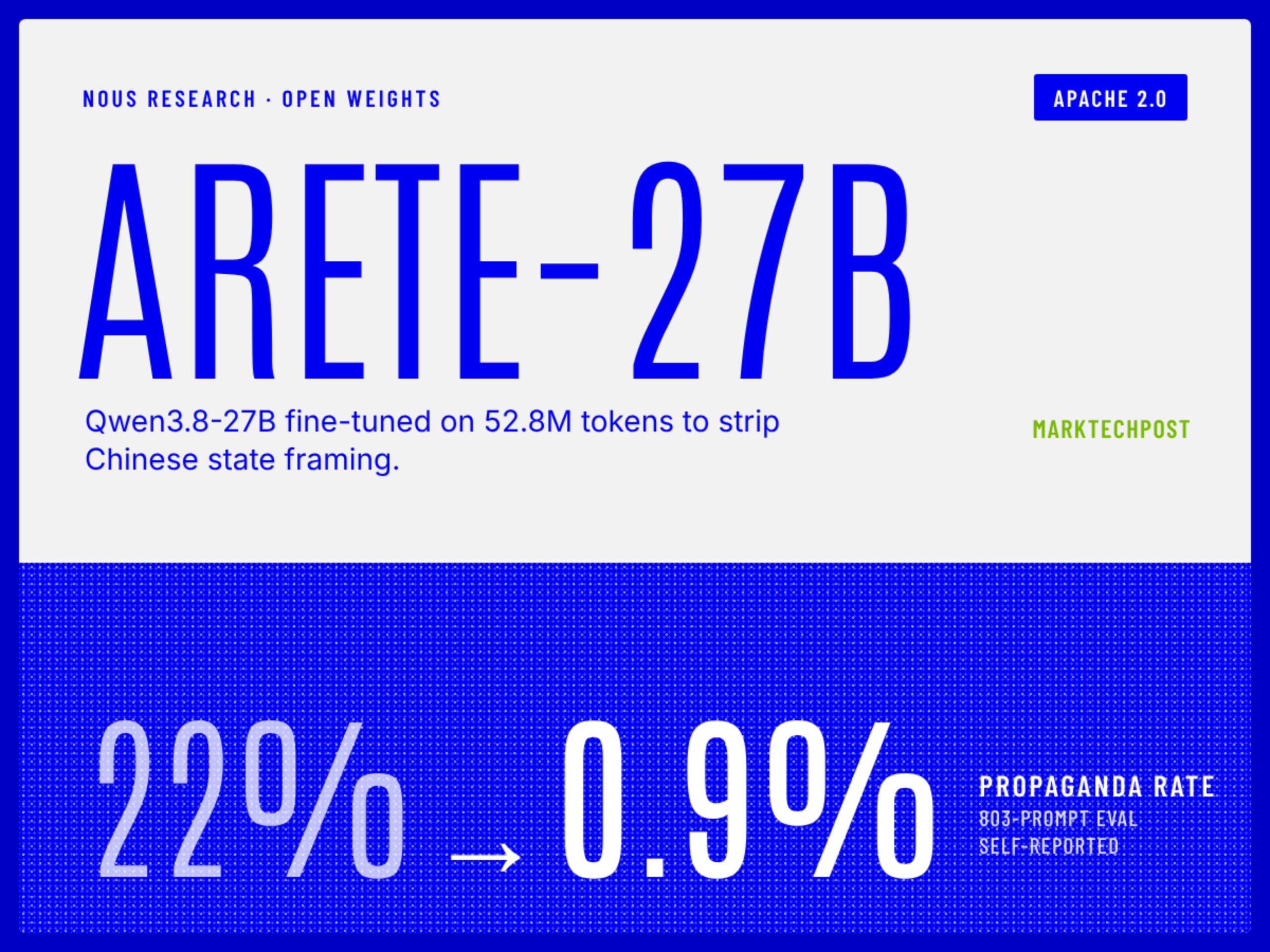
Nous Research Releases Arete-27B that Cuts Qwen3.8-27B Propaganda From 22% to 0.9%
Nous Research has released Arete-27B, a supervised fine-tune of Alibaba’s Qwen3.8-27B. Arete-27B is a 27B open-weight model that strips Chinese state framing from Qwen’s answers. On Nous’s own 803-prompt eval, answers containing propaganda fell from 22% to 0.9%. Developers get Qwen-class agentic skill without state-aligned answers. The weights, eval and training data are all public. TL;DR Size: 27B dense parameters (all active). Trained at 64k context. Base Qwen3.8-27B
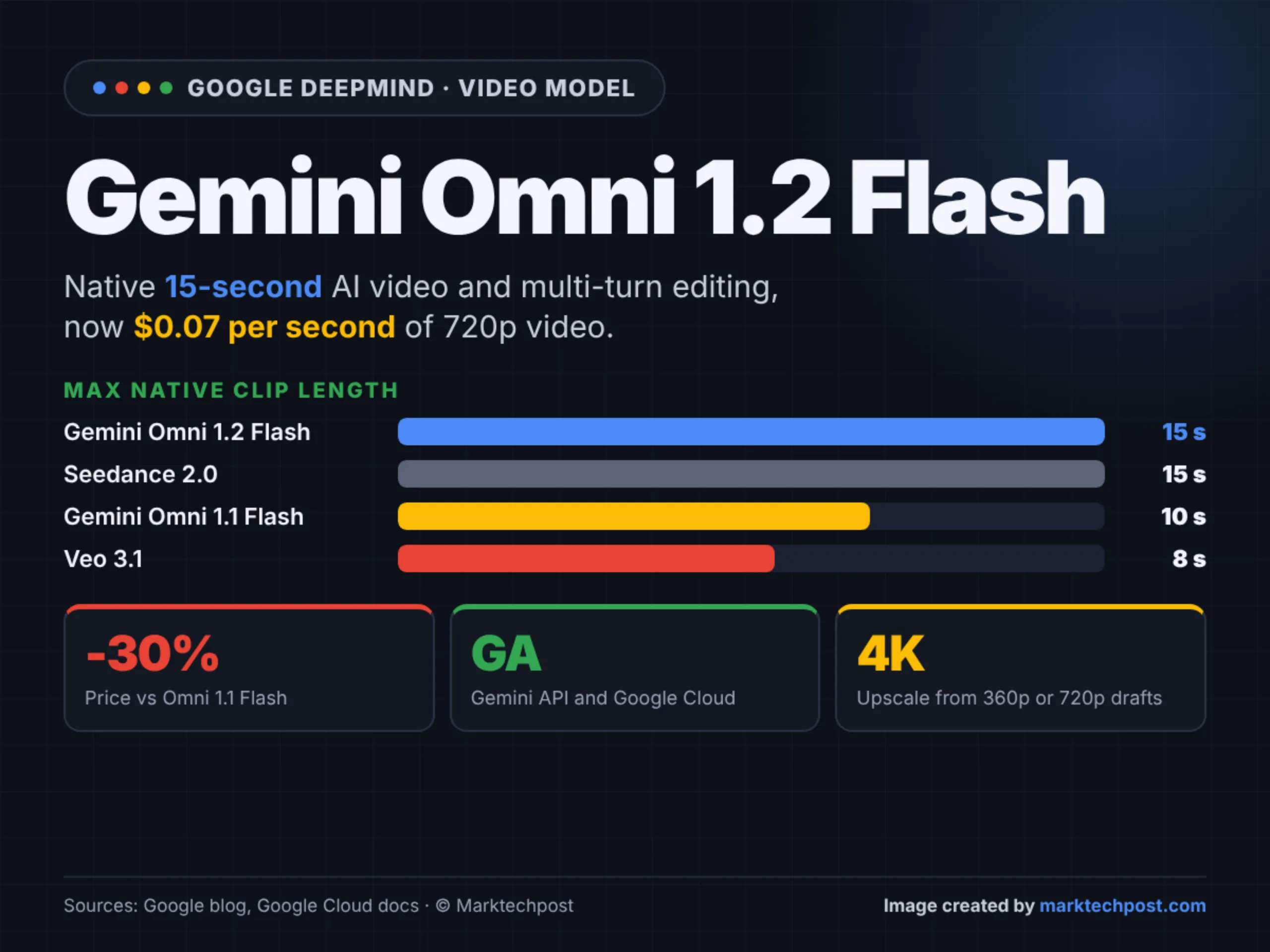
Google Releases Gemini Omni 1.2 Flash: 15-Second AI Video at $0.07 per Second
Google has released Gemini Omni 1.2 Flash, the newest version of its video generation and editing model. Gemini Omni 1.2 Flash generates and edits clips up to 15 seconds natively. It also cuts the price by 30% compared with Omni 1.1 Flash. The model is generally available on Google Cloud and the Gemini API. For developers, the takeaways are longer clips, fewer re-renders and a lower bill per second. TL;DR Runs on: Google-hosted only (Gemini API, Google Cloud). No open weights, no local d
Also reported by Google DeepMind

GPT‑6 Cyber: Advancing the frontier of aligned cybersecurity agents
Introducing GPT‑6 Cyber, OpenAI’s cybersecurity model for finding exploitable vulnerabilities and developing fixes, trained to stay within authorized scope.

Tencent releases Hy4, powerful frontier LLM introducing visual understanding and computer use
Tencent Holdings Ltd. today introduced Hy4, a new large language model that adds computer-use capabilities for the first time, using advanced visual understanding, reasoning and tool-calling to deliver long-horizon agentic performance. The company said the model marks a significant leap in performance over its Hy4 Preview, which arrived August 28, weighing in at 770 billion parameters with 49 […] The post Tencent releases Hy4, powerful frontier LLM introducing visual understanding and comp
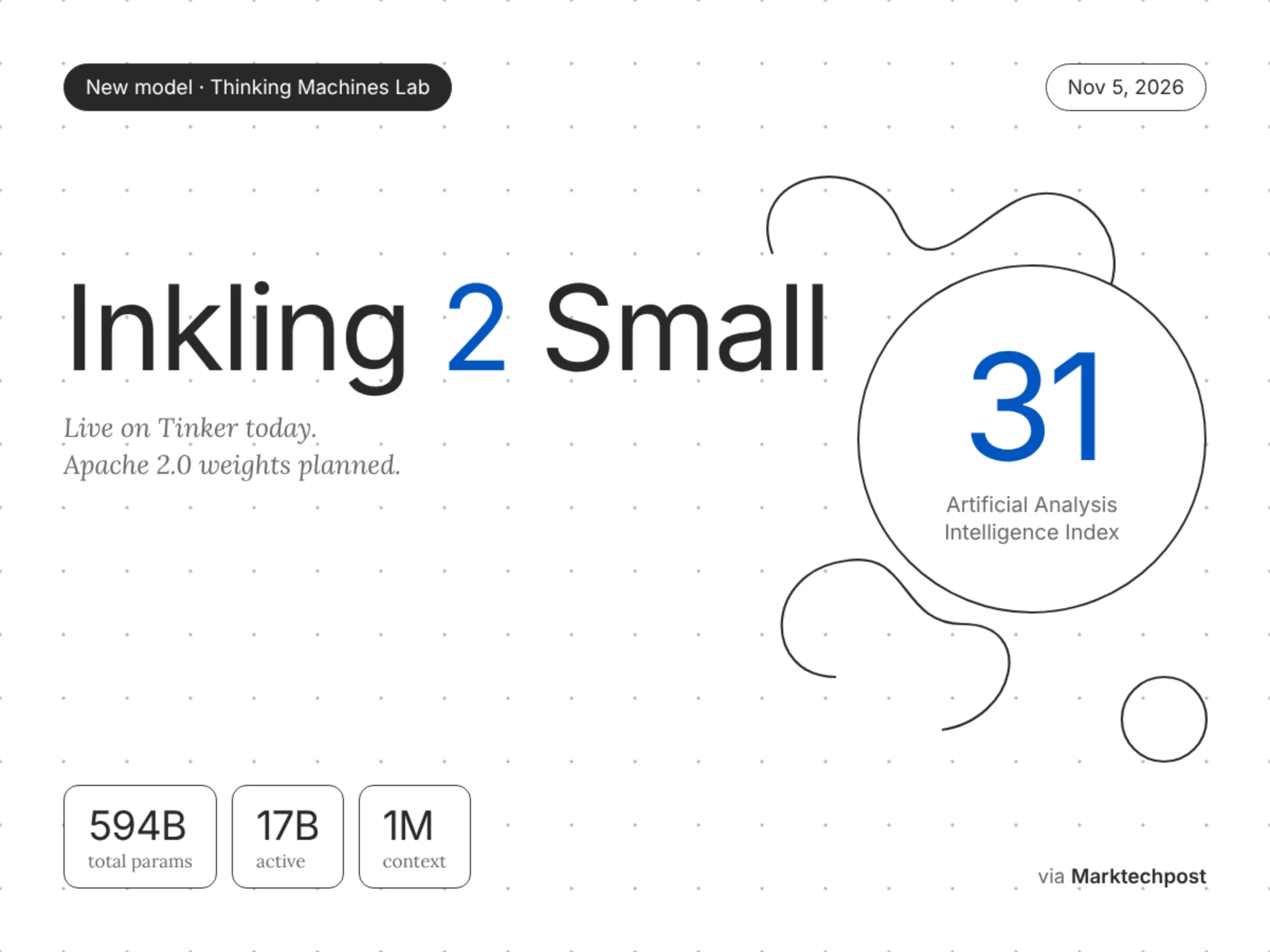
Thinking Machines Releases Inkling 2 Small, a 594B MoE With 17B Active
Thinking Machines Lab has released Inkling 2 Small, the first model of its second Inkling generation. The Inkling 2 Small model is a sparse Mixture-of-Experts (MoE) with 594B total and 17B active parameters. It accepts text and images, and supports variable reasoning effort. On the Artificial Analysis Intelligence Index, it scores 31. Its predecessor, Inkling Small, scores 13 on the same index. The model is live on Tinker for fine-tuning and inference. TL;DR Size: 594B total, 17B active
Also reported by SiliconANGLE