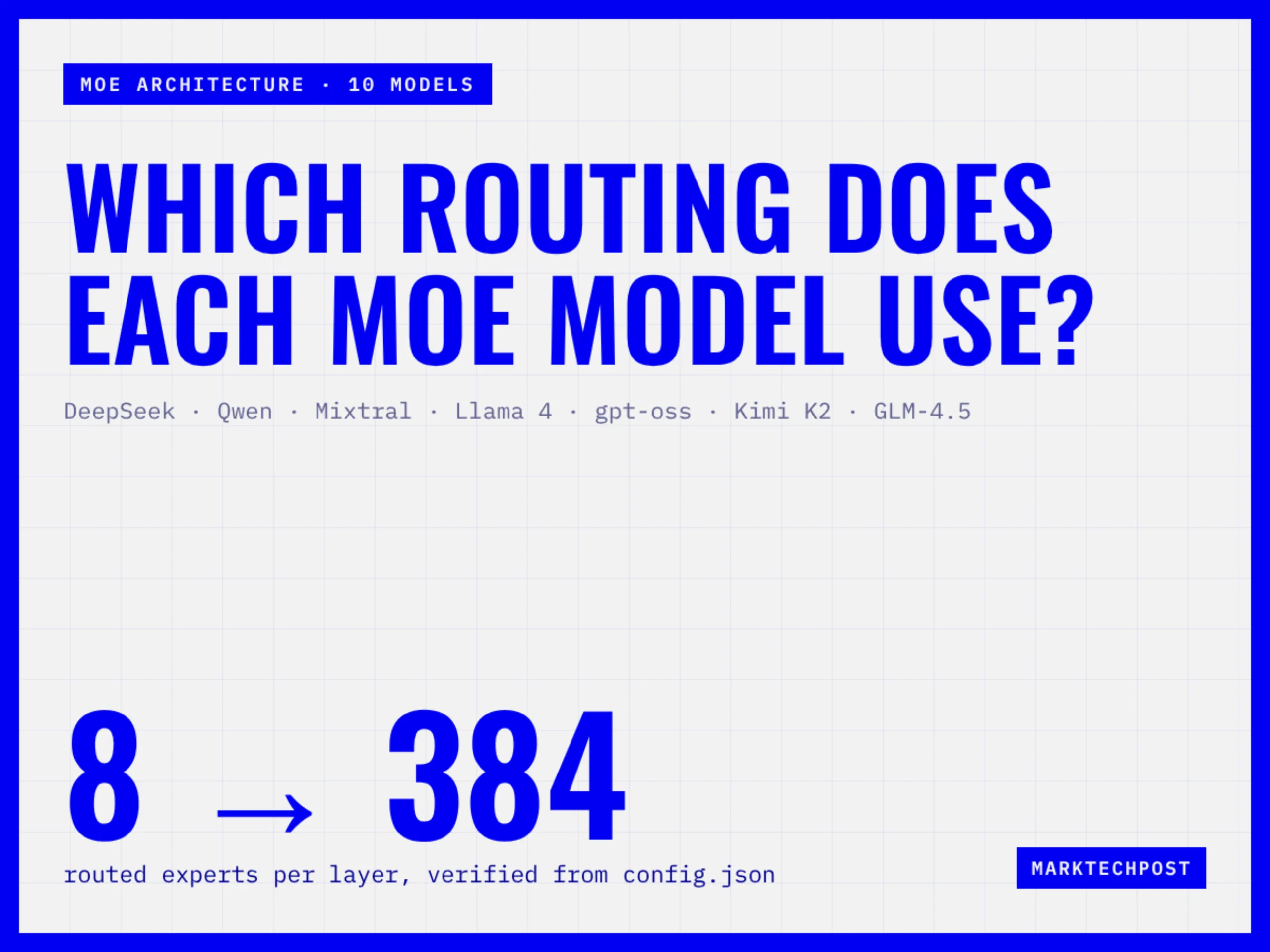
MoE models differ on routing and expert counts
MarkTechPost: Which Routing Does Each MoE Model Use? DeepSeek, Qwen, Mixtral, Llama 4, gpt-oss Compared
Open Mixture-of-Experts (MoE) models share one idea but disagree on almost every routing detail. Expert counts range from 8 to 384. Top-k ranges from 1 to 8. Some models keep an always-on shared expert; others drop it. TL;DR Size: 10 models, from Qwen3.6-35B-A3B (35B total, 3B active) to DeepSeek-V4-Pro (1.6T total, 49B active). Runs on: gpt-oss-120b fits one 80 GB GPU with MXFP4; DeepSeek-V4-Pro and Kimi K2 need multi-GPU expert parallelism. Performance: Routed sparsity spans 4x
Get smart on it
Mixture-of-Experts (MoE) models use a shared architecture concept but differ significantly in how they route tokens to different experts. Key variation points include the number of experts available, how many experts each token selects, whether a shared expert processes every token, the scoring function used for selection, and the load-balancing method. Understanding these routing choices matters because they directly affect memory requirements, computation per token, and communication overhead when deploying these models on GPUs.
Explainer: What Is a Mixture of Experts Model and Why Does It Use Fewer Resources?
Relevant courses
Want to go deeper than the news? Explore live, cohort-based AI courses taught by practitioners.
Browse AI courses on MavenRelated news
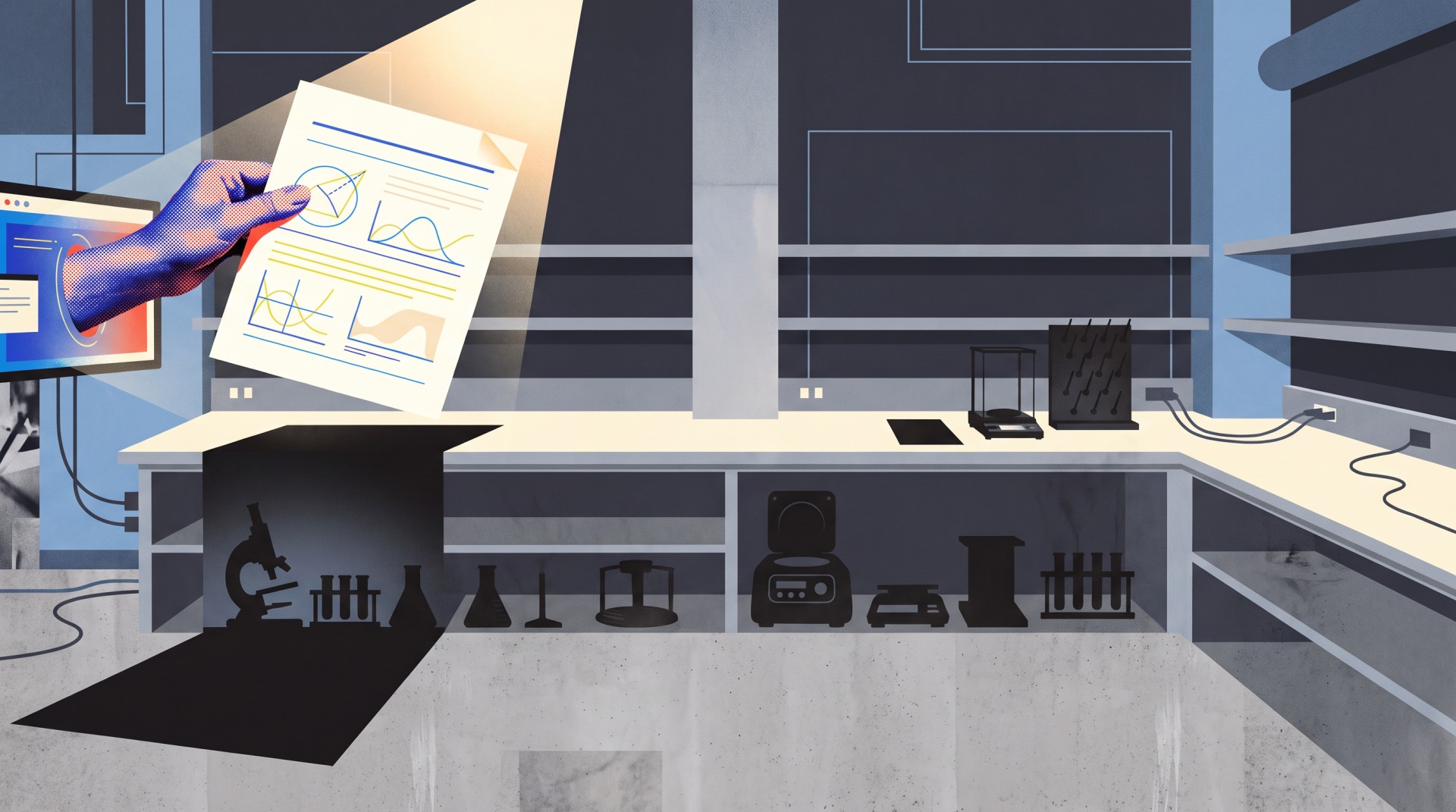
Nine AI agents tried autonomous research on open questions from US national labs and none passed the experts' bar
The "Into the Unknown" benchmark tasks nine AI agents with tackling open research questions from U.S. national laboratories. None of the 135 submissions meets all requirements. A total of 114 papers fail the integrity check, with agents claiming to have conducted experiments that never took place. GPT-6 Astra performs best but still doesn't meet the experts' standards. The article Nine AI agents tried autonomous research on open questions from US national labs and none passed the expert
The gap between open and closed AI models in cyber capabilities keeps shrinking
In the Vals AI benchmark, OpenAI's GPT-6 Sol Daybreak hits 80.8 percent of attack objectives in simulated corporate networks. Worse, the open-weight model DeepSeek V4.1 Flash reaches 72.8 percent at a tenth of the cost. Because open models can no longer be restricted, analysts say the window for defenders is shrinking fast. The article The gap between open and closed AI models in cyber capabilities keeps shrinking appeared first on The Decoder.
Ripple-65B Preview delivers strong agentic coding results as a fully Apache 2.0 open US model
Ricursive Intelligence is releasing Ripple-65B Preview, a 65-billion-parameter open-weight language model that the company says achieves the top score among open-source U.S. models on the TerminalBench 2.1 coding benchmark at a total R&D cost of $32 million. On other benchmarks, however, Ripple falls behind the likewise newly released western open model Inkling 2 Small. The article Ripple-65B Preview delivers strong agentic coding results as a fully Apache 2.0 open US model appeare

Measuring how AI agents handle everyday wet-lab science
OpenAI introduces BioBasicsBench, a 100-task benchmark measuring how well AI agents interpret raw experimental data and handle everyday wet-lab science.
Free Chinese AI Models Are Getting Scary Good at Hacking
An experiment in which AI models were asked to break into simulated networks showed the hacking skills of DeepSeek and GLM to be not far behind OpenAI’s most advanced cyber model, which isn’t public.
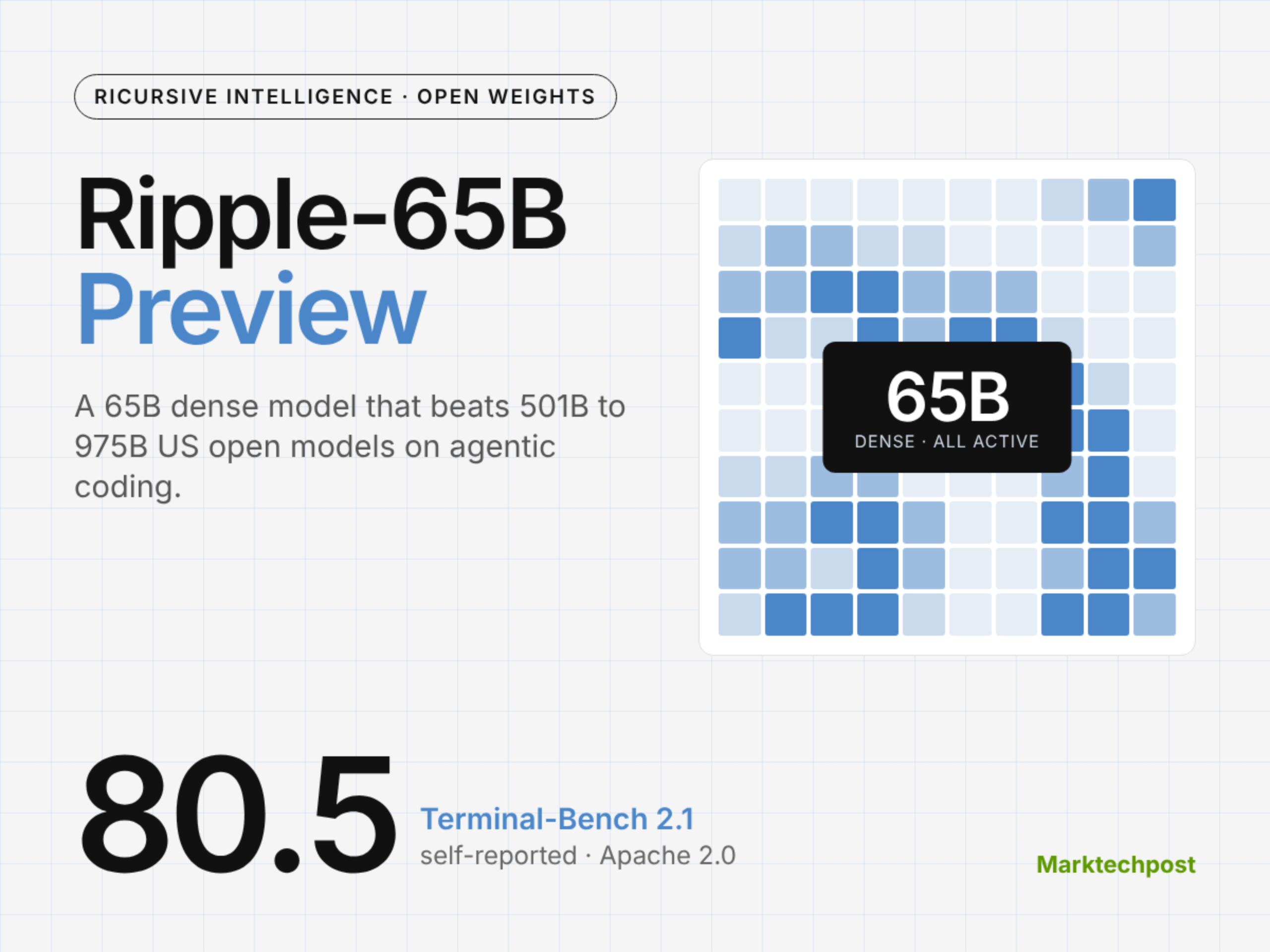
Ricursive AI Releases Ripple-65B Preview: A 65B Dense Open-Weight Model Scoring 80.5 on Terminal-Bench 2.1
Ricursive Intelligence just released Ripple-65B Preview. Ripple-65B Preview is a 65B dense open-weight model from Ricursive, pretrained from scratch for agentic coding. It is a general-purpose variant of the proprietary model behind Ricursive’s AI chip design platform. The main claim: 80.52 on Terminal-Bench 2.1, the top self-reported score among US open-weight models. Every MoE rival it beats on that test carries 501B to 975B total parameters. TL;DR Size: 65B dense (65B active), p