
Perplexity and Intelligence
How perplexity measures progress in AI models, and why it could help developers establish a shared approach to evaluating emerging capabilities.
Modern AI progress can be tracked through a single metric called perplexity, which measures how well a model predicts the next piece of text. The author argues that perplexity should become an industry-wide standard for comparing AI development across different labs and for establishing shared safety guidelines. As perplexity improves over time, AI models have shown unexpected new capabilities emerge, from fluent conversation to solving advanced mathematics problems, suggesting that similar breakthroughs could occur in AI research itself. The proposal is for developers to agree on common limits based on perplexity measurements and to coordinate safety standards before advancing to more capable systems.
One short email a day with the stories that matter. Free. Unsubscribe with one click.
Want to go deeper than the news? Explore live, cohort-based AI courses taught by practitioners.
Browse AI courses on Maven
AI claimed a solution to the 167 year-old Riemann Hypothesis, and a human did, too
Mathematicians are having their minds blown by the latest AI-driven result—and there's a competing human solution, too.
Also reported by SiliconANGLE

Hebbia sees improvements in financial research with GPT-6 Astra
Hebbia tested GPT-6 Astra for financial research. Its prerelease evaluations found gains in source coverage, citation relevance, and presentation quality.

Can AI help scientists identify promising drug candidates?
MedChemBench evaluates how well AI models interpret molecular structures, reason from experimental evidence, and select compounds in early drug discovery.
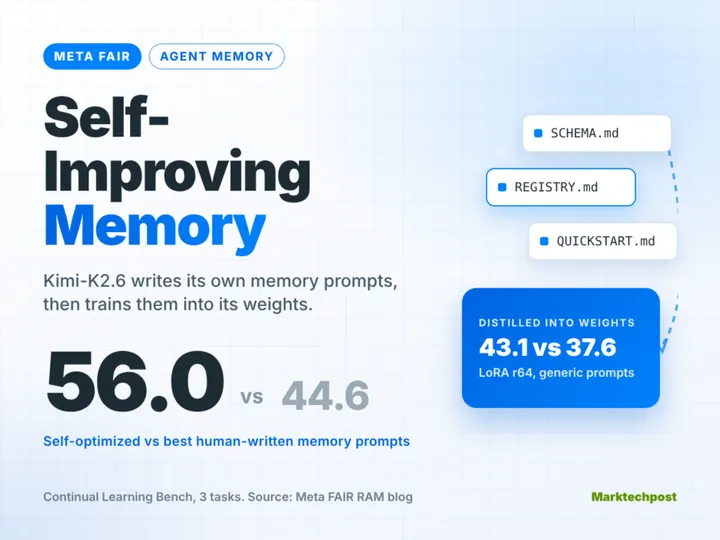
Meta FAIR Self-Improving Memory Hits 56.0 on Continual Learning Bench
Meta FAIR has introduced Self-Improving Memory, a method for AI agents that manage their own memory. The model first discovers its own memory instructions. It then trains those skills into its weights. Co-authors include researchers from the University of Washington and Johns Hopkins University. TL;DR Method: The base is Kimi-K2.6, a 1T-parameter MoE with 32B active and 256K context. Distillation adds a LoRA adapter (rank 64) on attention projections. Runs on: Training hardware is no

Research acceleration: The jagged frontier
OpenAI measures how coding agents are accelerating AI research, where their performance remains uneven, and what this signals about recursive self-improvement.
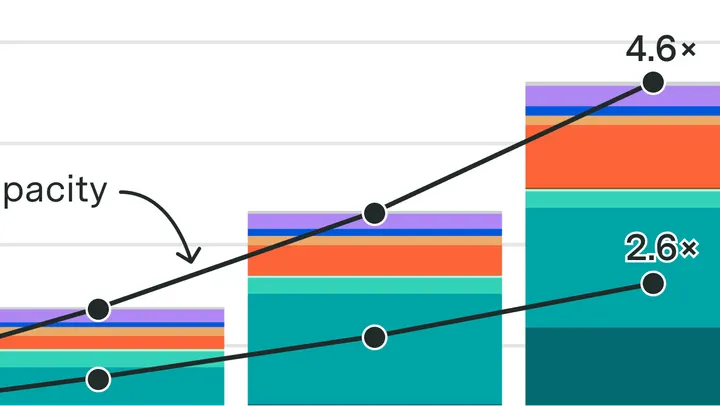
Agentic inference capacity grew 4.6× in a year, versus 2.6× for compute capacity
Our Inference Performance Index and chip sales data show agentic inference capacity grew nearly twice as much as 8-bit compute.