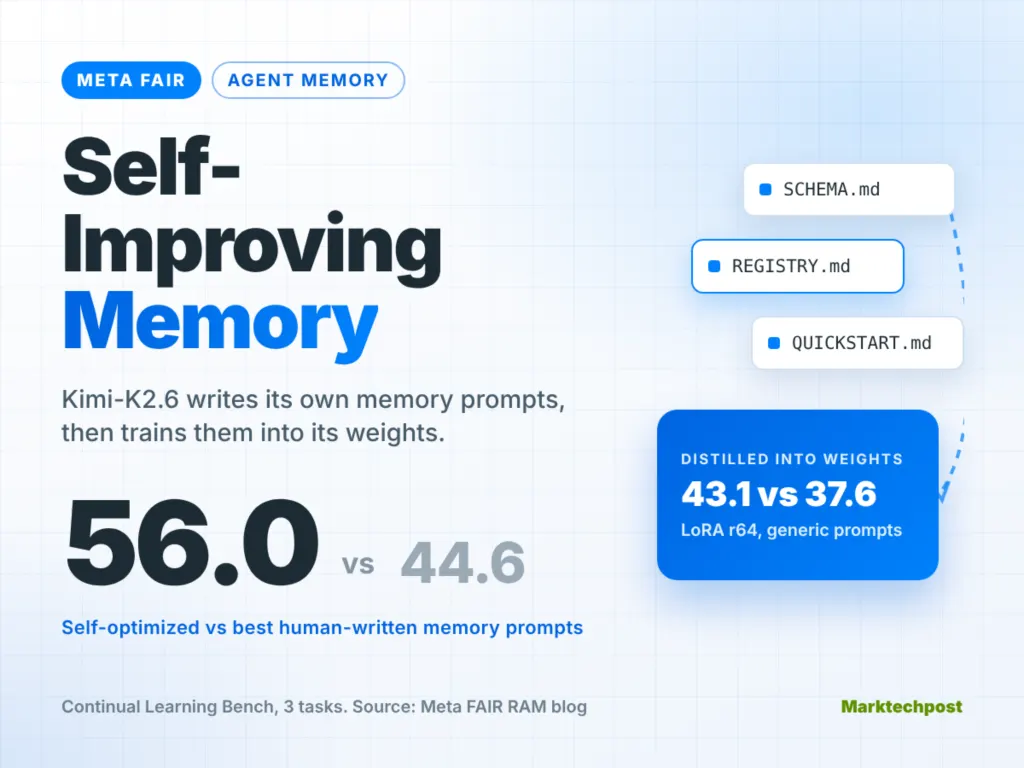
Meta FAIR Self-Improving Memory scores 56.0
MarkTechPost: Meta FAIR Self-Improving Memory Hits 56.0 on Continual Learning Bench
Meta FAIR has introduced Self-Improving Memory, a method for AI agents that manage their own memory. The model first discovers its own memory instructions. It then trains those skills into its weights. Co-authors include researchers from the University of Washington and Johns Hopkins University. TL;DR Method: The base is Kimi-K2.6, a 1T-parameter MoE with 32B active and 256K context. Distillation adds a LoRA adapter (rank 64) on attention projections. Runs on: Training hardware is no
Self-Improving Memory is a method that teaches AI agents to manage their own file-based memory by discovering optimal memory instructions and then embedding those skills into the model's weights through training. The approach works in two stages: first, a meta agent searches over and rewrites memory prompts by testing them across task streams, and second, the discovered prompts are distilled into the model using fine-tuning. On three continual learning tasks, the self-discovered memory prompts achieved an average score of 56.0, outperforming the best human-written prompts at 44.6, with particularly large gains on coding tasks. This matters because it demonstrates that AI systems can automatically optimize their own memory strategies better than humans can write them by hand, while also transferring those improvements into permanent model capabilities.
One short email a day with the stories that matter. Free. Unsubscribe with one click.
Want to go deeper than the news? Explore live, cohort-based AI courses taught by practitioners.
Browse AI courses on Maven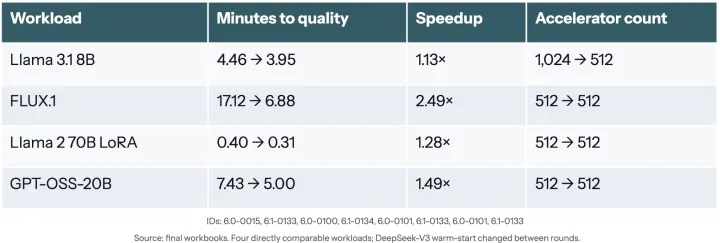
MLPerf Training v6.1: Bigger Clusters, Broader Hardware, and the Rise of Software-Driven Gains
The round at a glance MLPerf® Training v6.1 expands the benchmark suite and features even larger systems from our members. Two benchmarks join the suite: Qwen3.5-397B GRPO for agentic reinforcement learning, and DLRMv4-HSTU, a generative recommender. Google’s Ironwood and NVIDIA’s Rubin make their debut as Available systems. The largest jobs reached 10,240 GPUs (NVIDIA on GB300 and Azure on GB200, both training DeepSeek-V3) [1, 2], multi-node systems rose to 76% of the total, and the hardwar
Research acceleration: The jagged frontier
OpenAI measures how coding agents are accelerating AI research, where their performance remains uneven, and what this signals about recursive self-improvement.
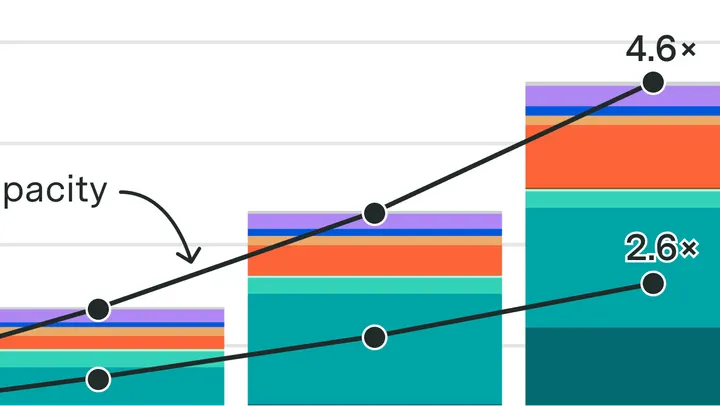
Agentic inference capacity grew 4.6× in a year, versus 2.6× for compute capacity
Our Inference Performance Index and chip sales data show agentic inference capacity grew nearly twice as much as 8-bit compute.
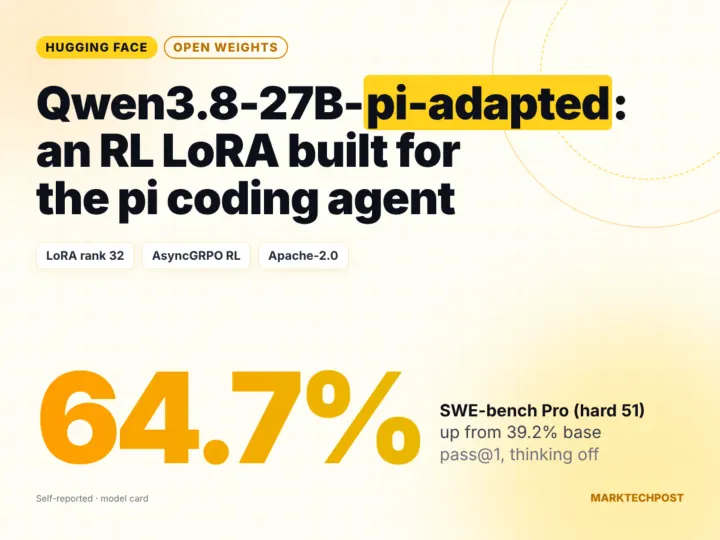
New LoRA Adapter Lifts Qwen3.8 Coding Success From 39% to 65%
Hugging Face’s harness-hub team has released Qwen3.8-27B-pi-adapted, a LoRA adapter for Qwen3.8-27B. It was trained with reinforcement learning to work inside the pi coding agent. The Qwen3.8-27B-pi-adapted LoRA adapter targets one harness instead of general chat. For developers running local coding agents, that is the point. You keep the open base model and swap in a small, harness-specific adapter. TL;DR Size: LoRA rank 32 (alpha 64) on Qwen3.8-27B, a 27B dense hybrid with 262,14
How good are Fable 5.2 and GPT-6.2 Astra at real work?
We tested Fable 5.2, GPT-6.2 Astra, and four other models on real Epoch work tasks. None met our employee standard, including the two that top our ECI.

Astra for Law leads in legal intelligence
Astra for Law ranked first in a launch evaluation spanning 24 areas of law. Every ChatGPT Enterprise customer can now request access.