
Gemini 4 Hydrogen launches for coding work
MarkTechPost: Google Releases Gemini 4 Hydrogen: 2.5x Faster Than Gemini 3.8 Flash
Google has released Gemini 4 Hydrogen, a fast model for coding and agentic work. Gemini 4 Hydrogen is a proprietary model from Google DeepMind built for everyday agent loops. It sits below the frontier models Gemini 4 Carbon and Gemini 4 Argon. Google calls it its “daily driver for agentic workflows.” TL;DR Size: 1,048,576-token unified window for input, thinking and output. Runs on: Google-hosted API only. No weights, no quantized variants, no self-hosting. Serving hardw
Part of a story that several outlets report: Google releases Gemini 4 Hydrogen AI model for Search
Google has released a new AI model called Gemini 4 Hydrogen designed for coding and agent workflows, positioned as a faster alternative to previous models. The model performs 2.5 times faster than an earlier version while achieving higher scores on several coding benchmarks, though it costs twice as much as the introductory pricing of its predecessor. The model is available only through Google's hosted API with a 1-million-token context window shared across inputs, outputs, and internal reasoning, and developers can pair it with a more powerful model for complex tasks that require better planning and problem-solving. Pricing is set at $1.50 per million input tokens and $7.50 per million output tokens, with reduced costs available through caching for longer prompts.
Explainer: Gemini 4 Hydrogen Explained: Speed, Benchmarks, and Costs
- AI claimed a solution to the 167 year-old Riemann Hypothesis, and a human did, too · TechCrunch
- MLPerf Training v6.1: Bigger Clusters, Broader Hardware, and the Rise of Software-Driven Gains · MLCommons
- Hebbia sees improvements in financial research with GPT-6 Astra · OpenAI
- All of today’s AI news, biggest first →
One short email a day with the stories that matter. Free. Unsubscribe with one click.
Want to go deeper than the news? Explore live, cohort-based AI courses taught by practitioners.
Browse AI courses on Maven
AI claimed a solution to the 167 year-old Riemann Hypothesis, and a human did, too
Mathematicians are having their minds blown by the latest AI-driven result—and there's a competing human solution, too.
Also reported by SiliconANGLE
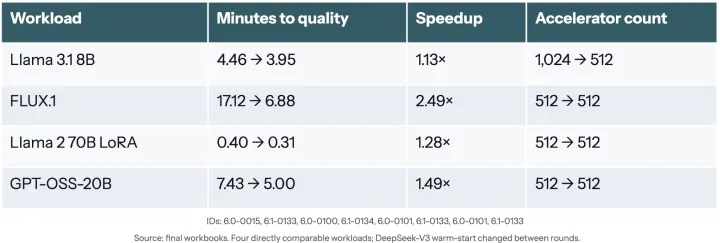
MLPerf Training v6.1: Bigger Clusters, Broader Hardware, and the Rise of Software-Driven Gains
The round at a glance MLPerf® Training v6.1 expands the benchmark suite and features even larger systems from our members. Two benchmarks join the suite: Qwen3.5-397B GRPO for agentic reinforcement learning, and DLRMv4-HSTU, a generative recommender. Google’s Ironwood and NVIDIA’s Rubin make their debut as Available systems. The largest jobs reached 10,240 GPUs (NVIDIA on GB300 and Azure on GB200, both training DeepSeek-V3) [1, 2], multi-node systems rose to 76% of the total, and the hardwar

Hebbia sees improvements in financial research with GPT-6 Astra
Hebbia tested GPT-6 Astra for financial research. Its prerelease evaluations found gains in source coverage, citation relevance, and presentation quality.

Can AI help scientists identify promising drug candidates?
MedChemBench evaluates how well AI models interpret molecular structures, reason from experimental evidence, and select compounds in early drug discovery.
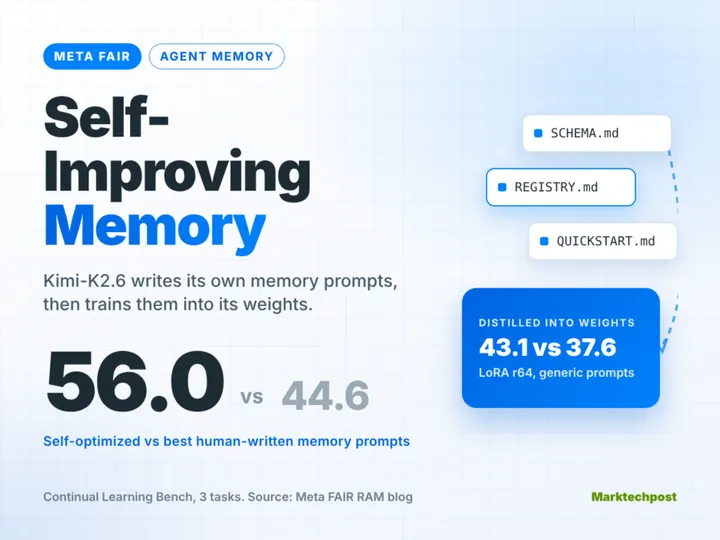
Meta FAIR Self-Improving Memory Hits 56.0 on Continual Learning Bench
Meta FAIR has introduced Self-Improving Memory, a method for AI agents that manage their own memory. The model first discovers its own memory instructions. It then trains those skills into its weights. Co-authors include researchers from the University of Washington and Johns Hopkins University. TL;DR Method: The base is Kimi-K2.6, a 1T-parameter MoE with 32B active and 256K context. Distillation adds a LoRA adapter (rank 64) on attention projections. Runs on: Training hardware is no
Research acceleration: The jagged frontier
OpenAI measures how coding agents are accelerating AI research, where their performance remains uneven, and what this signals about recursive self-improvement.