Cartesia Ships Sonic-3.6: A Streaming TTS Model That Now Leads Both Artificial Analysis Speech Arenas
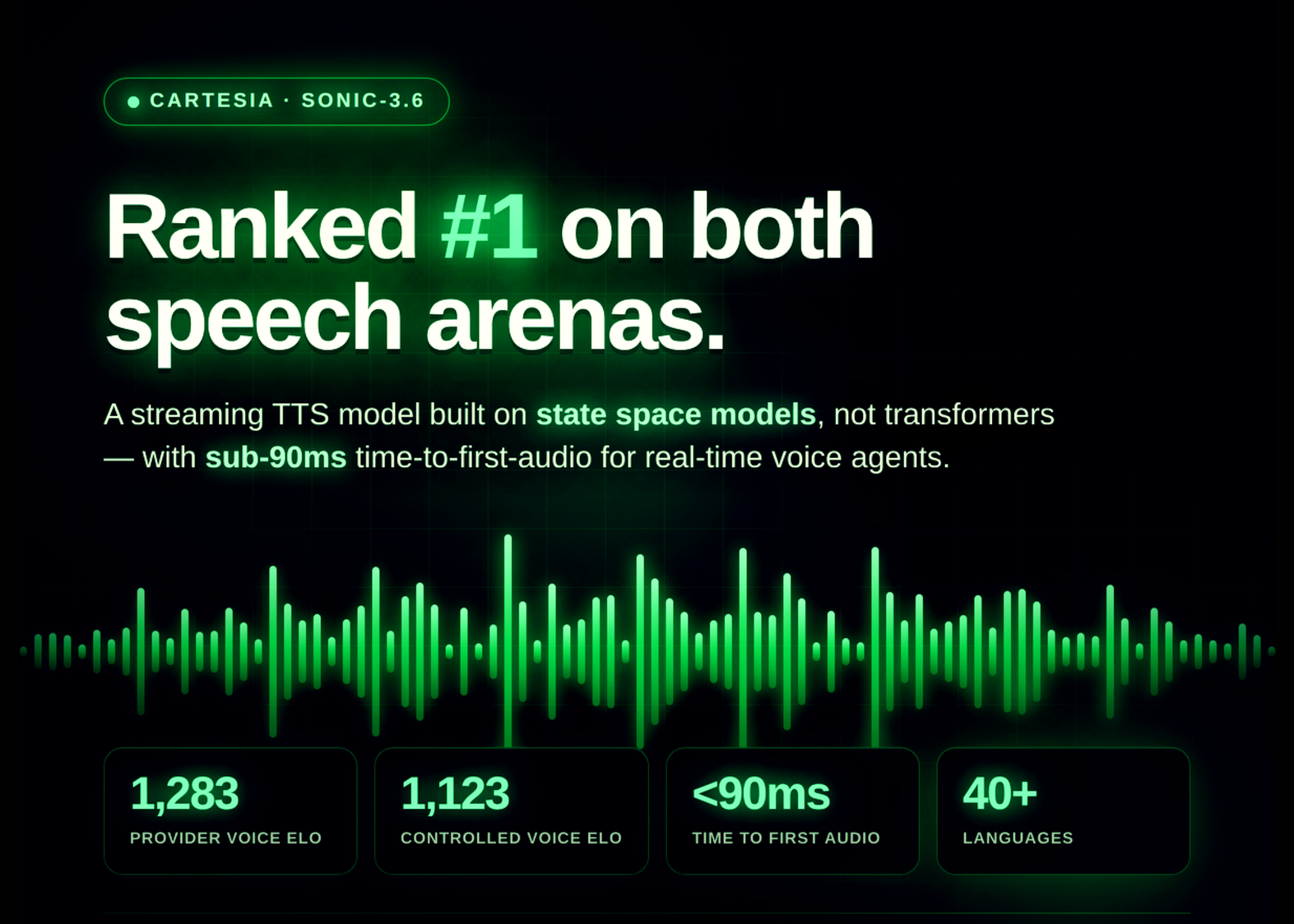
Cartesia has released Sonic-3.6, the newest version of its real-time text-to-speech model. It arrives roughly three months after Sonic-3.5. The new change is naturalness, and this one is independently checkable. Sonic 3.6 now holds #1 on both Artificial Analysis speech leaderboards — 1,283 Elo on the Provider Voice board and 1,123 on the Controlled Voice board. The second result matters more. That board clones every model onto the same eight reference voices, which isolates the synthesis engine
Get smart on it
Cartesia has released Sonic-3.6, a text-to-speech model that converts written text into spoken audio in real time. The model ranks first on both independent speech quality leaderboards, meaning it produces more natural-sounding speech than competing systems. It is available as a cloud-based service rather than software that can be downloaded and run locally, with pricing starting at a $5 tier for individual developers and scaling up for larger commercial operations.
Related news

With most information hidden, the game Stratego had stumped AI, until now
Deep Blue took down Garry Kasparov at chess in 1997, AlphaGo beat Lee Sedol at Go in 2016, and poker bots have been beating professionals for years. But one classic game called Stratego held out. Even DeepMind, with its exceptional budget, couldn't build a machine that reliably beat the best human players. Now, a team of researchers from Carnegie Mellon, MIT, New York University, and Stanford University has done it. Their AI, called Ataraxos, beat Pim Niemeijer, arguably the best Stratego player

Opus 5.5 loves to tell you ‘this matters’ (and other AI writing tells)
Opus 5.5’s biggest tell is the word “dependable,” which pops up 23 times more often than in human samples.