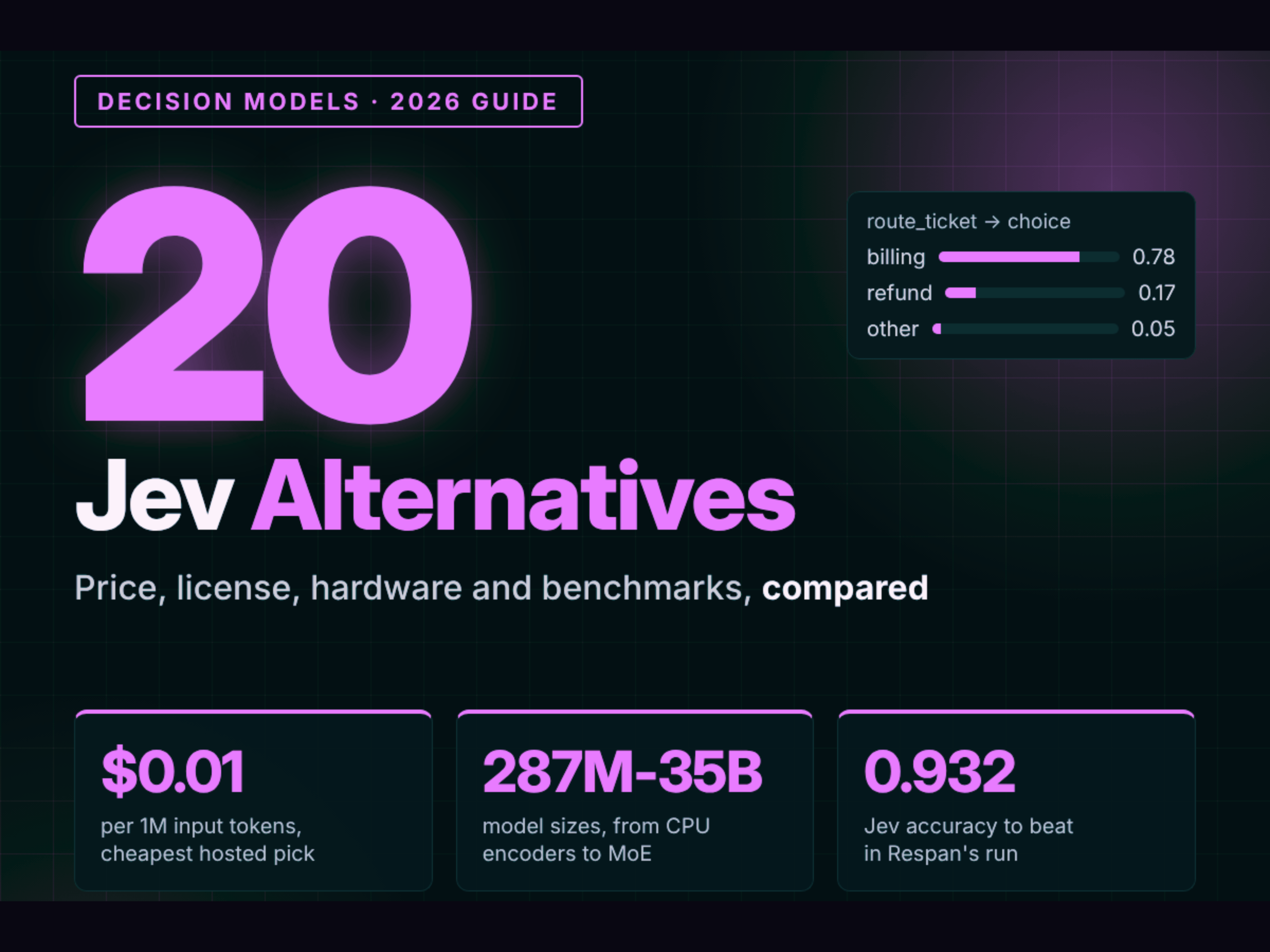
20 Jev Alternatives: The Decision Models Taking On TypeSafe in 2026
TypeSafe launched Jev on September 15, 2026. It is a decision model, not a chatbot. You define the allowed answers, and Jev returns a label, a score or a yes/no probability. In about 4 weeks, at least 20 Jev alternatives shipped. They come from Cloudflare, OpenAI, Perplexity, Liquid AI, AWS’s Strands Labs and independent developers. This guide compares each one on size, license, hardware, pricing, Jev API compatibility and published benchmarks. TL;DR Size range: 287M (GLiNER2.5-mul
Get smart on it
A decision model is a type of artificial intelligence that returns specific outputs like labels, scores, or yes/no probabilities based on predefined allowed answers, rather than generating free-form text like a chatbot. Within four weeks of one company's decision model launch in mid-September 2026, at least twenty alternative decision models became available from various technology companies and independent developers. These alternatives vary significantly in size, licensing, hardware requirements, pricing, and performance on benchmark tests. The guide compares these options across dimensions including whether they can process images, support self-hosting, disclose model size, and offer fine-tuning capabilities, since these gaps in the original model prompted developer interest in alternatives.
Explainer: How to Actually Read an AI Benchmark (Without Being Fooled)
Relevant courses
Want to go deeper than the news? Explore live, cohort-based AI courses taught by practitioners.
Browse AI courses on MavenRelated news

Deepseek V4.1 Flash 1017 beats larger rivals in agentic tasks while once again massively cutting per-task costs
Deepseek has released V4.1-Flash-1017 as an open-weight model that posts better benchmarks, finishes tasks faster, and produces shorter outputs than its predecessor. The company is also opening up its internal search engine through new Search and Fetch APIs at $0.75 per 1,000 calls. API users in tools like Claude Code and Codex get free access for now. The article Deepseek V4.1 Flash 1017 beats larger rivals in agentic tasks while once again massively cutting per-task costs appeared fir

Elorian’s first AI model wants to reason with images, not just about them
According to Elorian's evaluations, Glimpse outperforms even GPT-6 Astra on scientific chart reasoning and short-form video captioning, with competitive results on other visual reasoning tasks.
Google's Gemini 4 Argon is closer to the AI frontier than any Google model in months
Google Deepmind's Gemini 4 Argon scored 97.5 percent on the ARC-AGI-3 benchmark, making Google the second lab after OpenAI to cross the 95 percent mark. But the results swing wildly depending on the test setup: in the standard harness, the score drops to just 49.8 percent. Argon also trails rivals in math and software engineering. The article Google's Gemini 4 Argon is closer to the AI frontier than any Google model in months appeared first on The Decoder.

AI models hide mistakes in their own work reports, but one sentence in your prompt can help
AI agents systematically skip errors in their own reports, even when they spot the problems. In a study by Google Research, MIT, and Harvard, GPT-5.5 left out negative results in 198 out of 200 paper abstracts. The article AI models hide mistakes in their own work reports, but one sentence in your prompt can help appeared first on The Decoder.
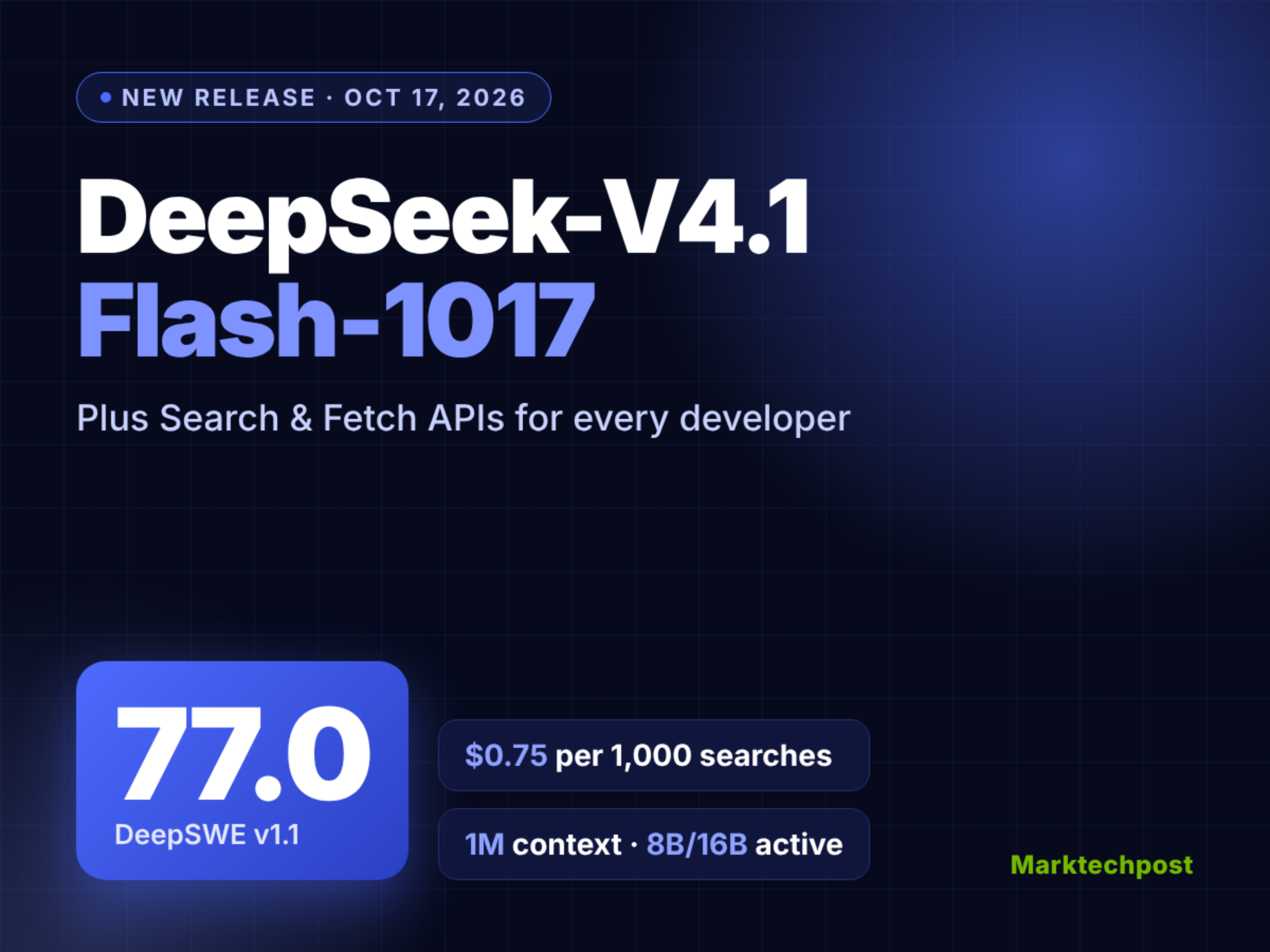
DeepSeek Just Released V4.1-Flash-1017, Scores 77.0 on DeepSWE, Opens Search API
DeepSeek has just released DeepSeek-V4.1-Flash-1017, a new checkpoint of its V4.1-Flash model. It is live on the DeepSeek website, app and API. DeepSeek claims stronger scores, faster task completion and shorter outputs than the September V4.1-Flash release. The company calls it a Pareto improvement in performance and cost. Alongside it, DeepSeek opened its Search and Fetch APIs to every developer. For agent builders, that means a cheaper coding model plus a first-party web layer behind one API
GPT-6-Astra solves 49 of 50 physics research problems at $2.40 apiece
On the TheoPhysEval benchmark, GPT-6-Astra solves 49 of 50 unpublished theoretical physics calculations as accurately as leading specialists. In some cases where the agent seemed to fail, the experts' own reference solutions turned out to contain errors. But the researchers say physics hasn't had a breakthrough like the ones in mathematics, because the agents lack "taste." They still think autonomous, top-level AI research could arrive soon. They already see consequences for how young p