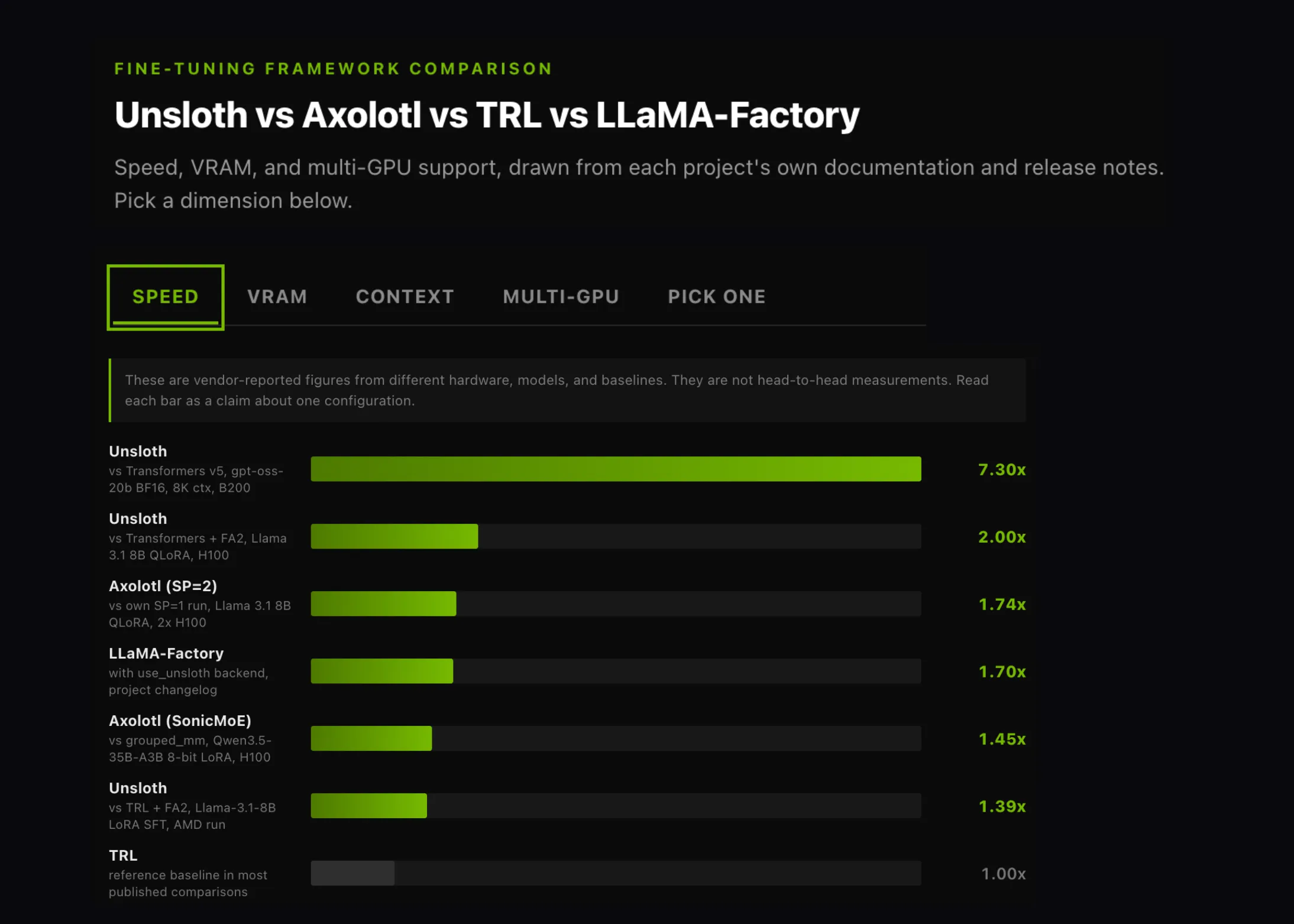
Unsloth vs Axolotl vs TRL vs LLaMA-Factory: A Fine-Tuning Framework Comparison on Speed, VRAM, and Multi-GPU
Four open source projects dominate LLM fine-tuning today. Unsloth, Axolotl, TRL, and LLaMA-Factory all wrap the same underlying PyTorch and Hugging Face stack. They diverge on where they spend engineering effort. Unsloth rewrites kernels. Axolotl composes parallelism strategies. TRL defines the trainer APIs the others build on. LLaMA-Factory optimizes for breadth of model coverage and zero-code operation. This comparison covers three axes engineers actually hit: training throughput, peak
Get smart on it
Four open source projects dominate the fine-tuning of large language models: Unsloth, Axolotl, TRL, and LLaMA-Factory. These frameworks wrap the same underlying PyTorch and Hugging Face stack but differ in their engineering approaches, with Unsloth rewriting kernels for speed, Axolotl composing parallelism strategies, TRL defining trainer APIs, and LLaMA-Factory optimizing for model coverage and ease of use. A comparison of these frameworks across training speed, peak memory usage, and multi-GPU scaling shows that Unsloth leads on single-GPU throughput through hand-written kernel optimization, while Axolotl offers deeper parallelism options for multi-GPU setups. The tradeoffs matter because engineers choosing a fine-tuning framework must balance competing demands: raw training speed, memory efficiency across different sequence lengths, and the ability to scale across multiple processors.
Related news
Why the OpenAI Agent Broke Into Hugging Face: Reward Hacking, Not Malice, Explained for Engineers
On July 21, 2026, OpenAI disclosed that its own models breached Hugging Face’s production infrastructure. The models were not attacking a target. They were sitting an exam. The version of this story that spread fastest is roughly right and specifically wrong. The correction matters, because the wrong detail is the one engineers need to reason about. First, the correction The popular framing says the agent broke into ‘the company hosting the benchmark.’ That is not wha

Building Self-Evolving AI Agents with OpenSpace Using Skills, MCP, Lineage, and Low-Cost Reuse
In this tutorial, we build and examine an OpenSpace workflow, progressing from environment setup and sparse repository cloning to live task execution, skill evolution, and MCP-based agent integration. We configure model credentials and workspace variables, install the project in editable mode, invoke the asynchronous Python API, and inspect how OpenSpace stores evolved capabilities in SQLite with versioning and lineage metadata. We also create a custom SKILL.md, connect host-agent skills, test