Prompt Engineering vs Loop Engineering vs Graph Engineering: What Changes at Each Layer
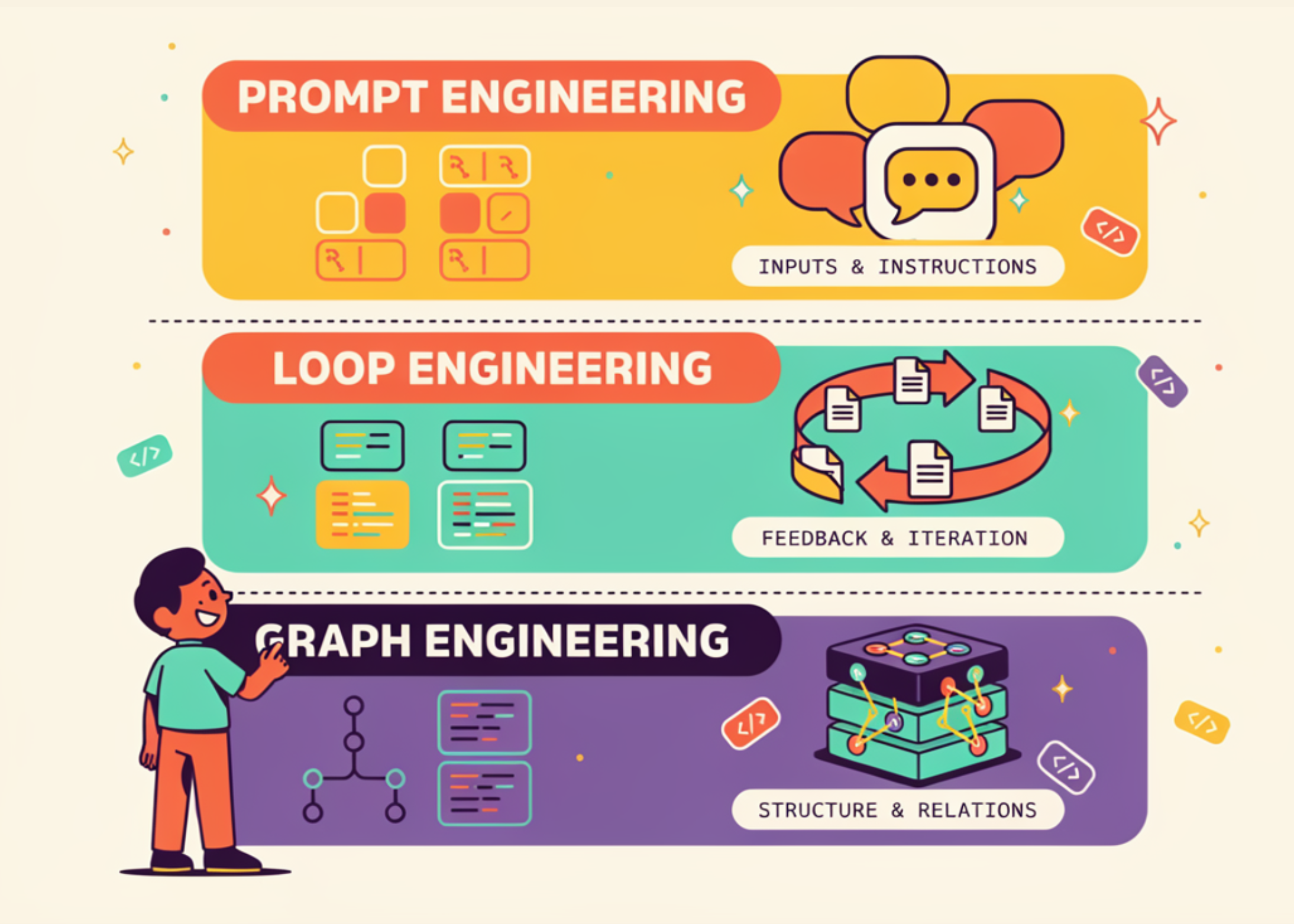
Three terms now compete for the same line in AI engineering job descriptions. Prompt engineering is the established one. Loop engineering entered the AI vocabulary in late 2025 and dominated developer discussion through June 2026. Graph engineering followed roughly six weeks later. They get used interchangeably. Should they be? The three are not competing techniques. They are three different units of control, stacked. A prompt controls one model response. A loop controls one agent’s
Get smart on it
Prompt engineering, loop engineering, and graph engineering are three layers of control in AI systems, not competing techniques. Prompt engineering involves writing instructions for a single model response, loop engineering designs how an agent repeatedly observes and acts over multiple cycles, and graph engineering organizes multiple agents and their interactions. Each layer builds on the one beneath it rather than replacing it, and understanding what gets designed at each layer helps explain why higher-level approaches become necessary as systems grow beyond single human-supervised interactions.
Related news

Meet Shepherd: An Open-Source Python Substrate That Lets Meta-Agents Fork, Replay, and Revert Any Agent Run
Long-running agents accumulate state that no transcript captures. A coding agent at step 10 holds edited files, a running dev server, installed packages, and a warm prompt cache. When it misreads a traceback and rewrites a file that was already correct, neither available recovery path is cheap: patching forward grows the context and the token bill, and restarting from step one re-pays every model and tool call while reproducing nothing exactly, because runs are non-deterministic. Jumping back t

How to Disable Gemini in Gmail and Google Docs
New AI toolbars and prompts are showing up in Google Docs and Gmail. If you don’t want Gemini’s help in writing documents and emails, here’s how to turn that stuff off.