Meet Token Saver: An Open-Source MCP Extension Using Local Hybrid RAG to Cut Claude PDF Token Costs 90-99%
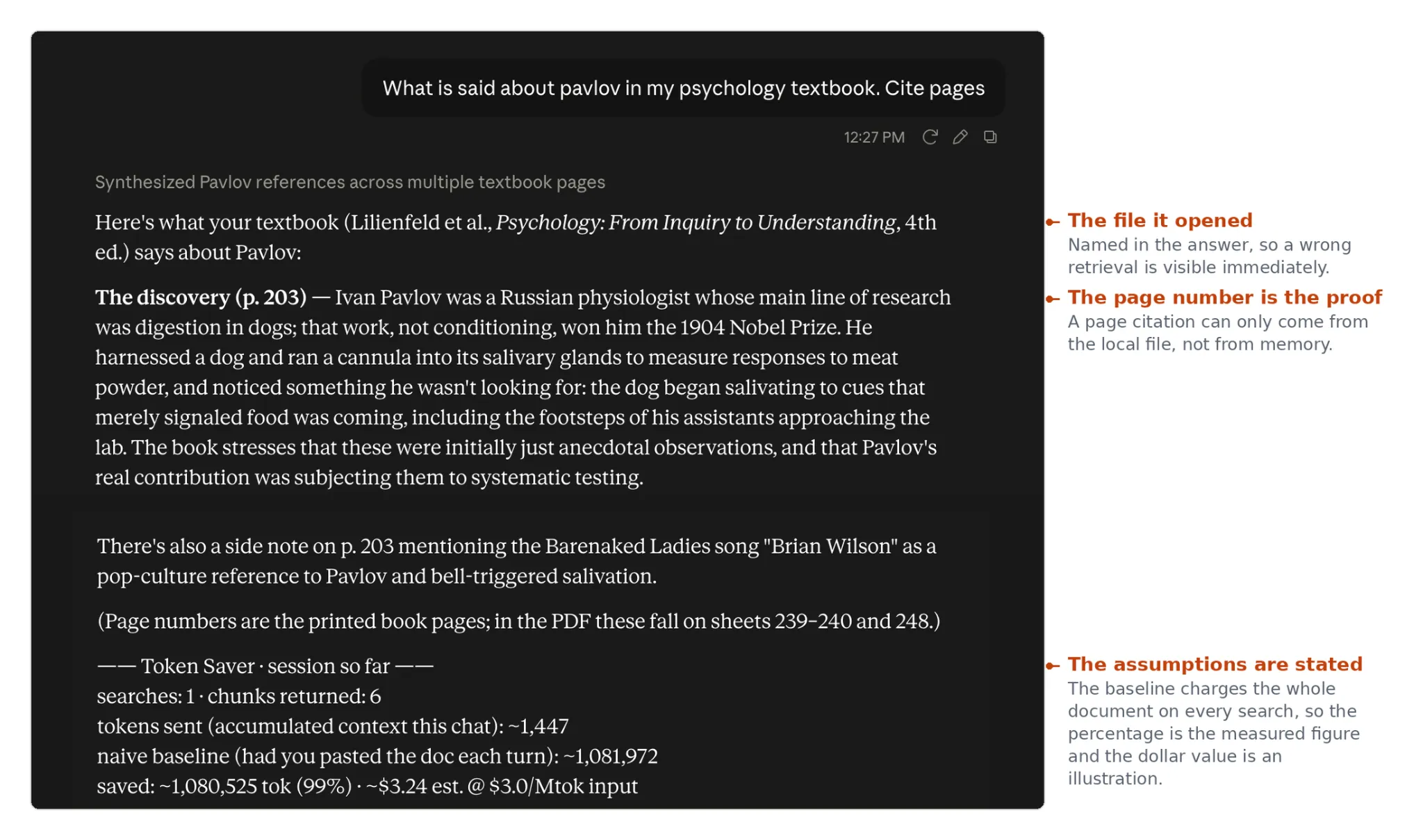
AI developers, researchers, and professionals frequently hit a frustrating wall when analyzing large documents with LLMs: the hidden, compounding cost of context windows. Pasting a 200-page PDF into a chat isn’t a one-time charge. Because the conversation history is re-sent to the model on every single turn, that massive document is paid for again with every follow-up question. Marktechpost AI team just released Token Saver, an open-source Model Context Protocol (MCP) extension for Cla
Get smart on it
Token Saver is an open-source extension that allows Claude to analyze PDF documents stored locally on a user's machine without uploading the files to external servers. The tool uses a hybrid retrieval system combining keyword matching and semantic search to extract only the relevant passages from a document, then sends those passages to Claude rather than the entire file. This approach reduces token consumption by 92 to 99 percent because users are charged only for the small relevant sections rather than the full document on every question. The extension matters because repeatedly asking questions about large PDFs normally requires re-sending the entire document with each follow-up query, creating significant costs, while Token Saver keeps documents private and limits what gets processed by the language model.
Related news

Meet Shepherd: An Open-Source Python Substrate That Lets Meta-Agents Fork, Replay, and Revert Any Agent Run
Long-running agents accumulate state that no transcript captures. A coding agent at step 10 holds edited files, a running dev server, installed packages, and a warm prompt cache. When it misreads a traceback and rewrites a file that was already correct, neither available recovery path is cheap: patching forward grows the context and the token bill, and restarting from step one re-pays every model and tool call while reproducing nothing exactly, because runs are non-deterministic. Jumping back t

How to Disable Gemini in Gmail and Google Docs
New AI toolbars and prompts are showing up in Google Docs and Gmail. If you don’t want Gemini’s help in writing documents and emails, here’s how to turn that stuff off.