LingBot-Map Tutorial: GPU-Aware Inference and Point Cloud Export
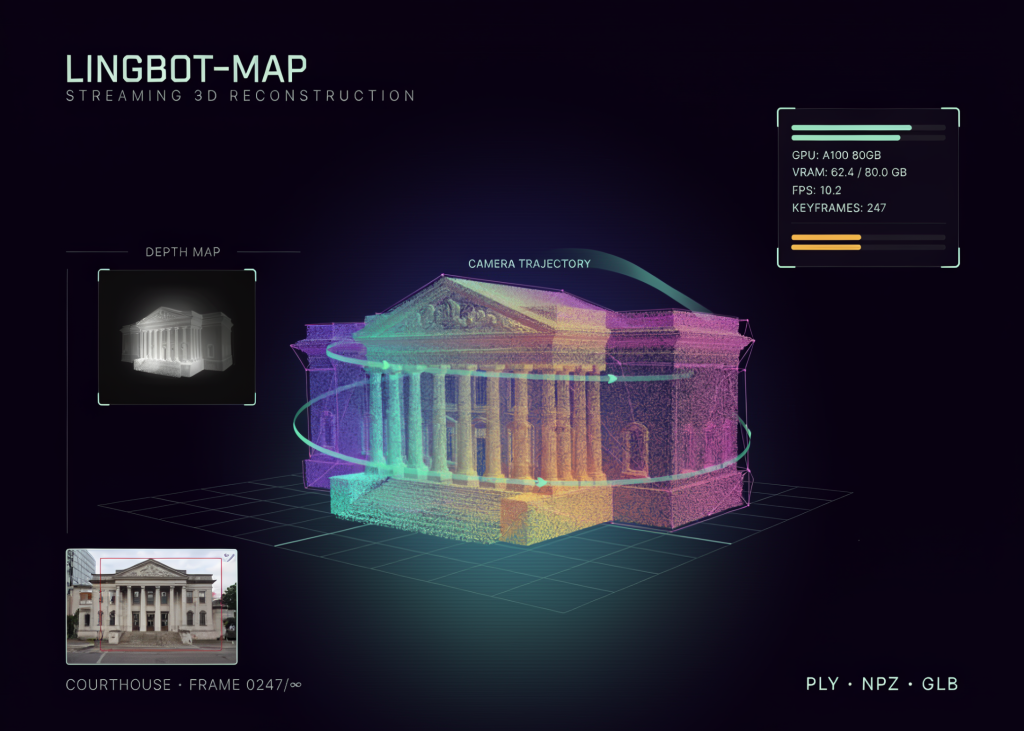
In this tutorial, we implement an end-to-end streaming 3D reconstruction pipeline with LingBot-Map. We begin by configuring the input source, reconstruction settings, checkpoint selection, and output controls, then probe the available GPU and automatically tune frame limits, camera iterations, scale frames, and KV-cache parameters according to the detected VRAM. We install the repository and its dependencies, download the pretrained checkpoint, preprocess image or video frames, and construct th
Get smart on it
This tutorial implements an end-to-end streaming 3D reconstruction pipeline using LingBot-Map, which converts image or video frames into 3D point clouds and scene visualizations. The approach automatically detects available GPU memory and adjusts processing parameters like frame limits and cache size accordingly to optimize performance on different hardware configurations. The process involves loading a pretrained checkpoint, performing mixed-precision inference to predict camera poses and depth maps, and exporting results in various formats including PLY and GLB files. This matters because it demonstrates how to adapt computationally intensive AI models to run efficiently on varying hardware resources while maintaining reconstruction quality.
Related news

Meet Shepherd: An Open-Source Python Substrate That Lets Meta-Agents Fork, Replay, and Revert Any Agent Run
Long-running agents accumulate state that no transcript captures. A coding agent at step 10 holds edited files, a running dev server, installed packages, and a warm prompt cache. When it misreads a traceback and rewrites a file that was already correct, neither available recovery path is cheap: patching forward grows the context and the token bill, and restarting from step one re-pays every model and tool call while reproducing nothing exactly, because runs are non-deterministic. Jumping back t

How to Disable Gemini in Gmail and Google Docs
New AI toolbars and prompts are showing up in Google Docs and Gmail. If you don’t want Gemini’s help in writing documents and emails, here’s how to turn that stuff off.