Designing Skill-Driven Financial Analysis Agents with Claude, Python, MCP Connectors, and Automated Deliverables
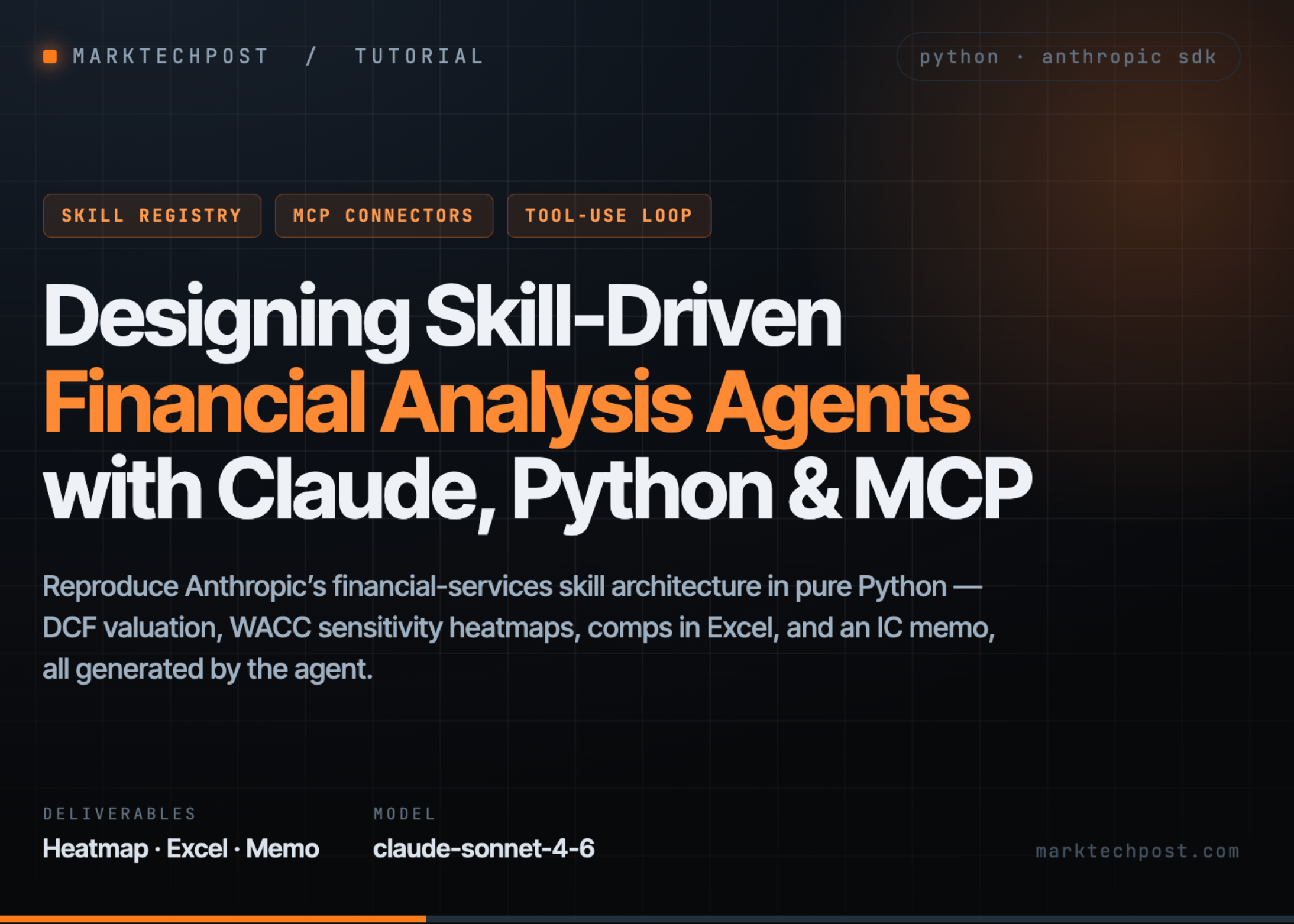
In this tutorial, we build an advanced workflow around Anthropic’s financial-services repository and reproduce its skill-driven architecture in pure Python. We begin by installing the required libraries, cloning the repository, and programmatically mapping its agents, vertical plugins, partner integrations, managed-agent cookbooks, and financial analysis skills. We then parse the repository’s SKILL.md files into a searchable registry and construct a reusable SkillAgent that injects selected fin
Get smart on it
This tutorial describes how to build financial analysis agents using Claude, Python, and skill-driven architecture from Anthropic's financial-services repository. The approach involves installing required libraries, cloning the repository, parsing skill definitions from markdown files into a searchable registry, and constructing a reusable agent that injects financial playbooks into Claude while supporting iterative tool use for calculations and file generation. The tutorial demonstrates practical applications including discounted cash flow valuation, sensitivity analysis, comparable-company analysis with Excel output, and investment committee memo drafting. This matters because it shows how to combine AI models with structured financial methodologies and external data connectors to automate complex analytical workflows.
Related news

Meet Shepherd: An Open-Source Python Substrate That Lets Meta-Agents Fork, Replay, and Revert Any Agent Run
Long-running agents accumulate state that no transcript captures. A coding agent at step 10 holds edited files, a running dev server, installed packages, and a warm prompt cache. When it misreads a traceback and rewrites a file that was already correct, neither available recovery path is cheap: patching forward grows the context and the token bill, and restarting from step one re-pays every model and tool call while reproducing nothing exactly, because runs are non-deterministic. Jumping back t

How to Disable Gemini in Gmail and Google Docs
New AI toolbars and prompts are showing up in Google Docs and Gmail. If you don’t want Gemini’s help in writing documents and emails, here’s how to turn that stuff off.