
Designing Scalable Interactive Visualizations with Reflex XY: Composition, Million-Point Rendering, Streaming, Custom Marks, and Export
In this tutorial, we explore the advanced visualization capabilities of the XY Python library by building interactive, scalable, and extensible charts. We begin with XY’s composition model, where we combine multiple marks, dual axes, annotations, tooltips, legends, themes, and interactive controls within a single chart declaration. We then work with Pandas DataFrames, faceted layouts, linked viewports, and million-point datasets that automatically switch to density-based rendering for efficient
The XY Python library enables creation of interactive charts that can handle large datasets and multiple visualization techniques within a single declaration. The library supports composition of various chart elements like multiple data series, dual axes, annotations, and interactive controls, while also providing density-based rendering for efficiently displaying million-point datasets. Charts can respond to browser interactions through selections and callbacks that route data back to Python, support real-time streaming updates, and can be exported as standalone HTML, SVG, and PNG files. The approach allows developers to build scalable visualizations with customizable visual components while managing memory and data-transfer efficiency.
One short email a day with the stories that matter. Free. Unsubscribe with one click.
Want to go deeper than the news? Explore live, cohort-based AI courses taught by practitioners.
Browse AI courses on Maven
OpenAI’s quarterly revenue reportedly crosses $10B for the first time
Sales of $10B represents an almost 50% jump from revenue of $6.7 billion the company recorded in the second quarter.

Agents that build their own databases are forcing a data foundation rethink
AI agents are changing how enterprises create, move and govern information, and data observability is turning into a prerequisite rather than a nice-to-have. Models get most of the attention, but the data beneath them decides whether they hold up in production. That pressure is now reaching the cloud-native community, where KubeCon organizers added a dedicated […] The post Agents that build their own databases are forcing a data foundation rethink appeared first on SiliconANGLE.

Hands-on with Ring’s new AI drone camera for your home
Ring’s new Drone Cam is a flying indoor security camera. Ring is finally shipping a flying indoor drone camera. For real this time. The Ring Drone Cam will arrive on January 27th, 2027, for $249.99, Ring founder Jamie Siminoff said at a launch event in New York City this week. If it does actually ship, it will arrive almost six years after the company announced its first flying camera, the Ring Always Home Cam. Designed to patrol inside your home when you're not there, the Drone
Also reported by TechCrunch and Ars Technica

OpenAI rolls out new business profiles, making ChatGPT just a little bit more like Google
OpenAI is looking to make ChatGPT a more robust consumer discovery engine, and a host of new features seek to empower businesses to help it do that.
Also reported by The Verge

AI agents carry memory and storage like people, so their data needs guarding while in use
As AI agents move into production on Kubernetes, cloud engineering teams at financial companies face a security problem that encryption alone can’t solve. Container orchestration has become the default foundation for AI workloads, and the data those agents use is now the main target. Payment networks feel that pressure more than most because every transaction […] The post AI agents carry memory and storage like people, so their data needs guarding while in use appeared first on Silic
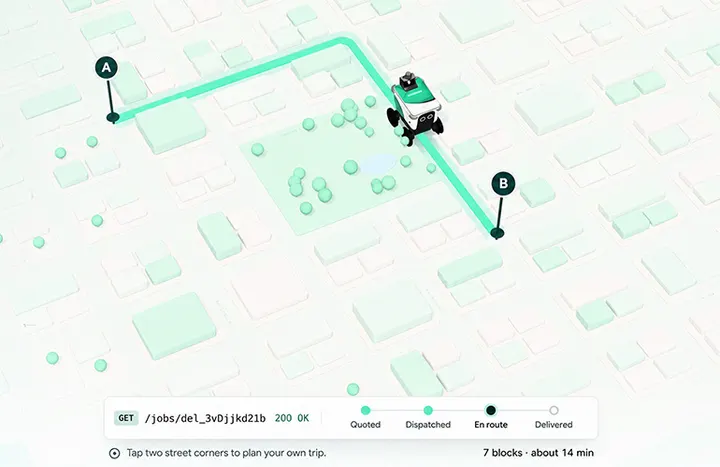
Serve Robotics opens robot delivery network for others to build on
The AV Delivery Developer Portal enables anyone to call robots from Serve’s delivery fleet. Source: Serve Robotics Serve Robotics Inc. today launched the AV Delivery Developer Portal, which it said gives developers, businesses, hobbyists, and AI assistants the opportunity to programmatically summon its sidewalk delivery robots. The company said its public application programming interface, or API, allows others to work with its autonomous robot fleet. It also released a sandbox environment