Cisco AI Introduces FAPO: Pipeline-Aware Prompt Optimization With Step-Level Failure Attribution and Claude Code Orchestration
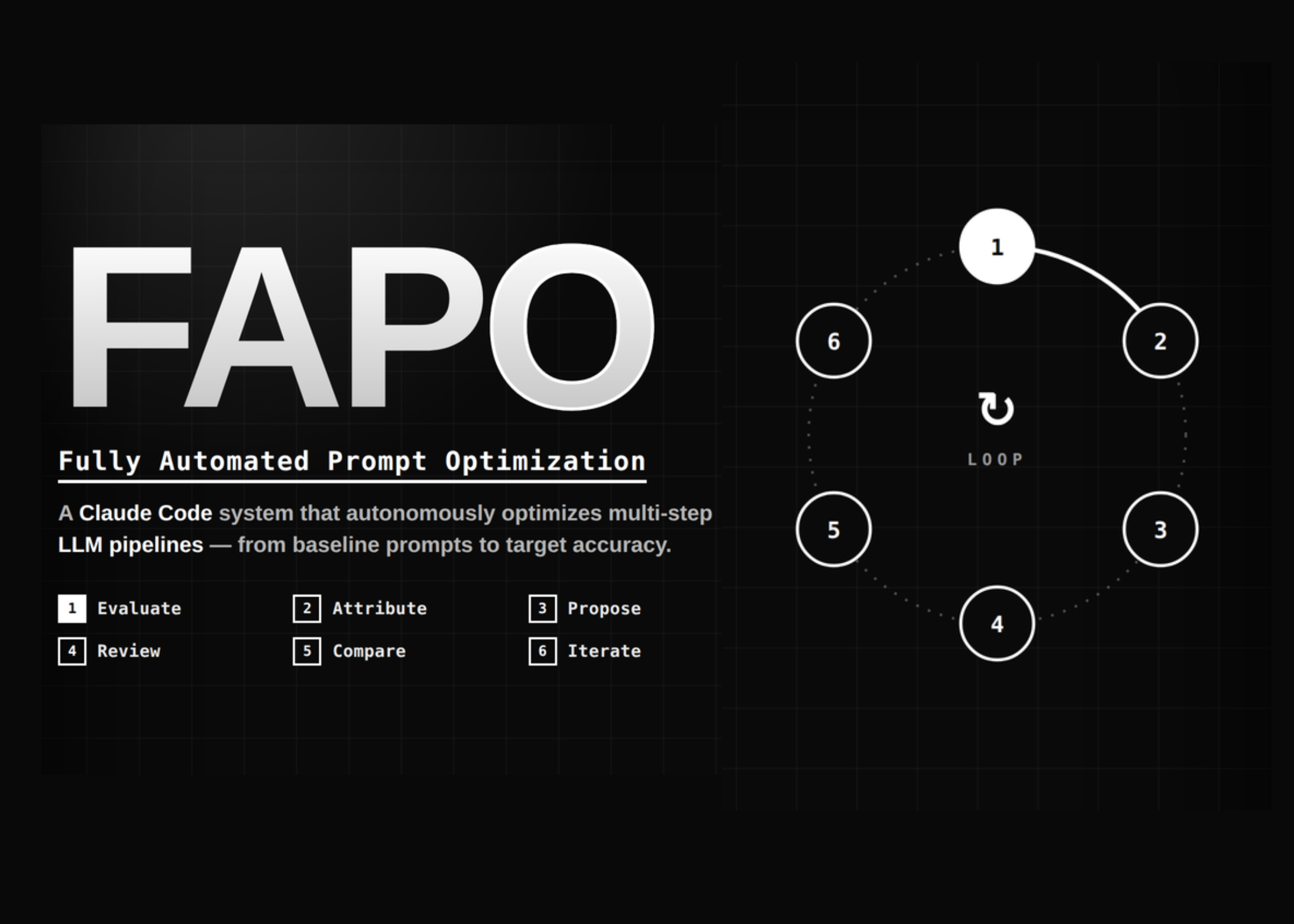
Getting prompts right is still the hardest part of shipping reliable LLM applications. Small wording changes can swing accuracy by 20 percent. What works on a few examples often breaks at scale. When a multi-step pipeline returns a wrong answer, finding the failing step means inspecting intermediate outputs by hand. Cisco AI introduced FAPO to address that bottleneck. FAPO stands for Fully Automated Prompt Optimization. It is a Claude Code-driven system that optimizes LLM pipelines from base
Make your prediction
Will Cisco AI publish the FAPO paper or code on GitHub by June 28, 2026?
Resolves by Jun 28, 2026
Your prediction
50% · 50/50 coin flip
NOYES
Get smart on it
Getting prompts right for multi-step AI systems is difficult, with small wording changes causing large accuracy swings and failures hard to diagnose. FAPO is an automated system that optimizes these multi-step pipelines by evaluating performance, identifying which step failed and why, proposing improvements, and iterating until reaching target accuracy. The system can make changes at three levels: prompt wording, parameter adjustments, or structural changes to the pipeline itself. In tests comparing FAPO to a competing optimizer, FAPO won on 15 of 18 benchmarks, with particularly large improvements when it was able to make structural changes to the pipeline rather than just prompt edits.
Related news

India’s MoEngage bets that the future of marketing is millions of AI agents
The all-cash deal gives MoEngage access to technology that assigns AI agents to individual customers.

Google Home will soon get better at recognizing you
A new update for Google Home could make it less likely your smart home cameras mistake you for someone else, just because you're facing away from the camera. Starting June 23rd, Google's expanding its facial recognition feature so that people you've tagged in your Familiar Faces library can continue to be identified when their faces aren't clearly visible, using "additional non-biometric signals (body size, clothing color, etc.)." The Familiar Faces library will also begin aut