Building a Stable Fable 5 Traces Workflow in Colab: Parsing Tool Calls, Auditing Data, and Training Baselines
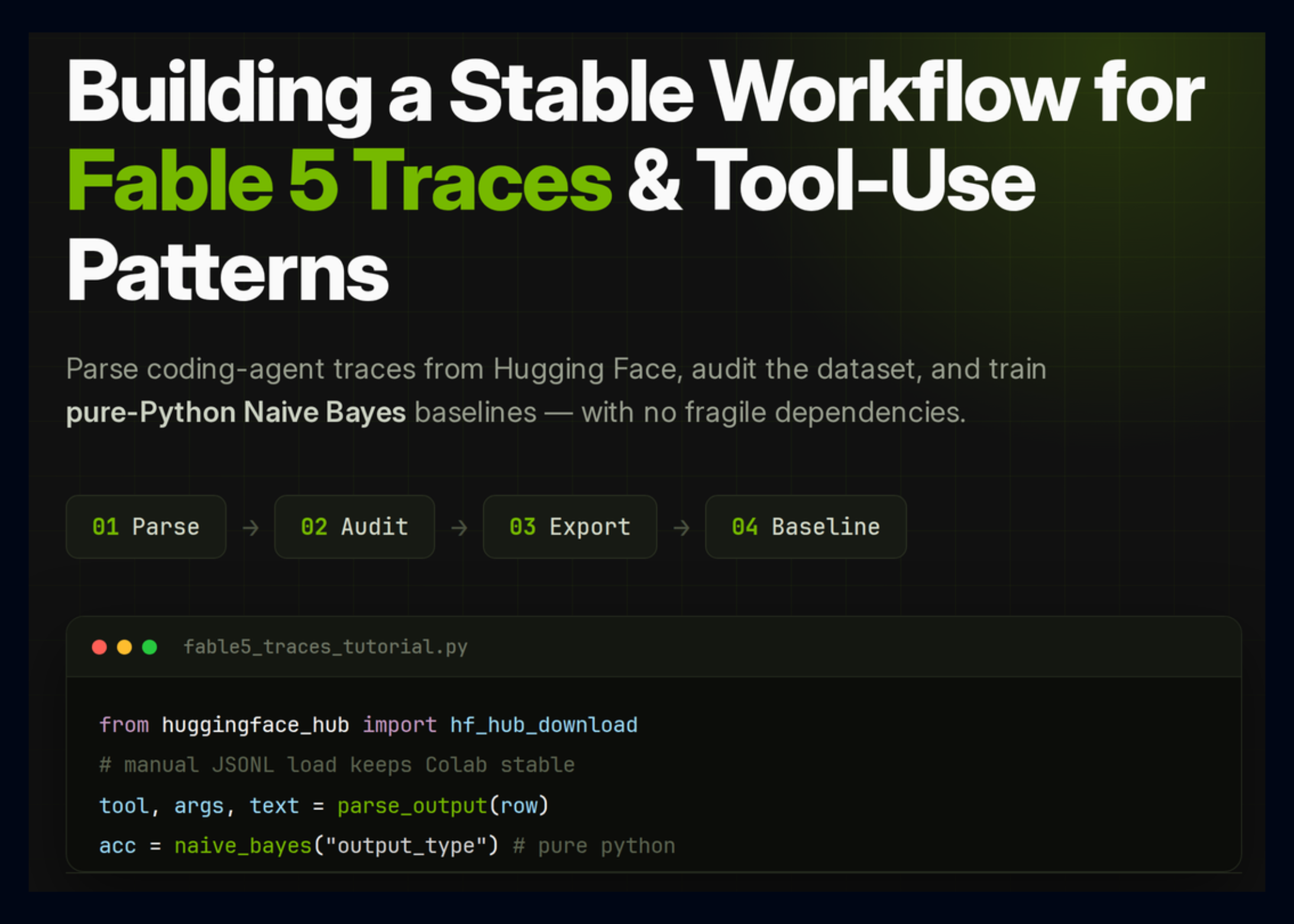
In this tutorial, we work with the Fable 5 Traces dataset from Hugging Face and build a complete workflow around real coding-agent trace data. We start by setting up a lightweight environment that avoids fragile dependencies such as datasets, scikit-learn, and scipy. Then we manually download and parse the merged JSONL file to keep the notebook stable in Colab. From there, we inspect repository files, preview raw trace examples, normalize tool calls and text outputs, audit the dataset structure
Get smart on it
The lesson for this story is being written.
Related news

The fittest founder in the room got cancer. Here’s how he used AI to fight back.
When confronted with cancer, Connor Christou fed everything tied tied to his regime — blood results, scan data, wearable output, journal entries — into Claude.

Meta’s Astryx Brings a CLI and MCP Server to an Open-Source React Design System Agents Can Read
Meta released Astryx this week. It is an open-source design system, currently in Beta. The project grew inside Meta’s monorepo over eight years. Astryx is built on React and StyleX. StyleX is Meta’s compile-time CSS engine. TL;DR Astryx is Meta’s open-source, agent-ready React design system, now in Beta. It pairs StyleX styling with a CSS-variable theme cascade and ten themes. A CLI and MCP server lets AI agents scaffold and document UIs. It is production-teste