Building a Multimodal RAG Pipeline with NVIDIA NeMo Retriever, Hosted NIMs, LanceDB, Reranking, and Grounded Generation
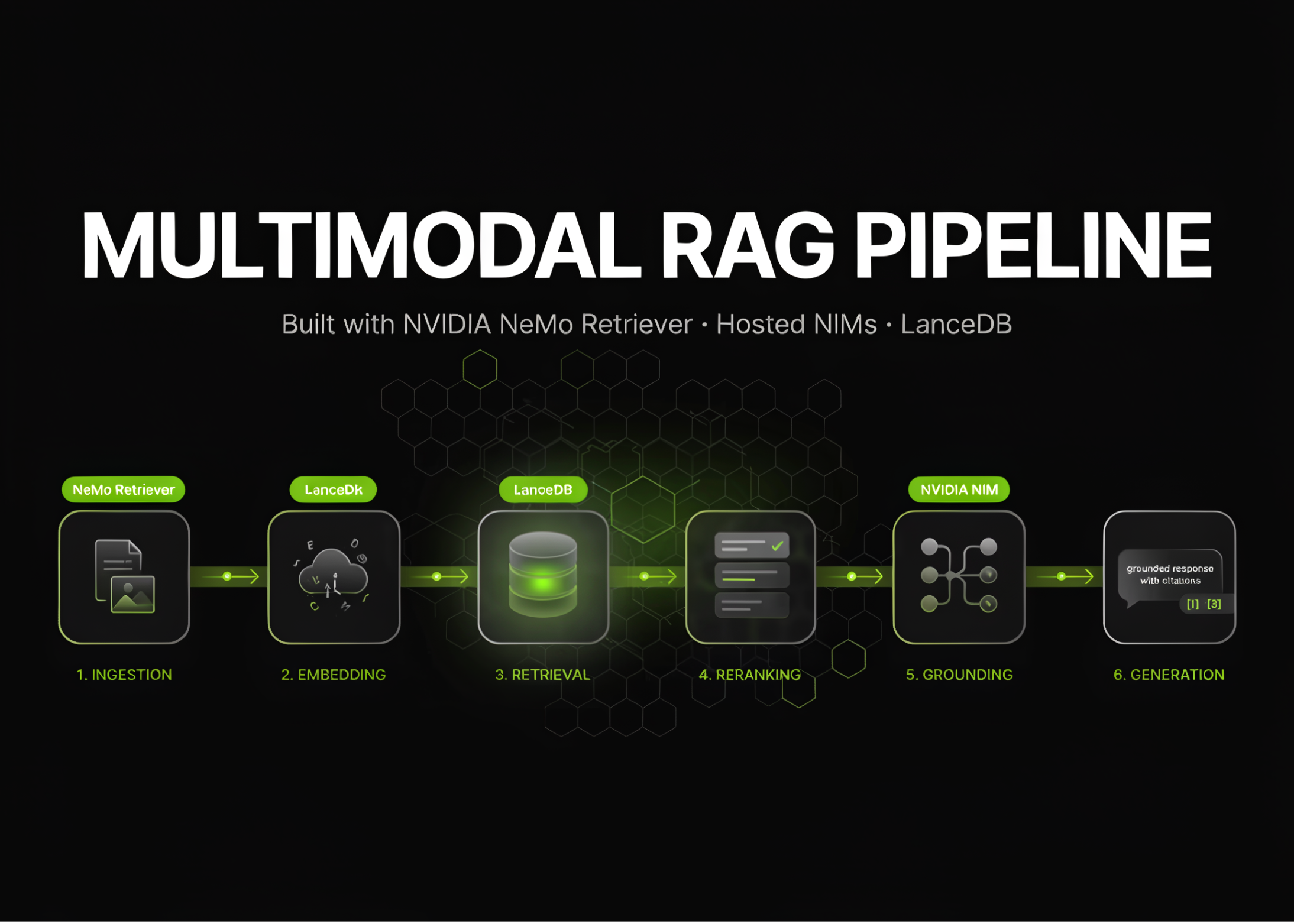
In this tutorial, we build an advanced multimodal retrieval-augmented generation pipeline with NVIDIA NeMo Retriever. We begin by configuring a Python 3.12 environment, installing the required packages, and performing offline PDF text extraction without relying on a GPU or external API key. We then extend the workflow with hosted NVIDIA NIM endpoints to detect page elements, extract tables, charts, and infographics, generate dense vector embeddings, and store the processed content in LanceDB. F
Get smart on it
A multimodal retrieval-augmented generation pipeline combines multiple types of data processing to extract and organize information from documents. This tutorial demonstrates building such a pipeline using NVIDIA NeMo Retriever and related tools, which extract text, tables, charts, and infographics from PDFs, convert them to vector embeddings, and store them in a database for intelligent retrieval. The pipeline includes steps for offline text extraction, multimodal content detection through hosted APIs, deduplication, embedding generation, and storage in LanceDB, followed by retrieval and response generation with citations. This approach enables systems to search and generate responses based on diverse document content types rather than just text alone.
Related news

Meet Shepherd: An Open-Source Python Substrate That Lets Meta-Agents Fork, Replay, and Revert Any Agent Run
Long-running agents accumulate state that no transcript captures. A coding agent at step 10 holds edited files, a running dev server, installed packages, and a warm prompt cache. When it misreads a traceback and rewrites a file that was already correct, neither available recovery path is cheap: patching forward grows the context and the token bill, and restarting from step one re-pays every model and tool call while reproducing nothing exactly, because runs are non-deterministic. Jumping back t

How to Disable Gemini in Gmail and Google Docs
New AI toolbars and prompts are showing up in Google Docs and Gmail. If you don’t want Gemini’s help in writing documents and emails, here’s how to turn that stuff off.