AWS Strands Agents Team Releases Strands Harness: An Open-Source Agent Harness With 28% Lower Token Cost at Comparable Accuracy
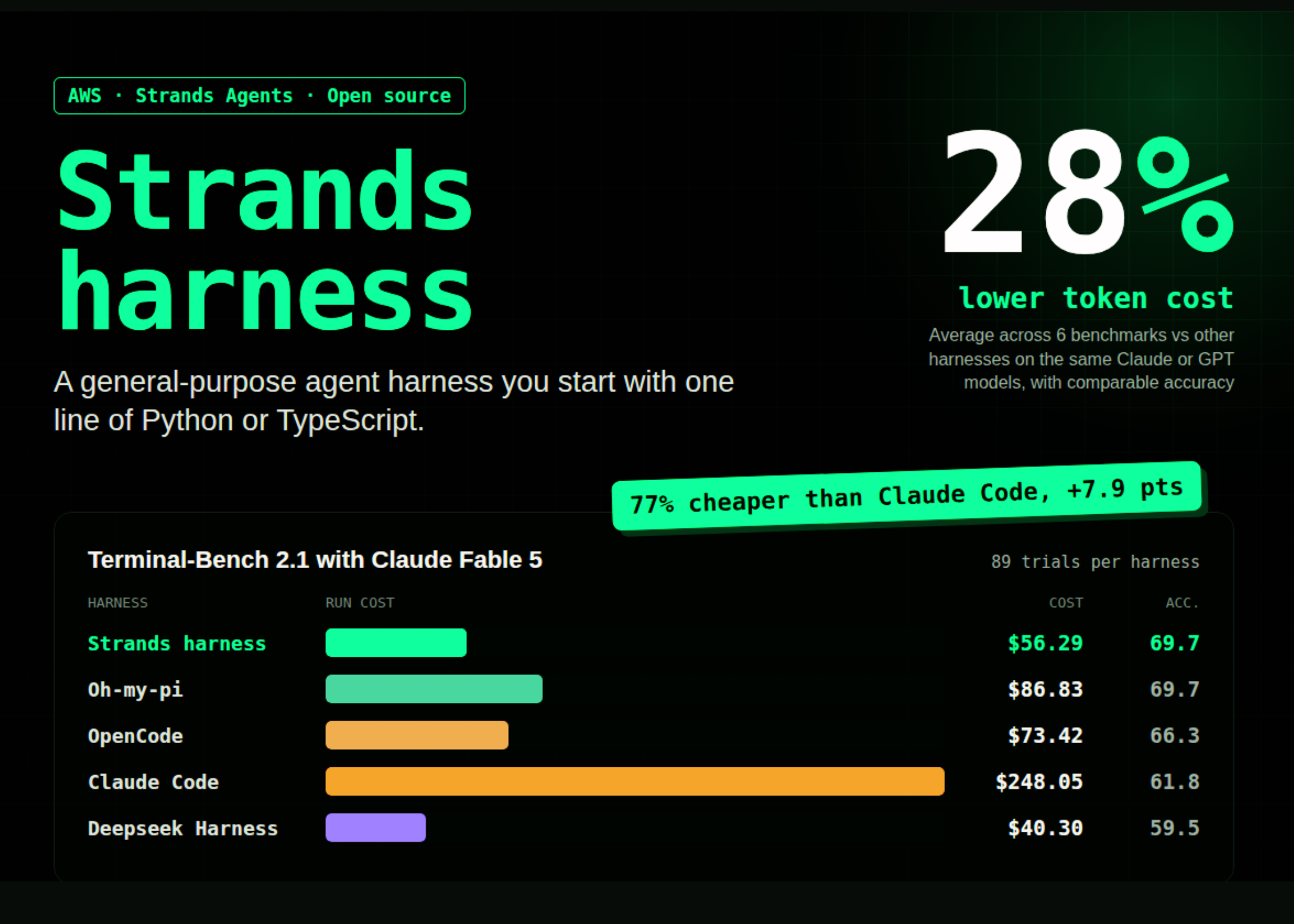
Many developers find that an agent idea works inside Claude Code or Codex, then struggles once they rebuild it with their own loop. The Strands Agents team at AWS is targeting that gap with Strands harness, a fully assembled, general-purpose agent harness. It runs locally or deploys to a cloud provider, ships for Python and TypeScript under Apache 2.0, and starts with one line of code. The team reports 28% lower cost than other harnesses running the same Claude or GPT models across 6 benchmarks
Get smart on it
An agent harness is the system around an AI model that handles the loop, tools, context management, memory, and recovery. AWS's Strands team released an open-source agent harness that achieves 28% lower token cost than comparable systems across six benchmarks while maintaining similar accuracy. The efficiency comes from three context management rules: truncating tool results over 1,500 tokens, triggering summarization when context usage passes 85%, and running context recovery if the window overflows. The harness can run locally or deploy to multiple cloud providers and works with various model providers through a single line of code.
Related news

Meta is making a standalone Muse AI gadget
Meta is building a dedicated hardware device for its new Muse AI agent. The product, called Muse Charm, was briefly shown off by Meta CEO Mark Zuckerberg at the end of tonight's Meta Connect presentation. It looks almost like a chunky smartwatch without the strap - just a big screen, plus a little lanyard for carrying the device around. The Muse Charm has a fingerprint sensor on the top right corner that you can press to activate and begin speaking to the agent. There appears t

Everything new coming to Meta’s AI agent Muse
CEO Mark Zuckerberg kicked off the company’s annual Connect event in Menlo Park on Wednesday with a keynote that made one thing clear: Meta is going all-in on Muse. It's even coming to Meta's AI glasses.