Adaptive Experimentation with Meta’s Ax: A Practical Coding Guide
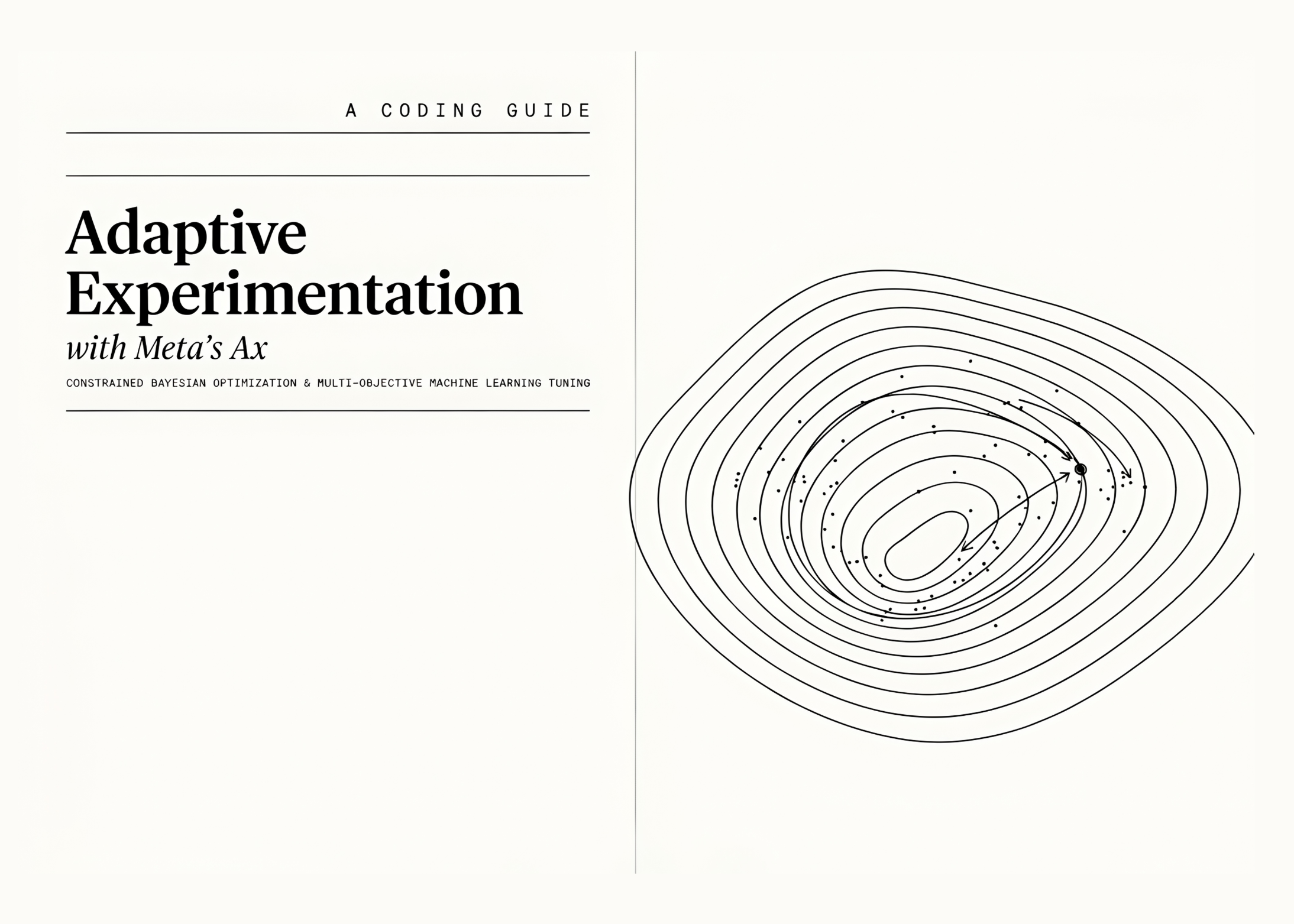
In this tutorial, we explore adaptive experimentation using Meta’s Ax with the modern Client API. We work through a complete workflow where we tune a RandomForest model on a synthetic classification dataset while balancing predictive accuracy against model footprint. We begin by defining a mixed search space with integer, float, log-scaled, and categorical parameters, then use Ax’s ask-tell optimization loop to run constrained Bayesian optimization, multi-objective optimization, and parameter-c
Get smart on it
This is a practical guide to adaptive experimentation, a method for systematically tuning machine learning model settings through an optimization loop. The tutorial demonstrates how to balance competing goals, such as maximizing predictive accuracy while keeping model size small, by defining a search space of parameters and letting an optimization system suggest configurations to test. The approach includes constrained single-objective optimization, where accuracy is maximized within a model size limit, and multi-objective optimization, where multiple goals are considered together to identify trade-off solutions. Understanding this matters because it automates the process of finding good hyperparameter settings rather than testing them manually, and handles situations where different performance metrics must be weighed against each other.
Related news

Meet Shepherd: An Open-Source Python Substrate That Lets Meta-Agents Fork, Replay, and Revert Any Agent Run
Long-running agents accumulate state that no transcript captures. A coding agent at step 10 holds edited files, a running dev server, installed packages, and a warm prompt cache. When it misreads a traceback and rewrites a file that was already correct, neither available recovery path is cheap: patching forward grows the context and the token bill, and restarting from step one re-pays every model and tool call while reproducing nothing exactly, because runs are non-deterministic. Jumping back t

How to Disable Gemini in Gmail and Google Docs
New AI toolbars and prompts are showing up in Google Docs and Gmail. If you don’t want Gemini’s help in writing documents and emails, here’s how to turn that stuff off.