
NVIDIA Cosmos-H-Dreams: Bringing Real-Time Generative Simulation to Surgical Robotics
The technology could reduce training time for robotic surgeons and help identify edge cases before procedures touch real patients.
Surgical robotics systems are moving toward using vision-language-action policies, but training and evaluating them is difficult because physical robots are expensive to operate and failures can damage instruments. A world foundation model called Cosmos-H-Dreams addresses this by creating a real-time, action-conditioned generative simulator that learns surgical dynamics directly from video and robot movement data rather than manually modeling every object and interaction. The system distills a larger teacher model into a faster student model and uses an accelerated inference library to run interactive simulations at speeds fast enough for real-time closed-loop control on a single GPU. This allows safer evaluation and synthetic data generation for surgical policies without repeated physical robot execution.
One short email a day with the stories that matter. Free. Unsubscribe with one click.
Want to go deeper than the news? Explore live, cohort-based AI courses taught by practitioners.
Browse AI courses on Maven
Google DeepMind releases new advanced robotics AI model and next-generation gene prediction model
Alphabet Inc.’s artificial intelligence research lab, Google DeepMind, Tuesday debuted the next generation of Gemini Robotics, the company’s most capable vision-language-action model to date for creating an “AI brain” for robotics. Separately, DeepMind announced AlphaGenome 2 today, a next-generation AI model that can predict how DNA sequences and their variations affect human cell types, creating […] The post Google DeepMind releases new advanced robotics AI model and next-generation gene
Also reported by MarkTechPost

Gemini Robotics 2.5 accelerates real-world general dexterity
Our most capable vision-language-action model enhances robot dexterity, reliability, and safety
Also reported by Ars Technica
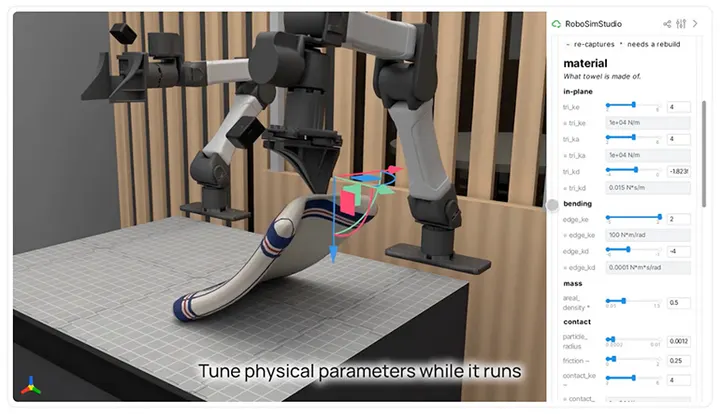
Can AI agents program industrial robots without training data? Berkeley says yes
The new RoboSimStudio is an open-source project that enables agentic AI coding of robotic simulation environments. | Credit: UC Berkeley UC Berkeley and NVIDIA have released open-source tools for a new approach: enabling teams of AI coding agents to write, simulate, and refine readable robot programs. Since the early days of industrial robots, programming, tuning, and troubleshooting robotic workcells has taken weeks to months. New research coming out of UC Berkeley has demonstrated that new age
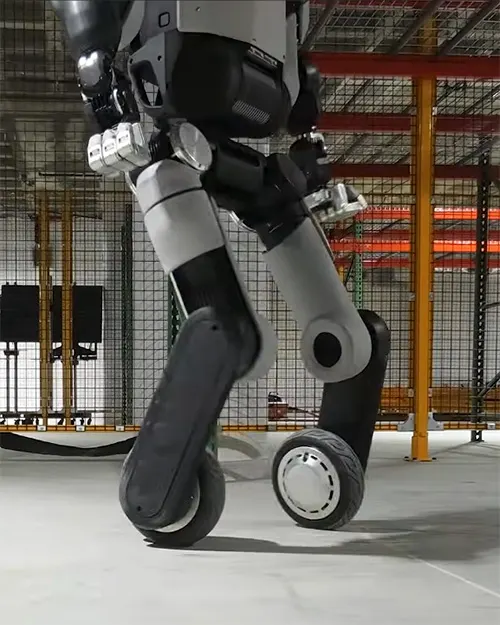
Boston Dynamics adds wheels to Atlas humanoid to test whole-body control
Bridging the divide between deterministic physics-based control and policy-driven adaptation, Boston Dynamics has deployed a hybrid locomotion architecture on a wheeled variant of its Atlas humanoid. The “experiment” combined classical model-based motor control with whole-body reinforcement learning to maintain dynamic stability across unstructured, real-world terrain. In the video, Andy Wu, controls engineer for Atlas at Boston Dynamics, highlights some recent experiments that he
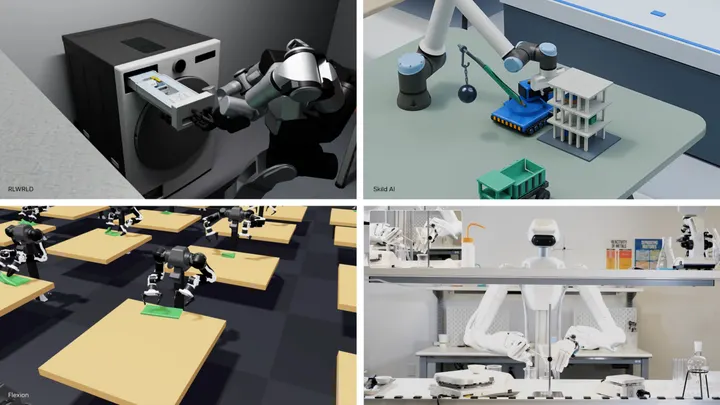
Practice Makes Precise: At CoRL, NVIDIA and Partners Reveal How Robots Rehearse Delicate Work in Simulation
Simulation, which has long been the proving ground for robots learning to walk, roll and hop, is now helping researchers teach robots tasks that require a finer touch: aligning gears, connecting cables and assembling small components. The shift from locomotion to manipulation is taking center stage at this week’s Conference on Robot Learning (CoRL) in Austin, Texas, alongside the rise of agentic robotics — a new paradigm that integrates frontier agents to create interpretable code for physical
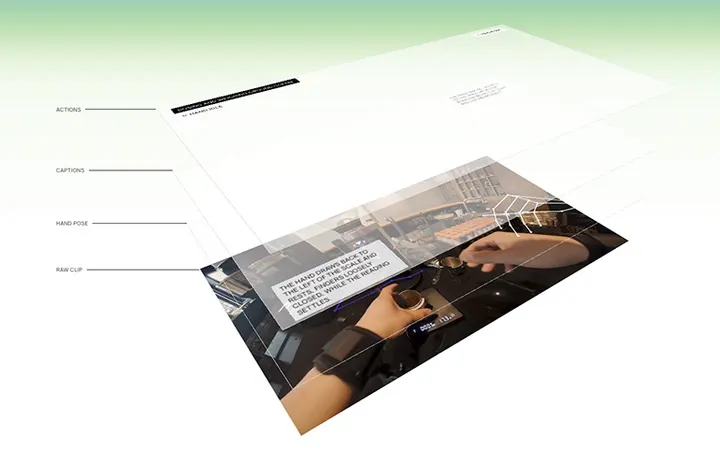
Memories.ai builds standardized egocentric video pipeline
Memories.ai models label every clip: Memories-H0 for hand pose, EgoAction for action segments. | Credit: Memories.ai Memories.ai is building a data pipeline for robotics companies that combines standardized video collection with AI-powered annotation to turn everyday egocentric footage into training data for robots. The San Francisco-based company is developing software and AI to help robots understand the physical world. It builds video-understanding models and data infrastructure, and it colle