Z.ai Ships GLM-5.3 Without Retraining the Base Model: Better at Complex Coding and Long-Horizon Tasks
Z.ai just released GLM-5.3. GLM-5.3 runs on the same 743B base model as GLM-5.2. Every reported gain comes from scaled post-training: more task environments, more environment types, longer training. The results land in two places. Coding jumps most on the longest-horizon benchmarks, with Terminal-Bench 3.0 moving from 4.6 to 28.3. Cybersecurity moved further than Z.ai says it expected, with CyberGym reaching 84.5%. Weights are not public yet. Is It Deployable? Partially, GLM-5.3 is live
Get smart on it
Z.ai released GLM-5.3, a new version of its language model that uses the same underlying base model as its previous version but achieves improvements through additional post-training on more tasks and environments. The model shows substantial gains in coding tasks, with one benchmark jumping from 4.6 to 28.3, and unexpectedly strong performance in cybersecurity applications like vulnerability discovery, where it outperformed some competing models. The weights are not yet publicly available but will be released in approximately two weeks after safety evaluation, though the model is already accessible through Z.ai's API and coding plan for some users. This matters because the improvements demonstrate that scaling post-training alone, without retraining the base model, can produce significant capability gains in complex tasks like long-horizon coding and security analysis.
Related news
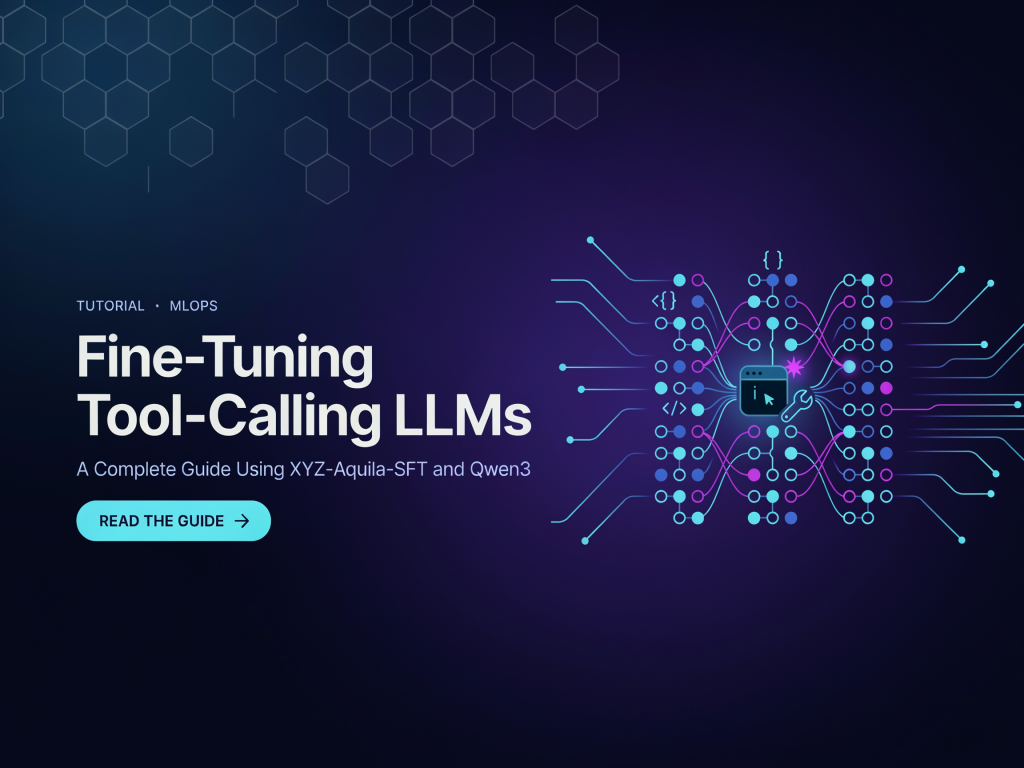
Fine-Tuning Tool-Calling LLMs: A Complete Guide Using XYZ-Aquila-SFT and Qwen3
In this tutorial, we implement an end-to-end supervised fine-tuning pipeline for the XYZ-Aquila-SFT dataset, Hugging Face Transformers, PyTorch, and PEFT. We stream and inspect the dataset, parse multi-turn tool-use trajectories, extract structured tool calls, analyze corpus characteristics, and preserve embedded reasoning and observation patterns. We then convert tool schemas between message-embedded and structured formats, render Qwen-compatible ChatML with assistant-only loss masking, prepar

Meta’s ‘open’ AI, and a $250M deal gone very wrong
Meta released Glimmer this week, an open-weight AI model anyone can download and run on their own hardware — a contrast to Muse Spark, the company’s more powerful model that stays locked behind its own APIs. The release landed alongside a letter from Mark Zuckerberg arguing AI should be “for everyone” rather than controlled by a handful of labs, but as Equity’s […]