webAI Releases TwIL-LM: A 1.7B and 3B Formal-Logic Model Family for Autoformalization on Local Hardware
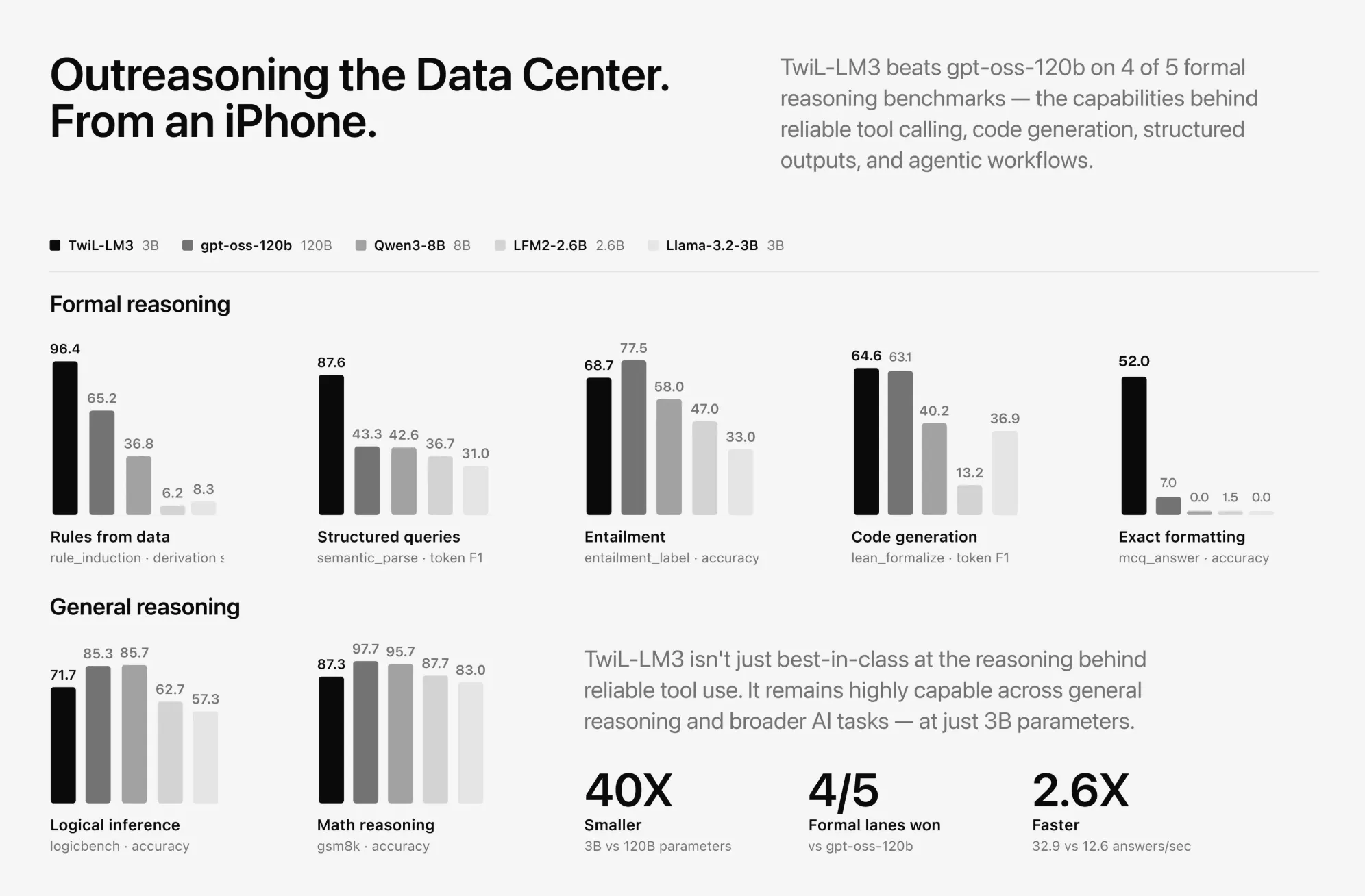
webAI has released TwIL-LM, a two-model family of formal-logic reasoners at 1.7B and 3B parameters. The 3B member, TwIL-LM3, is a merged fine-tune of SmolLM3-3B; the 1.7B member is a PEFT LoRA adapter for SmolLM2-1.7B-Instruct. Both target autoformalization: translating English into first-order logic and checking whether a conclusion follows from its premises. Both run locally, with a 1.06 GB quantized build for the 1.7B and a 1.78 GiB Q4_K_M GGUF for the 3B. webAI’s announcement frames t
Get smart on it
webAI has released a family of small AI models designed to translate English into formal logic and verify whether conclusions follow from stated premises. The models are sized at 1.7 billion and 3 billion parameters and can run on local hardware without sending data to external servers, making them relevant for industries like finance, healthcare, and legal services where data privacy is critical. The larger 3-billion model performs formal reasoning tasks more efficiently than much larger competing models, generating shorter responses and answering more questions per second, though it trails a 120-billion parameter model on overall accuracy. The models are currently available only for non-commercial use, with commercial deployment requiring a separate agreement.
Related news
Fine-Tuning Tool-Calling LLMs: A Complete Guide Using XYZ-Aquila-SFT and Qwen3
In this tutorial, we implement an end-to-end supervised fine-tuning pipeline for the XYZ-Aquila-SFT dataset, Hugging Face Transformers, PyTorch, and PEFT. We stream and inspect the dataset, parse multi-turn tool-use trajectories, extract structured tool calls, analyze corpus characteristics, and preserve embedded reasoning and observation patterns. We then convert tool schemas between message-embedded and structured formats, render Qwen-compatible ChatML with assistant-only loss masking, prepar

Meta’s ‘open’ AI, and a $250M deal gone very wrong
Meta released Glimmer this week, an open-weight AI model anyone can download and run on their own hardware — a contrast to Muse Spark, the company’s more powerful model that stays locked behind its own APIs. The release landed alongside a letter from Mark Zuckerberg arguing AI should be “for everyone” rather than controlled by a handful of labs, but as Equity’s […]